360 vs Mirror Photo Booth: Which Should You Add to Your Fleet?
360 vs mirror photo booth compared: experience, throughput, cost, rental pricing, setup, and ROI. Which one to add to your rental fleet next.
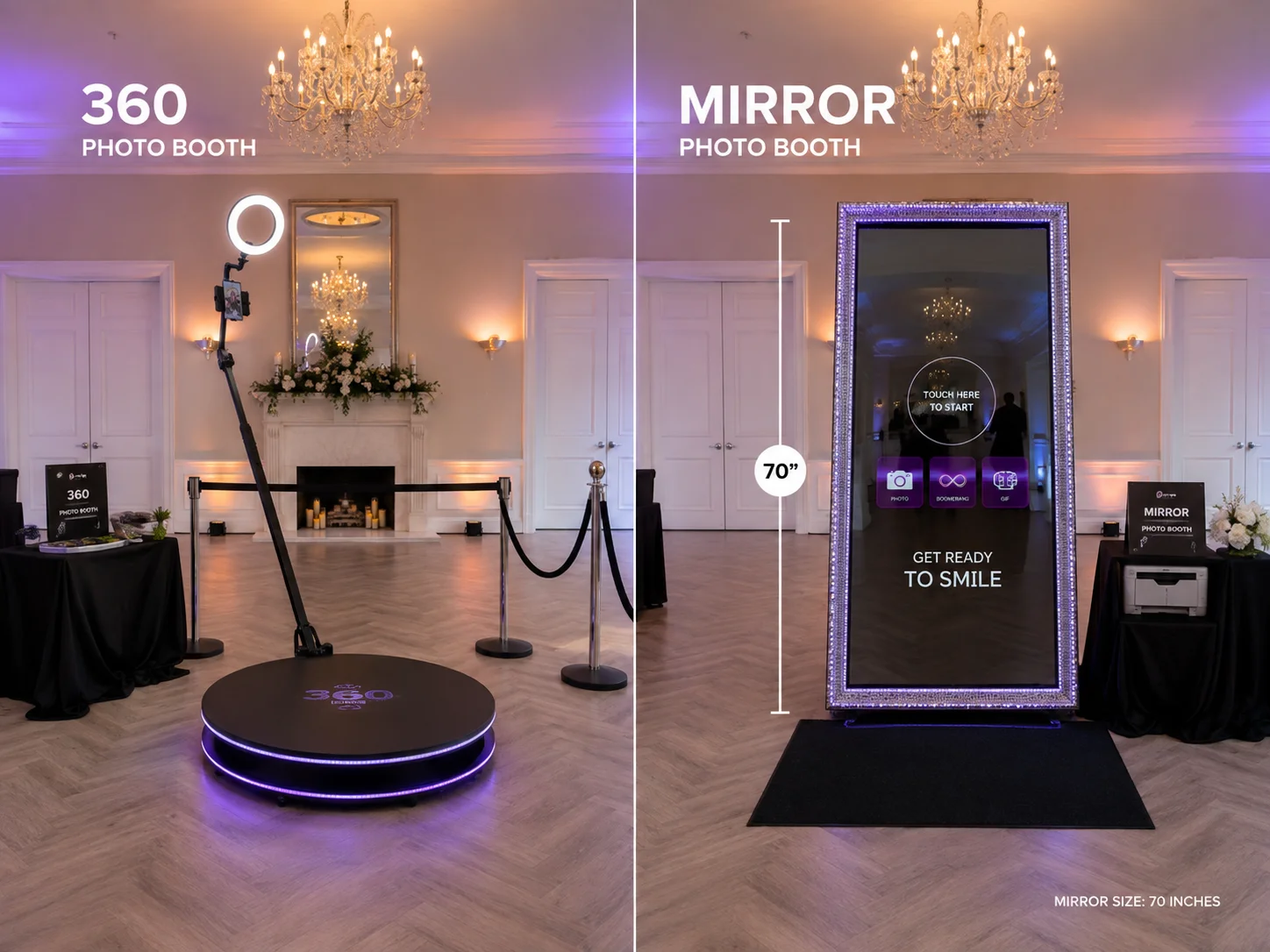
The 360 booth and the mirror booth are often sold as rival premium photo booths, but they do opposite jobs. The mirror processes a crowd. The 360 creates a moment.
The difference that decides the purchase is throughput. A mirror booth moves 40 to 60 guests an hour. A 360 booth moves 15 to 25. That single number changes the pricing, the booking model, and the ROI math, and it is the number most comparison articles skip.
This guide covers the real difference between the 360 and mirror booths: experience, throughput, cost, setup, and the ROI that follows from each.
Different Products, Different Jobs
| Dimension | 360 Photo Booth | Mirror Photo Booth |
|---|---|---|
| Output | Slow-motion video clips | Printed photos + digital |
| Throughput | 15 to 25 guests/hr | 40 to 60 guests/hr |
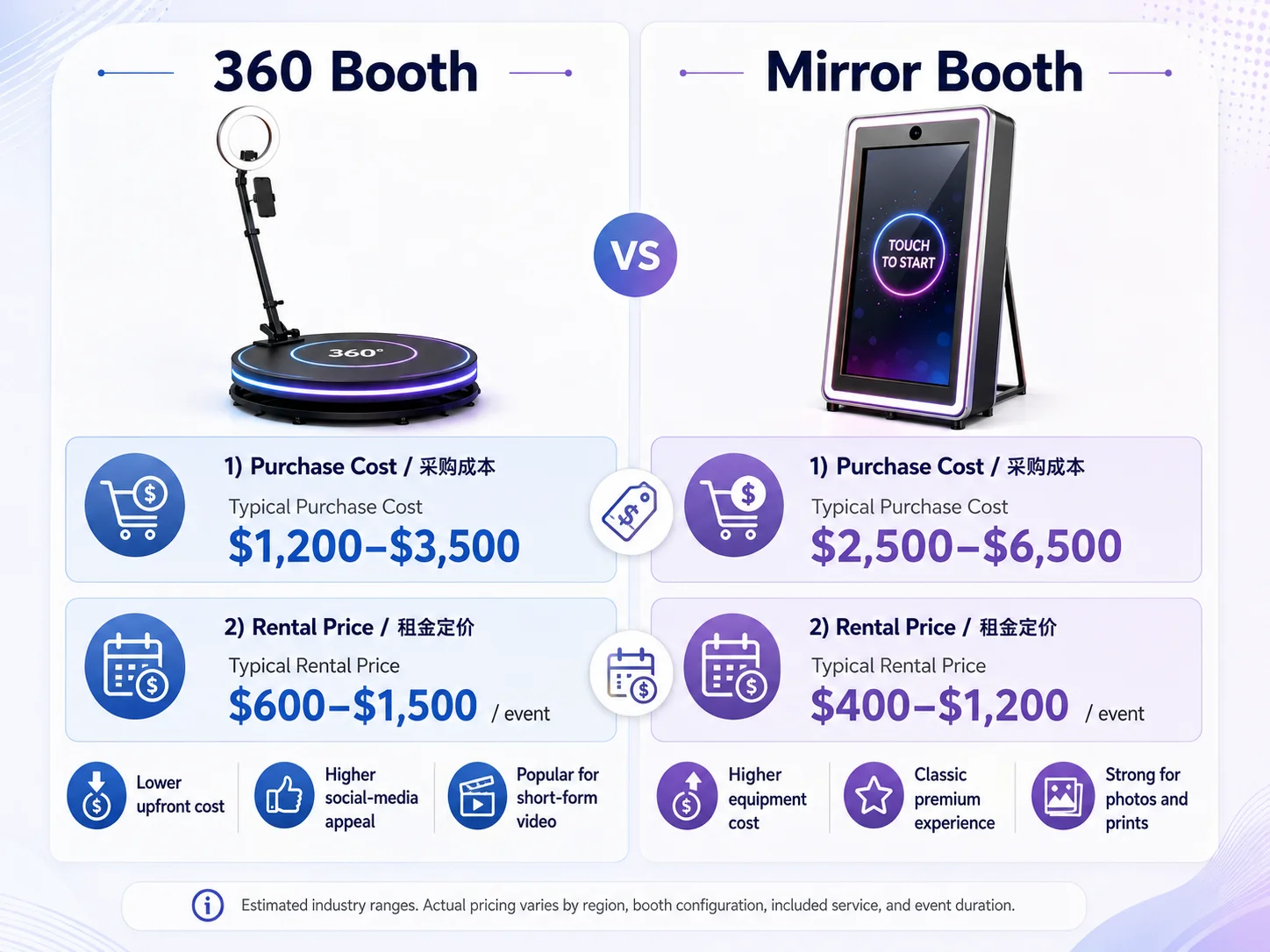
| Purchase cost | $ 6,000 to $ 15,000 | $ 4,000 to $ 8,000 |
| Typical rental | $ 900 to $ 2,000/event | $ 700 to $ 1,900/event |
| Social media impact | Very high | Moderate |
| Setup time | 60 to 90 minutes | 45 to 60 minutes |
| Floor space | 10x10 ft or larger | 8x8 ft |
| Best moment | Entrance, dance floor, brand activation | Main reception, guest flow |
The mirror booth is a workhorse. Guests line up, step up, tap the screen, and receive a printed photo with their signature. It processes a long guest list efficiently.
The 360 booth is a spectacle. A rotating arm sweeps around guests standing on a platform, capturing slow-motion video with lighting and music. Each capture takes two to three minutes, but the resulting clip gets posted, shared, and watched.
Fact: BiaoMing (Event Golden) manufactures overhead and ground 360 photo booths and 70-inch mirror photo booths, TÜV Rheinland certified.
Experience Compared: Video Impact vs. Photo Elegance
360 photo booth. Guests step onto a platform, the arm rotates 360 degrees around them, and the camera captures slow-motion video. The output is a polished clip with music, slow-motion effects, and optional brand overlays. Guests receive the video on their phone and post it immediately. The experience is theatrical, and the output is built for social media. Full details are in our 360 Photo Booth guide.
Mirror photo booth. Guests stand in front of a 70-inch touchscreen mirror, see their reflection, and are guided through animations, filters, and signing. The output is a printed photo strip plus digital copies. The experience is elegant and interactive, and the output is a physical keepsake. Full details are in our Mirror Photo Booth guide.
The difference in output drives everything downstream: video clips generate reach, printed photos generate sentiment. Clients who want visibility buy the 360. Clients who want keepsakes buy the mirror.
Throughput: Guests per Hour
This is the number that decides the purchase, and it deserves its own section.
| Metric | 360 Photo Booth | Mirror Photo Booth |
|---|---|---|
| Time per guest | 2 to 3 minutes | 60 to 90 seconds |
| Guests per hour | 15 to 25 | 40 to 60 |
| Guests per 4-hour event | 60 to 100 | 160 to 240 |
| Queue behavior | Long line, spectators gather | Fast line, keeps moving |
The mirror booth's throughput means it can cover an entire wedding guest list in one evening. The 360 booth's slow capture means only a fraction of guests get the experience, which is fine, because the rest watch and record the ones who do.
The throughput gap changes the business model:
- Mirror booth = coverage. It serves the whole event, so it books as the event's main photo booth for 4 to 6 hours.
- 360 booth = highlight. It serves a highlight moment, so it books for 2 to 3 hours at the entrance or dance floor, and the surrounding crowd becomes the audience.
Fact: BiaoMing exports 360 and mirror photo booths to over 200 countries, with 55% of sales to North America and 17% to Western Europe.
Cost and Rental Pricing
Purchase cost:
| Booth | Price Range | What Drives the Price |
|---|---|---|
| Mirror booth | $ 4,000 to $ 8,000 | Large touchscreen, glass, lighting |
| 360 booth | $ 6,000 to $ 15,000 | Rotating arm, camera, lighting ring, software |
Purchase price ranges are industry estimates based on current market listings; confirm exact quotes with suppliers.
Rental pricing (2026 data):
| Booth | Base (3 hrs) | Full Event (5-6 hrs) |
|---|---|---|
| Mirror booth | $ 500 to $ 800 | $ 800 to $ 1,900+ |
| 360 booth | $ 600 to $ 900 | $ 900 to $ 2,000+ |
Sources: oramaproductions.net, baltimoresound.net, and eventbrothersco.com (2026). The 360 booth commands roughly 20 to 30% more per event, reflecting its higher production value and the social media reach it generates. Hourly 360 pricing runs $ 200 to $ 500 per hour in premium markets (happyeventsus.com).
Setup, Space, and Crew
Mirror booth: 45 to 60 minutes. Position the mirror, level it, connect camera, printer, and lighting, calibrate the touchscreen. Needs about 8x8 ft of floor space and one or two people for transport.
360 booth: 60 to 90 minutes. Assemble the rotating arm, mount the camera and lighting ring, balance the platform, and test the rotation. Needs 10x10 ft or larger clear area, and the arm and platform mean a van or SUV and often two people.
The 360 booth's longer setup and larger footprint mean it needs a dedicated event area and more advance time. The mirror booth is more forgiving in tight venues.
Which Events Each Wins
| Event Type | Better Choice | Why |
|---|---|---|
| Wedding (main reception) | Mirror | High throughput, printed keepsakes for every guest |
| Wedding (highlight) | 360 | Slow-motion clips become the signature content |
| Corporate gala | Mirror | Elegant, branded prints |
| Brand activation | 360 | Video reach, social media impressions |
| Nightclub | 360 | Theatrical centerpiece, crowd engagement |
| Milestone party | Mirror | Framed keepsakes |
| Festival / trade show | 360 | Draws a crowd, generates video content |
The proven play: many operators run both at the same event. The mirror covers the main guest flow, and the 360 sits at the entrance or dance floor as the viral highlight. The package bills higher, shares one crew and vehicle, and gives the event two visual anchors.
ROI: What Throughput Means for Revenue
The throughput difference flows directly into the ROI math.
Mirror booth:
- Purchase: $ 6,000 (mid build)
- Rental: $ 900 average per event
- Net per event: $ 700 (after labor and consumables)
- Payback: about 8 to 9 bookings
- Strength: steady bookings, high throughput, predictable revenue
360 booth:
- Purchase: $ 10,000 (mid build with arm and lighting)
- Rental: $ 1,300 average per event
- Net per event: $ 900
- Payback: about 11 to 12 bookings
- Strength: premium pricing, viral output, brand-activation demand
| Metric | Mirror Booth | 360 Booth |
|---|---|---|
| Purchase cost | $ 4,000 to $ 8,000 | $ 6,000 to $ 15,000 |
| Avg rental | $ 700 to $ 1,900 | $ 900 to $ 2,000 |
| Net per event | $ 600 to $ 1,100 | $ 700 to $ 1,400 |
| Bookings to payback | 6 to 10 | 10 to 15 |
| Risk profile | Lower, steady | Higher, premium |
The mirror booth is the lower-risk earner. The 360 booth is the higher-ceiling earner. Which one to add to your fleet depends on what your market is missing: steady wedding coverage or a viral highlight piece.
Fact: BiaoMing provides a 5-year warranty on 360 and mirror photo booths with 20+ overseas warehouses for fast spare parts delivery.
Frequently Asked Questions
What is the difference between a 360 photo booth and a mirror photo booth?
A 360 booth captures slow-motion video of guests on a rotating platform, producing shareable clips with music and effects. A mirror booth is a large touchscreen mirror producing printed photos with animations and signatures. The 360 is built for social media; the mirror is built for physical keepsakes.
Which costs more, a 360 booth or a mirror booth?
A 360 booth costs more to buy, $ 6,000 to $ 15,000, versus $ 4,000 to $ 8,000 for a mirror booth. The 360 also rents for more: $ 900 to $ 2,000 per event versus $ 700 to $ 1,900 for the mirror.
How many guests can each booth serve per hour?
A mirror booth serves 40 to 60 guests per hour with 60 to 90 second sessions. A 360 booth serves 15 to 25 guests per hour with 2 to 3 minute captures. This throughput gap is the core operational difference.
Which booth is better for social media?
The 360 booth wins. Slow-motion video clips are designed to be posted and generate more reach than static photos. For brand activations and events where online visibility matters, the 360 is the stronger tool.
Which booth is better for weddings?
The mirror booth is better for the main reception, processing a large guest list efficiently and producing printed keepsakes. The 360 booth is better as a highlight feature at the entrance or dance floor. Many operators run both.
How long does each booth take to set up?
A mirror booth sets up in 45 to 60 minutes. A 360 booth takes 60 to 90 minutes, needing the arm, camera rig, and lighting assembled and balanced, plus a 10x10 ft or larger clear area.
What is the ROI difference between 360 and mirror booths?
The mirror pays for itself in 6 to 10 bookings with lower cost and higher throughput. The 360 takes 10 to 15 bookings given its higher price, but earns more per booking. Over a year, the 360 can generate more total revenue in brand-activation and nightclub markets.
Can I run both a 360 and a mirror booth in the same event?
Yes, and it is a proven upsell. The mirror covers the main guest flow and printed keepsakes, while the 360 sits at the entrance or dance floor as the social media highlight. The package bills $ 2,500 to $ 4,000, sharing one crew and vehicle.
How to Choose
Add the mirror booth first if: your market is wedding-heavy, you need a high-throughput workhorse for the main reception, and you want steady, predictable revenue with lower risk.
Add the 360 booth first if: your market has strong brand-activation or nightclub demand, your clients value social media reach over printed keepsakes, and you can charge premium rates for a viral highlight piece.
The most common path: add the mirror booth as the reliable earner, then add the 360 booth as the premium upsell once you see demand for video content. Together they cover the full event, and the package billing is stronger than either alone.
To explore either booth for your fleet, visit the BiaoMing 360 Photo Booth or Mirror Photo Booth product pages, or contact the team for a quote.
Browse related: 360 Photo Booth Guide | Mirror Photo Booth Guide | Mirror Photo Booth | Magazine Photo Booth
Sources
- Event Brothers Co. "Photo Booth Rental Cost in 2026: Real Prices by Type." (2026). eventbrothersco.com, Mirror and 360 booths typically run $ 900 to $ 2,000 per event.
- Orama Productions. "360 Photo Booth vs. Mirror Photo Booth." oramaproductions.net, 360 base 3-hour $ 600-$ 900; mirror base 3-hour $ 500-$ 800.
- Baltimore Sound. "How Much Is a Photo Booth Rental?" baltimoresound.net, Mirror $ 1,200-$ 1,900+; 360 $ 1,300-$ 2,000+.
- RTW Photo Booth. "360 vs Mirror Photo Booth." rtwphotobooth.com, Throughput: mirror 40-60 guests/hr, 360 slower cycle.
Ready to start your event business?
Get a free wholesale quote within 24 hours. Product details are confirmed by direct inquiry.
Get a Free Quote