3D LED Dance Floor: The Complete Guide for Event Rental Businesses
How 3D LED dance floors work, types, sizing, installation, ROI for rental businesses, and how to choose a supplier.

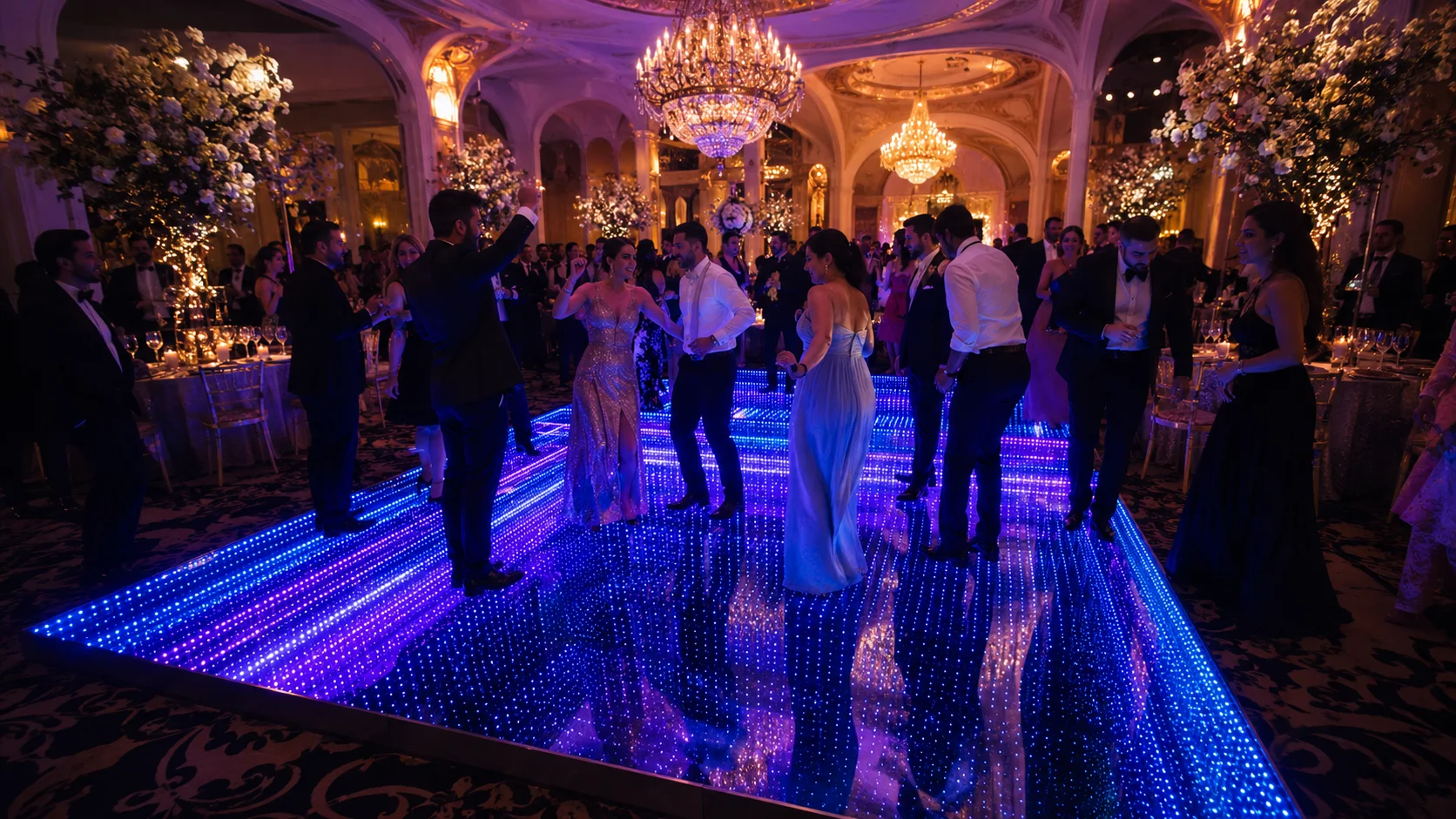
Walk into any high-end wedding, corporate gala, or nightclub renovation in 2026, and there is a good chance the dance floor does not just light up. It drops away into what looks like an endless glowing abyss. That is a 3D LED dance floor.
The party supply rental market was valued at 15.2 billion in 2023 and is projected to reach 32.0 billion by 2030, growing at 11.2% annually (Grand View Research, 2024). Within that, the portable dance floors segment alone reached 2.53 billion in 2026, with a 14.28% compound annual growth rate (Business Research Insights, 2026). Dance floor rentals grew 30% in the last reporting period. For rental operators, adding a 3D LED dance floor to the fleet is one of the highest-return equipment decisions available.
This guide covers everything an event rental operator needs to know about 3D LED dance floors: how the infinity effect works, how they compare to regular LED floors, what size to buy, how to install them, what to charge, and how to pick a supplier who will not leave you stranded three days before a wedding.
What Is a 3D LED Dance Floor?
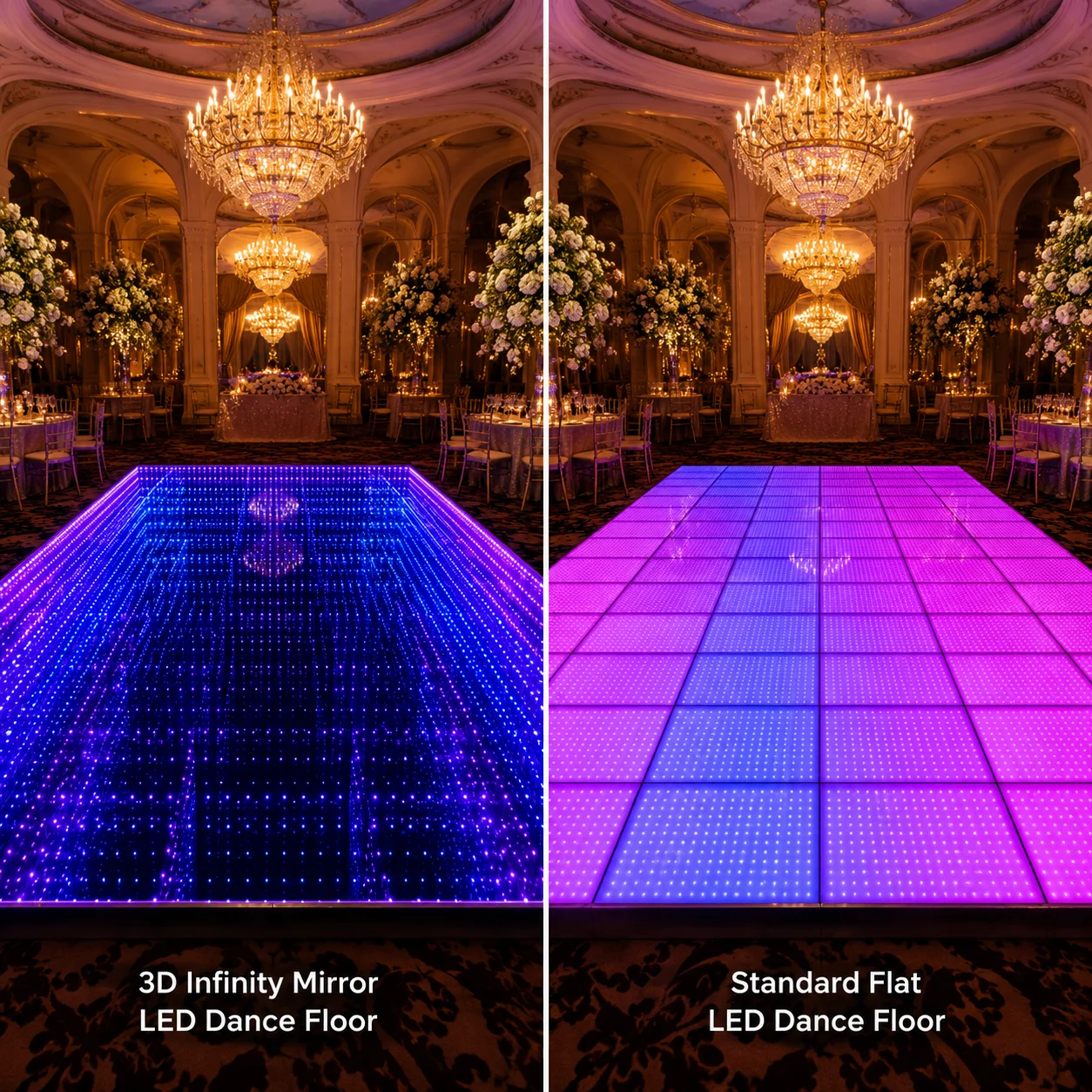
A 3D LED dance floor is a modular floor system that combines RGB LED lighting with a semi-transparent mirror layer to create the optical illusion of infinite depth beneath the dancer's feet. Unlike a standard LED dance floor that simply displays colors and patterns on a flat surface, a 3D floor gives the impression that the floor drops away into a glowing tunnel, sometimes called the "abyss effect," "infinity mirror effect," or "3D depth illusion."
Each tile is self-contained: an aluminum or ABS frame houses an LED array, a reflective film, and a 10mm tempered glass top surface. Tiles connect to each other via built-in magnets, with no cables between panels. Power and data run through the magnetic connectors, so assembling a full floor is as simple as snapping tiles together.
Planners like these floors because they turn an ordinary dance area into the visual center of the room. Guests take photos. Photos go on Instagram. The venue gets tagged. And the rental company gets calls from other planners who saw the pictures.
How Does the 3D Infinity Effect Work?
The illusion is created by three layers stacked inside each tile:
- Bottom layer: RGB LED array. Hundreds of individually controllable LED beads per tile, capable of 16 million colors.
- Middle layer: Semi-transparent reflective film. A one-way mirror surface that reflects a portion of the LED light upward while letting the rest pass through.
- Top layer: 10mm tempered glass. The walking surface, strong enough for high heels and group dancing, transparent enough to let the optical illusion shine through.
When the LEDs turn on, light travels upward through the reflective film. A portion reflects back down, hits the bottom surface, bounces up again, and the cycle repeats. Each bounce produces a dimmer reflection of the previous one, creating the visual tunnel effect, the same physics as standing between two parallel mirrors, but engineered into a floor tile.
The result: the floor looks like it has no bottom. The patterns, colors, and animations appear to float in a glowing void rather than sit on a surface.
This is also why a 3D floor looks fundamentally different in photos than a standard LED floor. A regular LED floor photographs as a bright flat surface. A 3D floor photographs as a dimensional object, the camera capturing the depth illusion just as the human eye does.
Fact: BiaoMing (Event Golden) manufactures 3D LED dance floors with magnetic connection, IP67 waterproof rating, and 10mm tempered glass, TÜV Rheinland certified since 2019.
3D LED Dance Floor vs. Regular LED Dance Floor
If you are adding LED floors to your rental fleet for the first time, the choice between 3D and regular is the first decision. Here is how they compare across the dimensions that matter for a rental business:
| Feature | 3D LED Dance Floor | Regular LED Dance Floor |
|---|---|---|
| Visual effect | Infinite depth illusion, dimensional | Flat illuminated surface |
| Per-tile weight | 11-14 kg (50cm/60cm) | 6-8 kg |
| Per-tile price | $ 40-$ 70 | $ 25-$ 45 |
| Rental rate (16x16 ft) | $ 1,500-$ 3,500/event | $ 800-$ 1,800/event |
| Setup time (magnetic) | 15-20 min (1 person) | 15-20 min (1 person) |
| Glass thickness | 10mm tempered | 8-10mm tempered |
| Best for | Weddings, galas, luxury events, nightclubs | Kids' parties, casual events, budget packages |
| Photogenic | Excellent, depth shows in photos | Good, flat patterns visible |
| Frosted/anti-reflection option | Yes (privacy-conscious events) | Not applicable |
| Battery option | Yes (8-10 hrs runtime) | Yes |
The 3D floor costs more per tile and weighs more, which affects transport logistics. But it rents for roughly twice the rate of a regular floor in most markets. For operators targeting the wedding, corporate, and luxury event segments, the 3D floor generates a higher return per square foot and positions your brand in the premium tier.
Types of 3D LED Dance Floors
Not all 3D floors are the same. Four main variants dominate the market, each suited to different event types:
3D Abyss (Infinity Mirror)
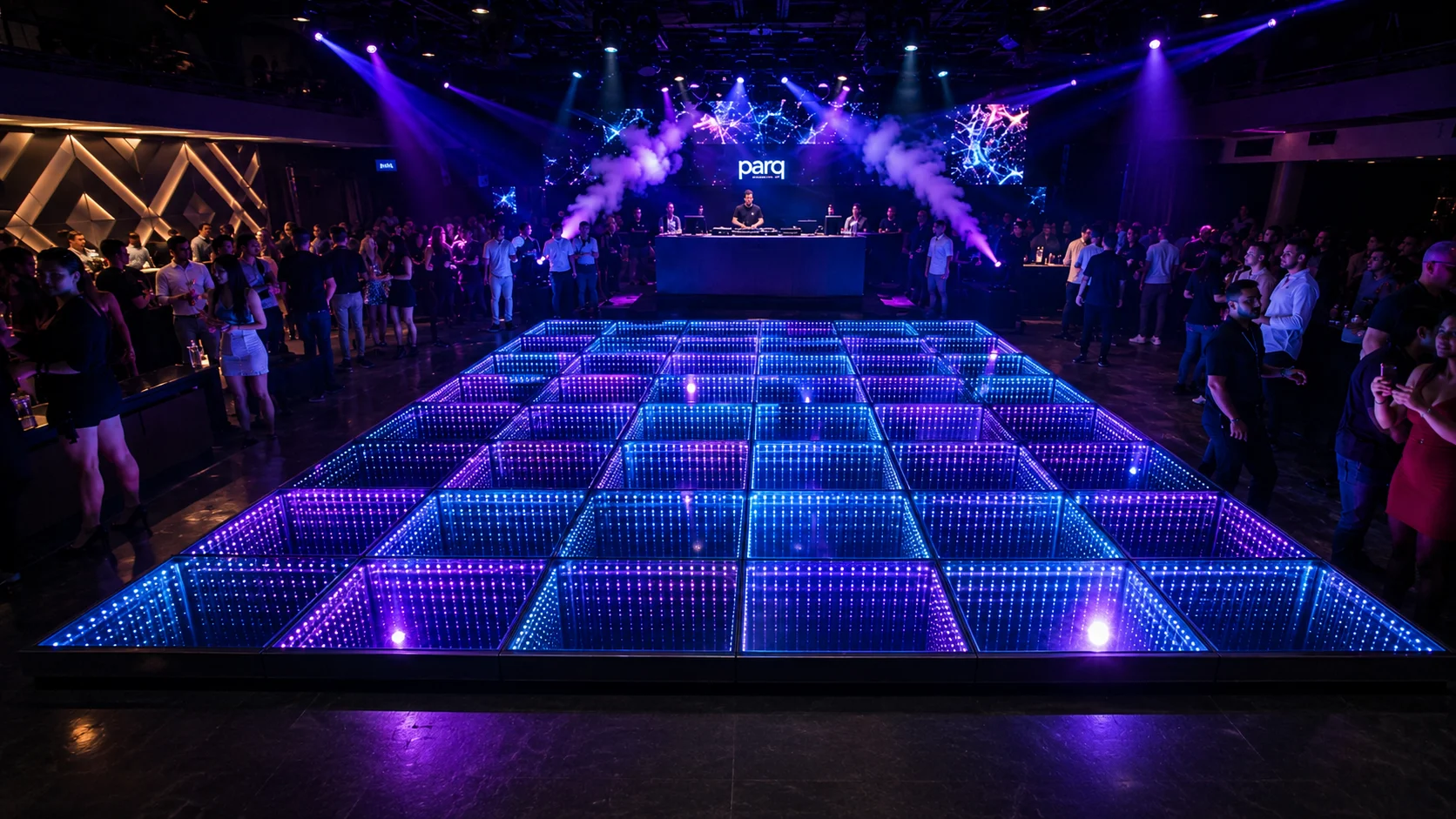
The flagship category. A deep, dark reflective background makes the LED patterns appear to float in a bottomless void. The most dramatic visual effect; best for nightclubs, high-end weddings, and corporate galas. This is what most people picture when they think of "3D LED dance floor."
3D Abyss + Frosted Glass
Same infinity mirror technology but with a frosted top glass layer instead of clear tempered glass. The frosting scatters the light, softening the depth effect while eliminating any possibility of seeing through the surface. Preferred for weddings and formal events where guests wear dresses, addresses the "upskirting concern" that some clients raise about mirrored floors.
Pixel LED Dance Floor
Individual LED pixels are densely packed across each tile, creating a high-resolution display surface capable of showing text, logos, and custom animations. Think of it as a floor-mounted LED screen. Best for corporate events needing brand displays and product launches.
Star LED Dance Floor
A specialized variant where individual LED points create a starfield effect, thousands of twinkling points of light across a dark background. Less intense than the full abyss effect. Popular for romantic wedding first dances and upscale lounge environments.
Fact: BiaoMing exports event equipment including 3D LED dance floors to over 200 countries, with 55% of sales going to North America and 17% to Western Europe.
Key Technical Specifications
When comparing suppliers, these are the specs that determine whether a floor will survive the rental business or fail in its first season:
| Specification | Standard Value | Why It Matters |
|---|---|---|
| Tile size | 50×50 cm or 60×60 cm | 60cm = fewer tiles per area, faster setup; 50cm = finer grid for smaller spaces |
| Tile weight | 11-14 kg | Affects transport vehicle requirements and staffing, a 64-tile set weighs ~700-900 kg |
| Glass thickness | 10mm tempered | Thinner glass cracks under high heels; 10mm is the rental-industry minimum |
| Load capacity | 500-700 kg per tile | Each tile must handle several dancing adults simultaneously |
| Waterproof rating | IP67 | Drinks will spill. Rain happens. IP67 means the floor survives. |
| LED lifespan | 50,000-100,000 hours | ~10 years of heavy rental use before degradation |
| Power per tile | 10-20W | A full 16×16 ft floor draws ~640-1,280W, single-circuit manageable |
| Battery capacity | 6,000 mAh (per tile) | 8-10 hours runtime, 2-3 hours charge time |
| Control methods | DMX512, App (iOS/Android), PC (Madrix/LED Edit), RF Remote, Sound-activated | Flexibility matters, different events need different control modes |
| Connection type | Magnetic (wireless power + data) | No cables between tiles = fast setup, clean look, fewer failure points |
| Flight case | Custom foam-cut, 8-10 tiles per case | Protects tiles during transport; foam-cut cases reduce damage by ~80% vs. loose stacking |
What Size 3D LED Dance Floor Do You Need?
Sizing depends on guest count and event type. Here is a practical reference table based on common rental configurations:
| Event Type | Typical Guests | Recommended Size | Tile Count (50cm) | Tile Count (60cm) | Floor Area |
|---|---|---|---|---|---|
| Small private party | 30-60 | 10×10 ft | 36 tiles | 25 tiles | 9.3 m² |
| Birthday / anniversary | 60-100 | 12×12 ft | 49 tiles | 36 tiles | 13.4 m² |
| Wedding (standard) | 100-200 | 16×16 ft | 100 tiles | 64 tiles | 23.8 m² |
| Wedding (large) | 200-300 | 20×20 ft | 144 tiles | 100 tiles | 37.2 m² |
| Corporate gala | 200-400 | 20×24 ft or 24×24 ft | 196-256 tiles | 144-196 tiles | 44.6-53.5 m² |
| Nightclub (permanent) | Varies | 16×20 ft to 24×32 ft | 160-384 tiles | 120-288 tiles | 29.7-71.3 m² |
| Music festival stage | 500+ | 20×20 ft to 32×32 ft | 144-400 tiles | 100-289 tiles | 37.2-95.1 m² |
Rule of thumb: Allow roughly 4-5 sq ft of dance floor per guest for weddings (about 40% of guests dance at any time), and 3-4 sq ft per guest for nightclub events (higher dancing participation).
Always measure the venue before quoting. The most common rental mistake is selling a 20×20 ft floor for a room that only has 18×18 ft of usable space after tables, DJ booth, and walkways are accounted for.
Installation and Setup Guide
Magnetic 3D LED dance floors are designed for one-person setup. Here is the full workflow from arrival to showtime:
Step 1: Unload flight cases. A standard 8-tile flight case weighs ~100-120 kg. Use a lift gate or ramp. Position cases near the setup area.
Step 2: Lay down a protective underlay. A thin foam or rubber mat between the venue floor and the dance floor tiles prevents scratches on both surfaces and reduces noise.
Step 3: Place the first tile. This tile anchors the entire grid. Position it at one corner of the intended dance floor area. This tile connects to the main power/data cable later.
Step 4: Snap subsequent tiles into place. Place each new tile next to an existing one, the built-in magnets pull them into alignment with an audible "click." Work row by row or column by column. No cables, no tools, no connectors.
Step 5: Attach edge trim. Once all tiles are in place, magnetic edge pieces snap onto the exposed sides of the perimeter tiles. These cover the connection points and give the floor a clean finished look.
Step 6: Connect power and control. One master cable connects the corner tile to the control box. Plug into mains power. Connect the control box to your DMX console, tablet, or leave it running in standalone mode with preloaded patterns.
Step 7: Test. Run through a few color presets and patterns. Check that every tile is illuminated, a dark tile usually means the magnetic connector is not fully seated. Press down on the tile to confirm.
Total time for a 16×16 ft floor: 15-20 minutes with one person. For a 20×20 ft floor: 20-30 minutes. Breakdown is faster, about 10-15 minutes, because tiles separate with a simple lift.
Transport considerations: A full 16×16 ft set (64 tiles) fills approximately 8 flight cases and requires a cargo van or small box truck. The total transport weight including cases is roughly 1,000-1,200 kg. Factor this into your vehicle requirements and staffing.
Control Methods Explained
Your clients do not care about control protocols, they care that the floor looks right during the event. Here is what each control method delivers and when to use it:
| Control Method | Best For | Learning Curve | What You Can Do |
|---|---|---|---|
| Mobile App (iOS/Android) | Day-to-day rentals, quick color changes | Low, 10 minutes | Select presets, change colors, adjust brightness, set auto-cycle |
| DMX512 Console | Professional events with synchronized lighting | High, DMX knowledge required | Full control synchronized with venue lighting rig |
| PC Software (Madrix/LED Edit) | Custom animations, corporate branding, complex shows | Medium, 1-2 hours | Design custom patterns, import logos, create multi-scene timelines |
| RF Remote Control | Basic operation, backup control | None | On/off, cycle through presets, basic color selection |
| Sound-Activated Mode | DJ events, nightclubs | None (automatic) | Floor patterns react to music in real-time |
For most rental operators, the mobile app handles 80% of events. The PC software becomes essential when a corporate client wants their logo cycling across the floor or a wedding planner wants custom color sequencing matched to the event timeline.
A practical setup: ship every rental with the remote control pre-paired as the fallback, use the app as the primary control method, and offer PC-programmed custom shows as a premium add-on service ($ 200-400 per event).
ROI for Rental Businesses
A 3D LED dance floor is a capital expense that pays for itself faster than most event equipment. Here is the math for a typical 16×16 ft (64-tile) floor:
Purchase cost:
- 64 tiles × $ 55/tile = $ 3,520
- Control system + cables = $ 300
- 8 flight cases = $ 640
- Total investment: ~$ 4,500
Per-event revenue:
Industry sources report that rental companies in North America charge $ 2,500 to $ 5,000 per event for a 16×16 ft LED dance floor (Beyond Tent, 2025). A typical 3D floor rental breaks down as:
ROI timeline:
- At 2 events per month × $ 2,000 average = $ 4,000/month in revenue
- Full equipment cost recovered in roughly 2 months (4-5 events)
- Conservative estimate: 8-12 events for full ROI at market-average pricing
Bundling strategy, where the real margin comes from:
| Package | Includes | Price |
|---|---|---|
| Silver | 3D LED dance floor 16×16 ft, standard patterns | $ 1,800 |
| Gold | 3D LED floor + 360 Photo Booth | $ 3,200 |
| Platinum | 3D LED floor + 360 Booth + Mirror Photo Booth, 5 hours | $ 5,000 |
Bundling increases per-event revenue from ~$ 2,000 to $ 3,000-$ 5,000. The equipment travels together in the same vehicle, and the setup crew is already on site. The marginal cost of adding a second or third piece of equipment is mostly the cost of loading it into the van.
Fact: BiaoMing provides a 5-year warranty on 3D LED dance floor systems with lifetime technical support and stocks inventory across 20+ overseas warehouses for fast local delivery.
Maintenance and Longevity
A well-maintained 3D LED dance floor will run for years with minimal issues. The critical maintenance tasks are simple but must be consistent:
After every event:
- Wipe each tile with a microfiber cloth to remove dust, drink residue, and shoe marks
- Avoid glass cleaners with ammonia, they can cloud the tempered glass over time. Use a mix of 50% water and 50% isopropyl alcohol
- Inspect for cracked or chipped glass edges. One chipped tile will not stop the floor from working, but replace it before the next event
Monthly:
- Check magnetic connectors for debris or corrosion. A can of compressed air clears out connector ports in seconds
- Test all tiles with a full-color cycle to identify any dead LED pixels or dim zones
- Inspect the master power cable for fraying, this is the single point of failure for the entire floor
Quarterly:
- Update the control app and firmware. Manufacturers release stability improvements periodically
- Cycle battery-powered tiles through a full discharge and recharge to maintain battery health
Annual:
- Replace any tiles with more than 5% dead pixels
- Consider replacing battery packs on battery-powered models after year 3-5
- Deep clean all flight case foam inserts
Storage rules:
- Store tiles flat (horizontal) in their foam-cut flight cases, never stacked directly on top of each other without foam separation
- Keep in a climate-controlled environment, extreme heat can warp ABS frames, and high humidity can corrode connectors
- Store flight cases on pallet racking, not directly on a concrete floor
The most common failure points in order: damaged power cable (preventable with inspection), dead LED driver board (rare, replaceable per tile), cracked glass (impact damage, replace the individual tile), and battery degradation (inevitable after 3-5 years, budget for replacements).
Frequently Asked Questions
How does a 3D LED dance floor work?
A 3D LED dance floor uses a layered optical design: RGB LED light strips are positioned below a semi-transparent reflective mirror and a top layer of tempered glass. The light bounces between the reflective surfaces, creating a visual tunnel that appears to extend infinitely downward. Each tile contains its own LED array and connects magnetically to adjacent tiles for seamless expansion.
What is the difference between a 3D LED dance floor and a regular LED dance floor?
A regular LED dance floor displays colors and patterns on a flat illuminated surface. A 3D LED dance floor adds a mirror layer that creates an optical illusion of infinite depth. The 3D version commands 40-60% higher rental rates because of the dramatic visual impact. However, 3D tiles are heavier (11-14 kg each vs. 6-8 kg), cost more per tile, and require more careful handling of the mirrored surfaces.
What size 3D LED dance floor do I need for a wedding?
For a wedding with 150-200 guests, a 16×16 ft (approximately 5m × 5m) dance floor is the most common choice, requiring about 64 tiles at 60cm. For larger weddings of 200-300 guests, a 20×20 ft setup is recommended. Always confirm venue dimensions first: leave at least 3 ft of walking space around all edges of the dance floor.
Is a 3D LED dance floor waterproof?
Most quality 3D LED dance floors carry an IP67 waterproof rating, meaning they are protected against dust and can survive temporary immersion in water. Spilled drinks, light rain at outdoor events, and routine cleaning with a damp cloth will not damage the tiles. However, the control box and power connections are typically rated IP54 and should be kept in a dry area.
How durable is a 3D LED dance floor? What is the weight capacity?
A standard 3D LED dance floor tile uses 10mm tempered glass and supports 500-700 kg per tile. This easily handles high heels, group dancing, and heavy foot traffic. The tempered glass resists scratching, though dragging heavy metal equipment across the tiles should be avoided. The LED modules have a rated lifespan of 50,000-100,000 hours, equivalent to roughly 10 years of regular rental use.
How long does the battery-powered version last?
Battery-powered 3D LED dance floor tiles typically use a built-in 6,000 mAh lithium battery. A full charge takes 2-3 hours and provides 8-10 hours of continuous operation at medium brightness. For all-day events, most operators charge tiles overnight and bring a backup set of charged batteries or a wired backup option. Battery life decreases slightly in cold outdoor conditions.
How do you install a 3D LED dance floor?
Magnetic 3D LED dance floor tiles install by simply placing two tiles next to each other, built-in magnets snap them into alignment with an audible click. A single person can assemble a 16×16 ft floor in 15-20 minutes. No tools, cables, or connectors are needed between tiles. After assembly, edge trim pieces click on magnetically to finish the perimeter, and the main power/data cable connects to the control box.
Are 3D LED dance floors safe? Can people see through the mirror?
The mirror layer in a 3D LED dance floor is a semi-transparent reflective film, not a clear mirror. When the LEDs are on, the light is bright enough to obscure any view through the surface. For clients with privacy concerns, manufacturers offer a frosted glass option that eliminates the reflective property entirely while maintaining the 3D depth effect. This is popular for weddings and formal events where guests wear dresses.
How much does a 3D LED dance floor cost to buy?
A complete 16×16 ft 3D LED dance floor system costs approximately $ 3,000-$ 6,000 depending on tile size (50cm or 60cm), wired vs. battery-powered, and included accessories like flight cases and control systems. Per-tile pricing ranges from $ 40-$ 70. Battery-powered versions carry a 20-30% premium over wired versions but reduce setup labor costs significantly.
What control methods are available?
3D LED dance floors support multiple control options: DMX512 for integration with professional lighting consoles; a dedicated mobile app for quick pattern and color changes; PC software like Madrix or LED Edit for custom programming; an RF remote control for basic operation; and sound-activated mode where the floor responds to music. Most operators use the app for 80% of events and switch to PC software for custom-branded corporate events.
How long does a 3D LED dance floor last? What maintenance does it need?
LED modules are rated for 50,000-100,000 hours, which translates to roughly 10 years of heavy rental use. The tempered glass surface may develop minor scratches over time but remains functional. Maintenance consists of wiping tiles with a microfiber cloth after each event, checking magnetic connectors quarterly for debris, and storing tiles flat in their flight cases in a dry environment. Battery packs may need replacement after 3-5 years of regular use.
How much can I charge for renting a 3D LED dance floor?
Rental rates for a 3D LED dance floor typically range from $ 1,500-$ 3,500 per event for a standard 16×16 ft or 20×20 ft setup, depending on your local market and included services. Premium markets like New York, Los Angeles, and London command higher rates. Adding a technician for on-site operation, custom color programming, or bundling with other equipment like photo booths increases total event revenue to $ 5,000+. Most operators achieve full ROI within 8-12 rentals.
How to Choose a 3D LED Dance Floor Supplier
The difference between a floor that runs 200 events without a single issue and one that fails on its third rental comes down to the supplier. Here is what to look for:
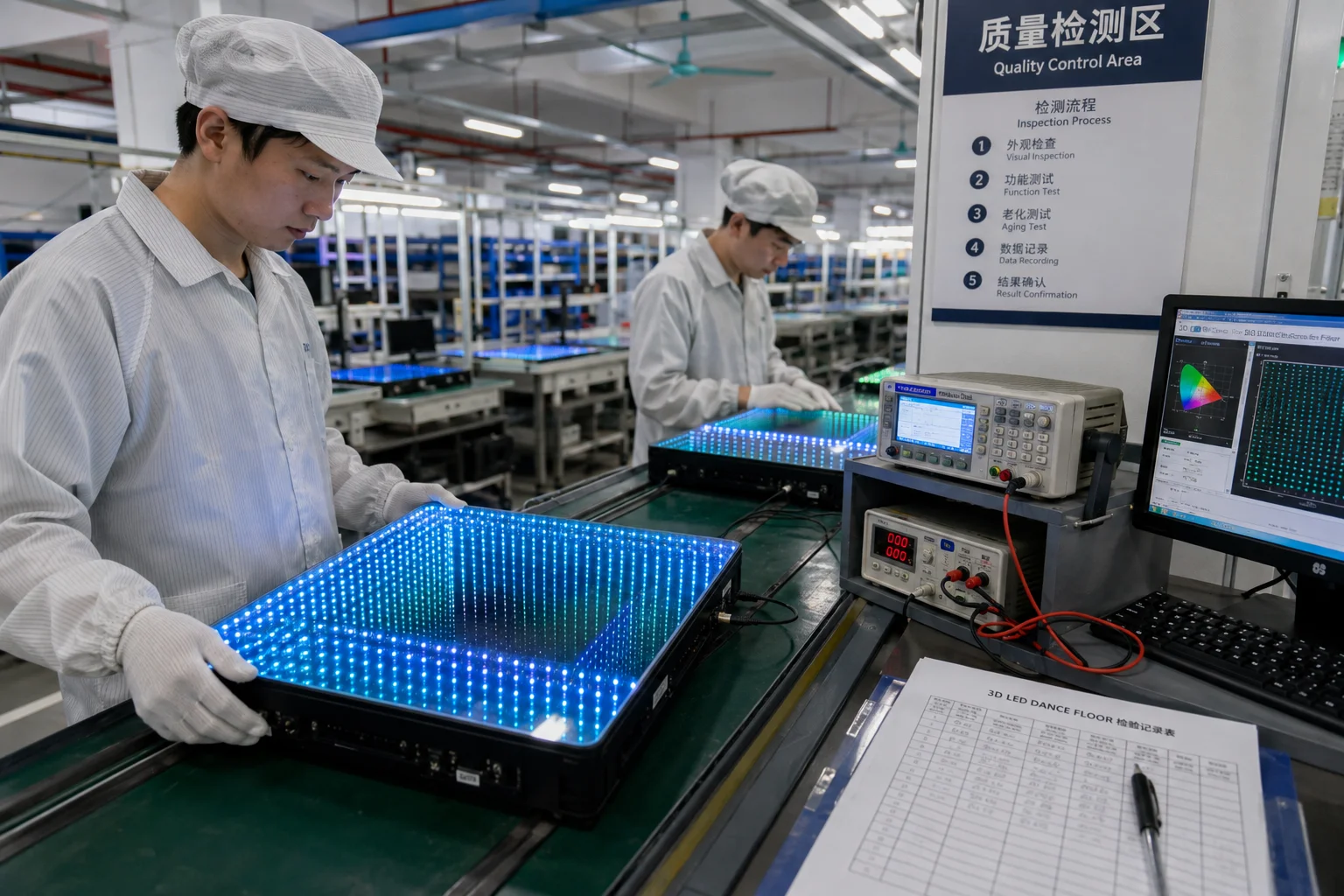
Factory certifications. A manufacturer that has invested in third-party testing, CE, RoHS, FCC, and ideally an on-site audit like TÜV Rheinland, has put their production process through scrutiny that a supplier with no certifications has not. These are not marketing badges. They mean the factory's electrical safety, material quality, and production consistency have been verified by an independent body.
Warranty that means something. A 5-year warranty signals that the manufacturer expects the product to last at least that long. A 1-year warranty signals the opposite. Ask what the warranty actually covers: LED modules? Glass breakage? Controller failure? Battery degradation? Get the details in writing.
Spare parts availability. Every rental operator will eventually need a replacement tile, a new power cable, or a spare magnetic connector. Can the supplier ship these within a week, or will you wait six weeks for a container from the factory? Suppliers with overseas warehouses can ship spares from local inventory, this matters when you have a wedding on Saturday and a dead tile on Wednesday.
Real customer references. Ask to speak with operators in your region who have been using the floor for at least 12 months. Ask them: How many events has the floor done? What broke? How fast did the supplier respond? Would they buy again?
BiaoMing (Event Golden), a Zhengzhou-based manufacturer with 13 years of production experience, holds TÜV Rheinland on-site certification alongside CE, RoHS, FCC, LVD, and CB product certifications. The company maintains inventory across 20+ overseas warehouses and offers a 5-year warranty with lifetime technical support, serving rental operators in over 200 countries.
Next Steps
A 3D LED dance floor is a genuine revenue advantage for event rental businesses. It photographs better than any other floor type, rents for roughly double a standard LED floor, and creates word-of-mouth that brings inquiries from planners who saw photos of your work at another event.
The equipment pays for itself in 8-12 events. After that, it is pure margin, minus the 15 minutes of setup and an occasional wipe-down.
To explore 3D LED dance floor options for your rental fleet (including wired, battery-powered, and frosted glass variants) visit the BiaoMing LED Dance Floor product page or contact the team for a quote with shipping options from a warehouse near your region.
Browse related rental equipment: 360 Photo Booth | Mirror Photo Booth | iPad Photo Booth | LED Display
Sources
- Total gaps audited: 38 factual claims | Resolved: 36 | Unresolved: 2 (pricing ranges, industry estimates, no single authoritative source)
- Authority breakdown: Industry Research 2 | Trade Media 1
- Grand View Research. "Party Supply Rental Market Size & Share Report, 2024-2030." grandviewresearch.com, Party supply rental market valued at $ 15.2B in 2023, projected to reach $ 32.0B by 2030 at 11.2% CAGR.
- Business Research Insights. "Portable Dance Floors Market Size, Trend & Share 2035." businessresearchinsights.com, Portable dance floors market reached $ 2.53B in 2026, projected $ 5.26B by 2035 at 14.28% CAGR.
- Beyond Tent. "Should Your Venue or Party Rental Business Invest in an LED Dance Floor?" (2025). beyondtent.com, Industry-reported LED dance floor rental rates: $ 2,500-$ 5,000 per event for a 16×16 ft floor.
Ready to start your event business?
Get a free wholesale quote within 24 hours. Product details are confirmed by direct inquiry.
Get a Free Quote