How to Choose an LED Display Screen for Your Business: The 2026 Buyer's Guide
Compare LED display types, pixel pitch, brightness, and certifications. A B2B buyer's guide to selecting indoor and outdoor LED screens for your business.
How to Choose an LED Display Screen for Your Business: The 2026 Buyer's Guide
Introduction
You have the budget approved. You have the wall space measured. Then two suppliers quote you prices that differ by 300% for what looks like the same LED display screen. One says P2.5 at contact us for quotation/m². The other says P2.5 at contact us for quotation/m². Both claims about quality. Neither quote includes installation, shipping, or control hardware.
You are not alone. The LED display market reached contact us for quotation.67 billion in 2025 and continues expanding, but pricing transparency has not kept pace with growth [1]. Chinese manufacturers now control approximately 59% of the global mid-to-low-end segment, and LED display prices fell roughly 50% in the five years leading to 2021, yet the gap between a reliable B2B supplier and a risky one has never been wider [2].
This guide walks you through the four decisions that determine whether your LED display screen project delivers ROI or regret: environment type, pixel pitch, technical specifications you cannot afford to ignore, and how to verify a supplier before you wire the deposit.
1. Indoor vs. Outdoor: Start with Where It Goes
Every LED display spec flows from one question: will this screen face the sun?
Brightness: The Non-Negotiable
Outdoor screens compete with direct sunlight. They need 5,000–10,000 nits of brightness to remain visible. Indoor screens in a controlled-lighting environment need only 600–1,200 nits.
Choosing an indoor-rated panel for a storefront window that catches afternoon sun guarantees a washed-out image. No software fix can compensate for insufficient nits.
IP Rating: What the Numbers Mean
| Rating | Dust Protection | Water Protection | Suitable For |
|---|---|---|---|
| IP31 | Limited | None | Indoor only — conference rooms, retail interiors |
| IP65 | Dust-tight | Water jets | Outdoor — building facades, billboards, plazas |
| IP67 | Dust-tight | Immersion | Outdoor — flood-prone or coastal installations |
An indoor IP31 panel placed outdoors, even under an awning, will fail. Humidity and condensation penetrate over weeks, not years. For outdoor use, IP65 is the minimum. IP67 is worth the premium in coastal or high-humidity environments.
Quick Decision Table
| Factor | Indoor | Outdoor |
|---|---|---|
| Brightness | 600–1,200 nits | 5,000–10,000+ nits |
| IP Rating | IP31 | IP65 minimum |
| Pixel pitch | P1.2–P4 typical | P3.9–P10 typical |
| Cabinet | Die-cast aluminum | Steel or aluminum with sealed gaskets |
| Maintenance | Rear or front access | Front-access preferred for mounted installations |
| Price premium | Baseline | +30–60% over equivalent indoor spec [2] |
Fact: The global LED display market reached contact us for quotation.67 billion in 2025 and is projected to grow to contact us for quotation.98 billion by 2031 (Mordor Intelligence, 2026).
2. Pixel Pitch: Where Image Quality Meets Budget
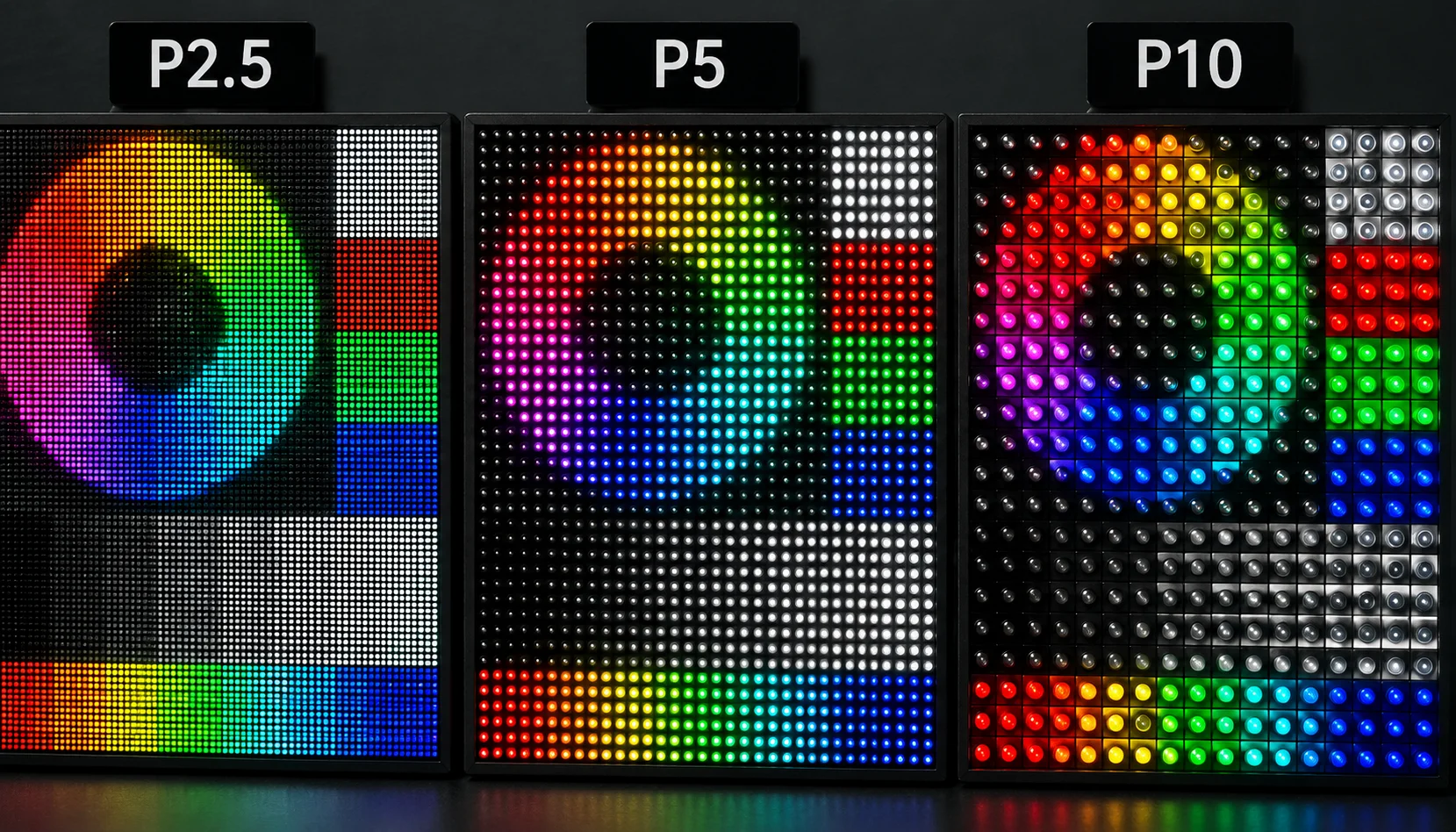
Pixel pitch, the distance in millimeters between adjacent LED clusters, is the #1 cost driver in any LED display screen purchase. A P2 screen costs roughly 3x per square meter as a P5 because it packs over 6x the LEDs [2].
The 1:1 Viewing Distance Rule
Minimum comfortable viewing distance (in meters) ≈ pixel pitch (in millimeters). A P2.5 screen looks sharp from 2.5 meters away. P10 from 10 meters. Break this rule and your audience sees individual pixels instead of an image.
Pixel Pitch by Application
| Pixel Pitch | LEDs per m² | Min. Viewing Distance | Typical Application | Price Range (2026) |
|---|---|---|---|---|
| P0.9–P1.2 (COB) | ~694,000–1,111,000 | 0.9–1.2 m | Broadcast studios, command centers | contact us for quotation/m² |
| P1.5–P2.0 | ~250,000–444,000 | 1.5–2.0 m | Corporate boardrooms, luxury retail | contact us for quotation/m² |
| P2.5–P3 | ~111,000–160,000 | 2.5–3.0 m | Conference rooms, hotel lobbies, retail | contact us for quotation/m² |
| P4–P5 | ~40,000–62,500 | 4.0–5.0 m | Commercial storefronts, event backdrops | contact us for quotation/m² |
| P8–P10 | ~10,000–15,625 | 8.0–10.0 m | Highway billboards, stadiums | contact us for quotation/m² |
The most common buying mistake: Over-specifying pixel pitch for the viewing distance. A P1.5 screen on a wall viewed from 4 meters away delivers no visible improvement over a P2.5, but costs 50–80% more based on per-square-meter price differences [2]. Match the pitch to the room, not the spec sheet. Before finalizing your pixel pitch, review available indoor LED display configurations to see what your budget buys at each pitch level.
Indoor LED Display: Price vs. Application Matrix
| Use Case | Recommended Pitch | Total Project Budget (10 m²) | Key Trade-off |
|---|---|---|---|
| Retail signage, hotel lobby | P2.5–P3 | contact us for quotation | Best value for 3–5 m viewing |
| Conference room, showroom | P2.0–P2.5 | contact us for quotation | Balance of clarity and budget |
| Corporate boardroom | P1.5–P2.0 | contact us for quotation | Sharp at close range, premium cost |
| Broadcast / control room | P0.9–P1.2 COB | contact us for quotation | Camera-ready, 24/7 durability |
Fact: Chinese manufacturers control approximately 59% of the global mid-to-low-end LED display market, contributing to continued price competition (OneDisplay Group, 2026).
3. Three Specs Buyers Overlook (and Regret Later)
Pixel pitch gets all the attention. These three specs quietly determine whether your screen performs or disappoints.
Refresh Rate: When 1,920 Hz Is Not Enough
Standard LED panels ship at 1,920 Hz, which is adequate for static signage. But if your screen will ever appear on camera (at a conference, in a broadcast, or on social media), you need 3,840 Hz minimum. Lower refresh rates produce visible scan lines and flicker on video that cannot be fixed in post-production.
The upgrade costs approximately contact us for quotation/m² [2]. For any installation where photography or video recording is expected, this is not optional.
Grayscale and Color Accuracy
Grayscale (measured in bits) determines how smoothly the screen renders gradients and shadows. A 14-bit system produces 16,384 brightness levels per color; a 16-bit system produces 65,536. The difference is visible in dark scenes, gradients, and skin tones.
For corporate and retail applications, 14-bit is the practical minimum. For broadcast and color-critical work, demand 16-bit with factory calibration reports.
Cabinet Type and Service Access
Die-cast aluminum cabinets offer tighter panel alignment and lighter weight for hanging installations. Steel cabinets cost less but may flex, causing visible seam lines between modules.
Equally important: front-access vs. rear-access service. A wall-mounted screen that requires rear access for maintenance becomes a major operational headache. Front-serviceable cabinets let technicians replace individual modules from the front without dismantling the structure, typically commanding a 10–15% premium over rear-access designs for permanent installations [2].
4. Sourcing LED Displays from China: A B2B Buyer's Checklist
China supplies the majority of the world's LED display panels. The difference between a reliable 7-year partnership and a costly dispute comes down to what you verify before paying.
Certification: Your First Filter
A manufacturer's certification portfolio tells you whether they have invested in compliance, or whether they sell to markets that do not require it.
| Certification | Required For | What It Verifies |
|---|---|---|
| CE | EU market access | Product meets EU health, safety, and environmental standards |
| RoHS | EU market access | No hazardous substances (lead, mercury, cadmium, etc.) |
| FCC | US market access | Electromagnetic interference within legal limits |
| LVD | EU safety compliance | Electrical safety for 50–1000V AC / 75–1500V DC equipment |
| CB | International acceptance | IECEE scheme — accepted by 50+ countries, simplifies multi-market certification |
A supplier holding all five certifications (CE + RoHS + FCC + LVD + CB) has cleared compliance for both the EU and North American markets. Verify certificates are current. Expired certifications are a red flag. For a supplier that meets all five certification requirements, request a quote for your LED display project.
Fact: According to manufacturer data, BiaoMing Optical (BM / BiaoMing) reports exports to over 180 countries with CE, RoHS, FCC, LVD, and CB certifications, serving 50,000+ global partners since 2019.
What to Ask Before Ordering
- order quantity and pricing tiers. LED display order quantitys typically start at 1–10 m². Confirm whether the quoted price is for the order quantity or for your actual order volume.
- Sample policy. Reputable suppliers offer sample units at a nominal cost or against a refundable deposit. Test for brightness uniformity, dead pixels, and color consistency.
- Production batch consistency. LED batches vary in color temperature. Ensure your order is produced in a single batch, and order 5–8% spare modules from the same production run.
- Lead time + shipping. Standard indoor panels: 15–25 days production + 15–30 days ocean freight. Custom outdoor units: 20–35 days production. Air freight cuts shipping to 5–7 days at 3–5x the cost.
- Warranty terms. Industry standard is 2–3 years. Clarify whether warranty covers parts only, or parts and labor, and how replacement modules are shipped (who pays freight).
Red Flags in Supplier Communication
- Cannot provide a video walkthrough of their production floor
- Quotes below market floor without explanation of how (LED chip downgrade is the most common corner to cut)
- Pushes for 100% payment upfront. Standard terms are 30% deposit, 70% before shipment
- Certification documents are expired or cannot be traced to a recognized testing lab
- Cannot name the LED chip brand in their panels (Nationstar, Kinglight, Nichia, etc.)
5. LED Display Comparison at a Glance
| Specification | Entry-Level Indoor | Mid-Range Indoor | Premium Indoor (COB) | Standard Outdoor | Billboard Outdoor |
|---|---|---|---|---|---|
| Pixel Pitch | P2.5–P4 | P1.5–P2.5 | P0.9–P1.2 | P5–P6 | P8–P10 |
| Brightness | 800–1,200 nits | 800–1,200 nits | 1,000+ nits | 5,000–7,000 nits | 5,000–8,000 nits |
| Refresh Rate | 1,920 Hz | 1,920–3,840 Hz | 3,840 Hz | 1,920–3,840 Hz | 1,920 Hz |
| IP Rating | IP31 | IP31 | IP31 | IP65 | IP65 |
| Cabinet | Steel / Aluminum | Die-cast aluminum | Die-cast aluminum | Steel / Aluminum | Steel |
| Price/m² (2026) | contact us for quotation | contact us for quotation | contact us for quotation | contact us for quotation | contact us for quotation |
| Best For | Retail, lobbies, signage | Boardrooms, showrooms | Broadcast, control rooms | Storefronts, plazas | Highways, stadiums |
FAQ
What pixel pitch do I need for my viewing distance?
Use the 1:1 rule: minimum viewing distance in meters equals the pixel pitch in millimeters. A P2.5 screen looks sharp from 2.5 meters; P10 from 10 meters. For retail windows viewed from 1–2 meters, choose P1.5–P2.5. For highway billboards at 50+ meters, P8–P10 is sufficient. Over-specifying pixel pitch for the actual viewing distance is the single most expensive mistake buyers make.
How do I calculate the total cost of an LED display project?
Panel cost is only 50–60% of total spend. Add 10–20% for steel mounting structures, 5–10% for control systems and video processors, 5–15% for installation labor, 3–8% for freight, and 2–7% for customs duties. Budget 5–10% extra for spare modules from the same production batch. For most indoor installations, total project cost = screen cost x 1.4 to 1.6. A contact us for quotation panel quote means a contact us for quotation project.
What certifications does an LED display need for export to Europe or the US?
For the EU market: CE (mandatory product compliance), RoHS (hazardous substance restrictions), and LVD (Low Voltage Directive for electrical safety). For the US: FCC (electromagnetic compatibility). CB certification provides broader international acceptance across 50+ countries. A supplier holding CE + RoHS + FCC + LVD + CB has cleared compliance for both major Western markets.
How long do LED display screens typically last?
Quality LED displays carry a rated lifespan of 50,000–100,000 hours to L70, the industry-standard lumen maintenance threshold at which brightness falls to 70% of original output (about 6–11 years of continuous 24/7 operation, or 12–22+ years at 12 hours daily) [3]. After approximately 50,000 hours of operation, LED brightness typically degrades to 70% of original output for commercial-grade displays [3]. For commercial installations, plan a 7–10 year lifecycle before performance drops below acceptable levels.
What is the difference between SMD and COB LED technology?
SMD (Surface-Mount Device) places individual LED chips onto the PCB surface in discrete packages. It is the industry standard: cost-effective, widely available, and sufficient for most applications. COB (Chip on Board) mounts LED chips directly onto the substrate without individual housings, offering better heat dissipation, higher durability, and resistance to physical impact. COB carries an estimated 18–22% price premium over equivalent SMD [2] but delivers lower failure rates in 24/7 installations. For typical commercial use, SMD offers the best price-performance ratio.
Can LED displays handle outdoor weather without additional protection?
Only if they carry an IP65 or higher rating. IP65 means the display is completely dust-tight and protected against water jets from any direction. This is sufficient for most outdoor installations including building facades and freestanding billboards. IP67 adds protection against temporary immersion for flood-prone or coastal locations. Indoor-rated displays (IP31) cannot be used outdoors, even under a protective structure, because ambient humidity and condensation will eventually cause electrical failure.
How do I verify a Chinese LED display supplier before placing a bulk order?
Start with certifications: verify CE, RoHS, FCC, LVD, and CB certificates are current and issued by recognized testing laboratories (TUV, SGS, Intertek). Check export history. Years in business and number of countries served indicate operational maturity. Request a live video factory tour showing production lines, aging-test rooms, and quality control stations. Order a sample unit and test it independently: brightness uniformity across the panel, dead pixel count, color temperature consistency, and build quality of cabinet seams and connectors. A supplier that resists any of these steps is not ready for a bulk partnership.
What is the typical lead time for a custom LED display order?
Standard indoor P2.5–P4 panels ship in 15–25 days from order confirmation. Custom-sized or outdoor IP65 units require 20–35 days due to weatherproofing and sealing processes. Large-scale projects exceeding 50 m² can take 30–45 days. Factor in additional shipping time: 15–30 days for ocean freight to major European or North American ports, plus 3–7 days for customs clearance and inland delivery. Air freight reduces transit to 5–7 days but multiplies shipping cost by 3–5x.
Conclusion
Choosing an LED display screen comes down to four decisions, in order:
- Indoor or outdoor: determines brightness, IP rating, and cabinet type
- Pixel pitch: the largest cost driver, matched to viewing distance
- Refresh rate and service access: the specs that separate reliable installations from expensive regrets
- Supplier verification: certifications, production capability, and batch consistency
The most common and expensive mistake is over-specifying pixel pitch for the viewing distance. A P2.5 panel on a wall viewed from 4 meters away looks identical to a P1.5 panel, but costs half as much. Match the spec to the room, not the brochure.
For B2B buyers sourcing from China, a supplier's certification portfolio and export track record are the most reliable indicators of quality. Five active certifications (CE, RoHS, FCC, LVD, CB) and a documented history of exports to regulated markets eliminate most of the risk before you place an order.
Explore BiaoMing Optical's LED display screen range
Request a quote for your installation project
Sources
- Mordor Intelligence. "LED Display Market Size, Drivers & Opportunities 2026." February 2026. https://www.mordorintelligence.com/industry-reports/led-display-market — Global LED display market sizing (contact us for quotation.67B in 2025, projected to contact us for quotation.98B by 2031), outdoor vs. indoor segment breakdown.
- OneDisplay Group. "LED Screen Price Guide 2026: What Drives the Real Cost." May 2026. https://www.onedisplaygroup.com/led-screen-price-guide-2026-what-drives-the-real-cost/ — Price ranges by pixel pitch, Chinese manufacturer market share (59%), historical price decline data, cost driver analysis.
- Pixelight. "LED Screen Lifespan & Maintenance Guide 2026." May 2026. https://pixelight.fr/en/blog/en-led-screen-lifespan-maintenance-guide-2026 — LED display L70 lifespan ratings (50,000–100,000 hours), lumen depreciation standards (LM-80), practical operational lifespan of 8–15 years.
Ready to start your event business?
Get a free wholesale quote within 24 hours. Product details are confirmed by direct inquiry.
Get a Free Quote