Indoor vs. Outdoor LED Display: How to Choose the Right Screen
Indoor vs outdoor LED displays compared: brightness, IP rating, pixel pitch, cost, maintenance, and a decision matrix for every application.
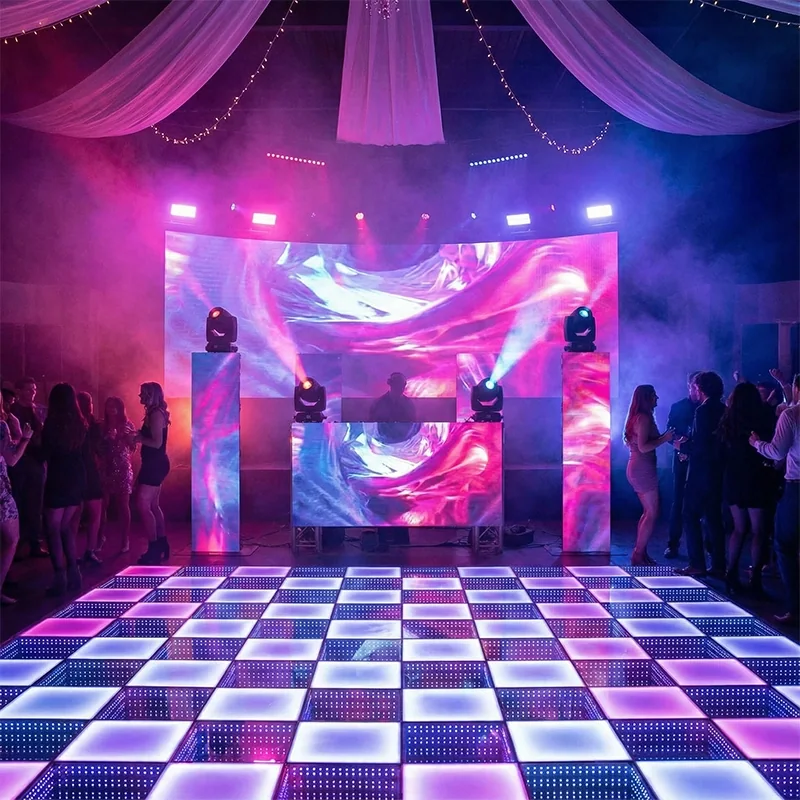
Buyers often treat indoor and outdoor LED displays as the same product with a higher brightness number and a rain rating. That shortcut is why projects that look identical on paper behave very differently after a year in the field. Outdoor environments punish weak sealing, poor thermal design, and fragile connectors. Indoor environments punish poor close-viewing performance, noise, and color inconsistency on premium content.
The right choice is rarely "indoor means fine pitch, outdoor means bright." It is about matching the display to viewing distance, ambient light, weather exposure, service access, and your maintenance reality.
This guide covers what actually separates indoor and outdoor LED displays: brightness, waterproofing, pixel pitch, thermal behavior, cost, and the decisions that determine whether your screen still looks good at year three.
The Real Difference Between Indoor and Outdoor LED Displays
The environment changes the failure modes.
Indoors, the risks are close viewing, long operating hours, and the expectation of uniform, camera-friendly visuals in controlled spaces: lobbies, retail stores, control rooms, conference rooms. The engineering priorities are pixel pitch, color accuracy, and low noise.
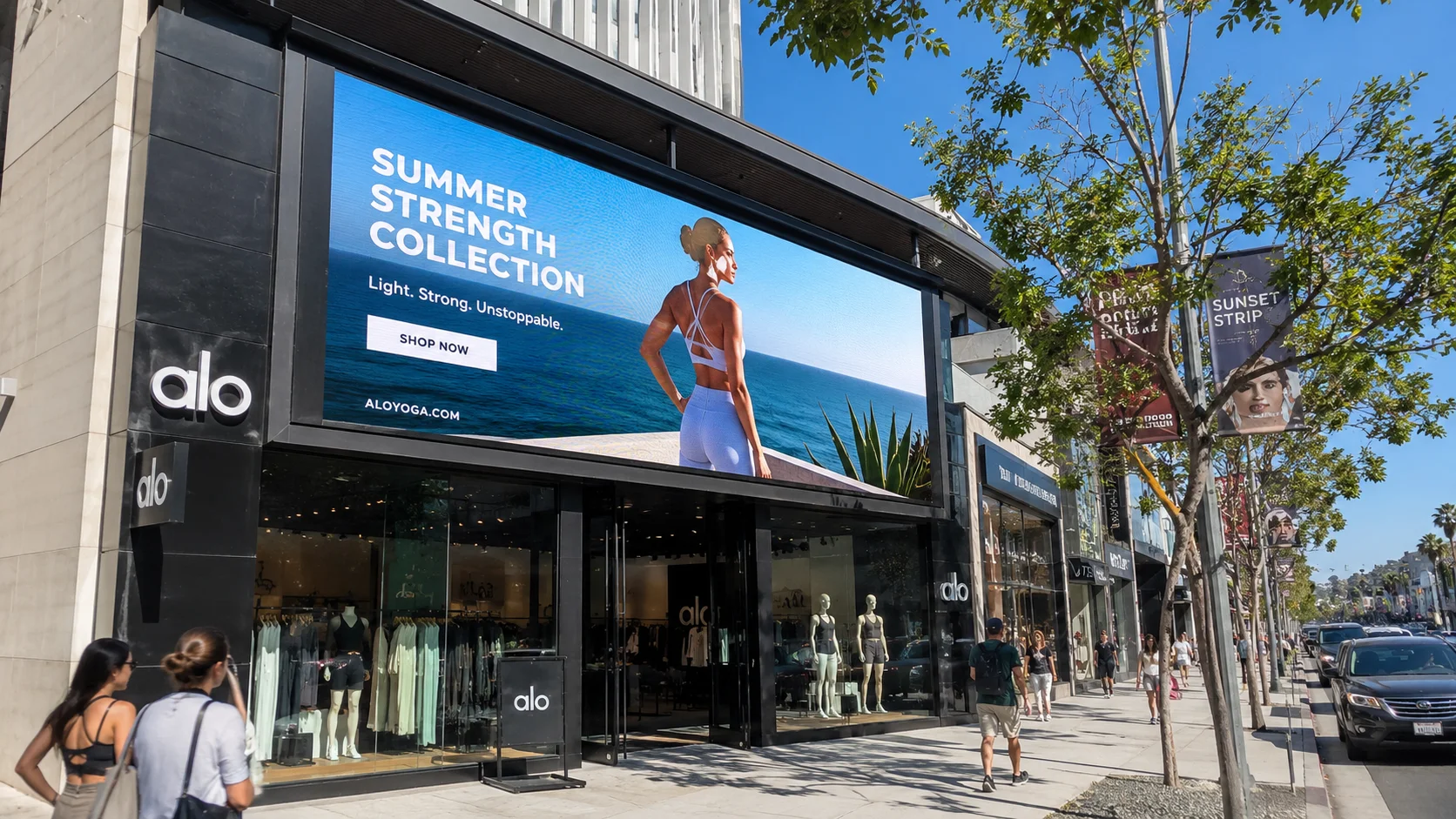
Outdoors, the risks are moisture ingress, dust, UV exposure, wind-driven rain, thermal cycling, and corrosion. The engineering priorities are brightness, sealing, thermal management, and impact resistance. Even a display that "works" can suffer brightness decay, color shift, and repeated service events that erode ROI.
The buyer's job is to translate the installation environment into requirements, not to compare brochure specs.
| Factor | Indoor LED Display | Outdoor LED Display |
|---|---|---|
| Brightness | 800-1,500 nits | 5,000-6,500 nits |
| Waterproofing | IP20-IP40 (dust protection only) | IP65 (dust-tight + water jets) |
| Pixel pitch range | P1.2-P4 (fine pitch common) | P3.91-P16 (coarser pitch) |
| Viewing distance | Close (1-10 m) | Far (5-50+ m) |
| Cooling | Passive or light airflow | Active fans + thermal design |
| Corrosion protection | Standard | Sealed connectors, coated PCBs |
| Cabinet weight | Lighter | Heavier (sealed construction) |
| Cost per m² | $ 800-$ 2,500 | $ 1,300-$ 3,500 |
| Maintenance access | Usually easy (indoor) | Often difficult (height, traffic) |
Brightness: Why Outdoor Screens Need 5,000+ Nits
Brightness is measured in nits (candela per square meter). It is the single most important spec for outdoor screens and the most misunderstood.
Brightness requirements by environment:
| Environment | Required Brightness |
|---|---|
| Indoor: lobby, retail, conference | 800-1,500 nits |
| Indoor: glass-front store (sun-facing) | 2,500-3,500 nits |
| Outdoor: shaded (awning, covered walkway) | 3,500-4,500 nits |
| Outdoor: direct sunlight | 5,000-6,500 nits |
| Outdoor: south-facing, full-day sun | 6,500 nits |
The trade-off buyers miss: higher sustained brightness means higher drive current, which means more heat. Heat accelerates LED aging, increases fan wear, and shortens module life. A screen bought at 6,500 nits and run at full brightness in a hot climate will age faster than a 5,000-nit screen run at 80% output.
The practical question is not "what is the maximum nit number in the brochure" but "what sustained brightness is required for readability at my actual ambient conditions, and what thermal headroom exists at that operating point."
For most buyers, this means: buy enough brightness for the worst case (direct sun), then use auto-brightness control so the screen dims at night. Auto-brightness extends module life and cuts power use by up to 50%.
Waterproofing and IP Ratings Explained
IP (Ingress Protection) ratings are defined by IEC 60529. Two digits: the first covers dust, the second covers water.
- IP65: dust-tight (6) + protected against water jets (5). The standard for outdoor LED displays. Handles wind-driven rain and hose-down cleaning.
- IP54: dust-protected (5) + water splashes (4). Common on indoor screens that may face dust but no water.
- IP20: finger-protected (2) + no water protection. Typical for fine-pitch indoor screens.
Why outdoor needs more than the rating number: IP65 is a test classification, not a guarantee. The rating assumes new, properly assembled units. In the field, gaskets dry out, screws loosen, and connectors corrode. A coastal installation faces a different corrosion profile than a dry inland city. A screen under a canopy behaves differently than one in open exposure.
The operational implication: outdoor screens need a sealing strategy that survives years, not a one-time test pass. Buyers should ask about connector sealing, drainage paths, and gasket replacement intervals, not just "is it IP65?"
Pixel Pitch and Viewing Distance
Pixel pitch is the distance in millimeters between adjacent pixels. Smaller pitch = higher resolution = sharper close-up image = higher cost.
The selection rule: minimum viewing distance (meters) ≈ pixel pitch (mm)
| Application | Typical Viewing Distance | Recommended Pitch |
|---|---|---|
| Lobby, reception (close viewing) | 1-3 m | P1.2-P2.6 |
| Retail storefront | 3-8 m | P3-P4 |
| Shopping mall atrium | 3-10 m | P3-P4 |
| Conference room, boardroom | 2-5 m | P1.5-P2.6 |
| Sports venue, stadium | 10-50 m | P6-P16 |
| Outdoor billboard | 20-100 m | P8-P16 |
| Street signage, gas station | 10-40 m | P4-P8 |
Two mistakes buyers make:
- Choosing pitch by habit, not by viewer distance. "Indoor equals fine pitch" is wrong. An auditorium with a 20-meter viewing distance does not need P1.9, and a pedestrian-zone outdoor screen viewed from 3 meters cannot use P16.
- Ignoring content type. Text and logos need finer pitch than video at the same distance, because letter edges expose pixelation faster than moving images. If your content is mostly text with thin strokes, step one pitch grade finer.
The correct pitch is a function of closest typical viewing distance, content type, and how long the viewer has to process the message. Never a category label.
Fact: BiaoMing (Event Golden) manufactures indoor and outdoor LED displays from P1.9 to P3.91, with outdoor models rated IP65 and up to 6,500 nits, TÜV Rheinland certified.
Thermal Design and Durability
Heat is the quiet killer of LED displays. Both indoor and outdoor screens fail thermally, but in different ways.
Outdoor thermal stress: direct sun heats cabinets above ambient temperature. Enclosures bake, thermal cycling (hot day, cold night) expands and contracts materials, and fans work continuously in hot climates. The result of poor thermal design: premature component failure, uneven aging across the screen, and visible brightness non-uniformity.
Indoor thermal stress: continuous operation in conditioned spaces, but often in architectural cavities that restrict airflow. A screen recessed into a wall pocket with no airflow can overheat even in an air-conditioned lobby.
What thermal design means in practice:
- How heat spreads across the cabinet (aluminum conducts; steel insulates)
- Whether dust buildup reduces heat transfer (filters need cleaning)
- Whether the installation geometry blocks convection (recessed pockets need fans)
- Whether brightness derates as temperature rises (quality screens auto-dim at high temperature)
Ask the supplier for the operating temperature range and how the screen manages heat at full brightness. A screen that runs at 100% brightness in a 40°C environment without derating is either lying or about to fail.
Cost Comparison: Indoor vs. Outdoor
Price per square meter varies with pixel pitch more than with indoor/outdoor classification. But at the same pitch, outdoor carries a 40-70% premium.
| Cost Component | Indoor (P3.91) | Outdoor (P3.91) |
|---|---|---|
| Module + cabinet | $ 800-$ 1,200/m² | $ 1,300-$ 1,900/m² |
| Brightness module premium | Base | +30-50% (5,000+ nits) |
| Sealing + cooling | Minor | +$ 150-$ 300/m² |
| Control system | Included | Included |
| Installation structure | $ 150-$ 400/m² | $ 300-$ 600/m² (heavier, weather-rated) |
| Typical installed total | $ 1,200-$ 2,000/m² | $ 2,000-$ 3,500/m² |
Total cost of ownership (TCO), not just purchase price:
| Cost Factor | Indoor | Outdoor |
|---|---|---|
| Purchase price | Lower | Higher |
| Maintenance frequency | Low (quarterly cleaning) | High (monthly cleaning, quarterly gasket checks) |
| Maintenance cost | Low (easy access) | High (lifts, traffic control, weather windows) |
| Brightness decay impact | Slow, tolerable | Fast, screen may fail daylight requirements at year 5 |
| Power cost | Lower (fewer nits) | Higher (5,000+ nits sustained) |
| Typical service life | 8-12 years | 6-10 years |
The ROI truth: outdoor maintenance is expensive because access is expensive. Indoor maintenance is expensive when visual matching is difficult after module replacement. Both are avoidable when serviceability and calibration discipline are planned from the start.
Fact: BiaoMing exports indoor and outdoor LED displays to over 200 countries, with 55% of sales to North America and 17% to Western Europe.
Decision Matrix by Application
| Application | Environment | Brightness | Pitch | IP Rating | Key Consideration |
|---|---|---|---|---|---|
| Retail storefront window | Glass-front, may face sun | 2,500-3,500 nits | P3-P4 | IP54+ | Auto-brightness to match window glare |
| Shopping mall atrium | Indoor, controlled light | 1,500-2,000 nits | P3-P4 | IP40 | Fine pitch for close escalator views |
| Restaurant / cafe menu board | Indoor | 1,000-1,500 nits | P2.5-P3.9 | IP40 | Color accuracy for food content |
| Conference center lobby | Indoor | 1,200-1,800 nits | P2.6-P3.9 | IP40 | Quiet operation (low fan noise) |
| Gas station canopy sign | Outdoor, sun + weather | 5,000-6,500 nits | P4-P8 | IP65 | 24/7 operation, high reliability |
| Street billboard / DOOH | Outdoor, direct sun | 5,500-6,500 nits | P8-P16 | IP65 | Auto-brightness, remote content management |
| Stadium / arena display | Outdoor or covered | 5,000-6,500 nits | P6-P16 | IP65 | Impact resistance, fast refresh for sports |
| Airport / transit display | Indoor, bright light | 1,500-2,500 nits | P3-P4 | IP54 | 24/7 operation, remote management |
Common Buying Mistakes
Mistake 1: "Indoor vs outdoor is just IP rating and brightness." Wrong. IP and nits matter, but they do not capture thermal gradients, corrosion risk, impact resistance, or how installation geometry changes airflow.
Mistake 2: Choosing pixel pitch without defining the closest real viewer. Many indoor spaces have no close viewers (auditoriums). Many outdoor spaces do (pedestrian zones). Document the closest typical viewing distance, not the average.
Mistake 3: Ignoring noise and HVAC implications indoors. LED walls can introduce fan noise and heat load that are unacceptable in boardrooms, studios, and premium retail. Specify maximum noise levels and ventilation requirements.
Mistake 4: Underestimating corrosion and lifecycle sealing outdoors. UV and weather degrade gaskets, coatings, and plastics over time. Reliability declines show up as intermittent failures and escalating service calls.
Mistake 5: Not defining what "acceptable" looks like after repairs. Module swaps without a calibration and matching plan create visible patching that shortens practical lifespan even when the system is electrically healthy.
Fact: BiaoMing provides a 5-year warranty on LED display systems with 20+ overseas warehouses for fast spare module delivery.
Frequently Asked Questions
What is the difference between indoor and outdoor LED displays?
The core differences are brightness, waterproofing, and durability. Indoor displays run 800-1,500 nits with no waterproofing. Outdoor displays run 5,000-6,500 nits, carry IP65 ratings, and use sealed, corrosion-resistant construction. Outdoor units cost 40-70% more per square meter.
How bright does an outdoor LED display need to be?
Direct sunlight needs at least 5,000 nits; 5,500-6,500 nits for south-facing or full-sun locations. Shaded outdoor locations can run 3,500-4,500 nits. Indoor displays need only 800-1,500 nits. Excess brightness wastes money and accelerates LED aging.
Can I use an indoor LED display outdoors?
No. Without IP65 sealing, moisture and dust corrode the electronics within months. At 1,500 nits or less, the image is invisible in daylight. Sunlight heat can also damage unprotected modules. Outdoor-rated displays can run indoors, but you overpay.
What does IP65 mean for LED screens?
IP65 per IEC 60529 means completely dust-tight (6) and protected against water jets (5). Outdoor LED displays typically need IP65 on cabinets and modules. The rating is a test classification, not a guarantee, so seals need scheduled inspection.
What pixel pitch do I need for my LED display?
Minimum viewing distance in meters equals pitch in millimeters. Storefronts viewed from 5+ meters work with P4-P6. Mall screens suit P3-P4. Stadiums use P8-P16. Close viewing under 3 meters needs P1.5-P2.6. Pick the coarsest pitch that looks sharp at your closest viewer distance.
How much do indoor and outdoor LED displays cost?
Indoor displays run about $ 800-$ 2,500 per square meter. Outdoor runs $ 1,300-$ 3,500 per square meter, a 40-70% premium from brightness modules, IP65 sealing, active cooling, and corrosion-resistant construction. Installed projects add 20-40% for structure and installation.
How long do LED displays last?
LED modules are rated 100,000 hours: roughly 11 years at 24/7 operation. Most displays lose 20-30% brightness in the first 5 years, after which outdoor screens may struggle in daylight. Power supplies typically need replacement after 5-7 years. Displays can run 10+ years with module replacement.
Do outdoor LED displays need more maintenance?
Yes. Outdoor screens face moisture, UV, thermal cycling, and pollution. Industry practice: quarterly gasket inspection, monthly cleaning in dusty areas, annual corrosion checks. Access cost dominates: a screen 10 meters up needs a lift for every service call. Indoor screens mainly need periodic dust cleaning.
How to Choose an LED Display Supplier
Whether indoor or outdoor, the supplier decision determines your screen's uptime for the next decade.
Factory certifications. Third-party testing, CE, RoHS, FCC, and ideally an on-site audit like TÜV Rheinland, verifies electrical safety and production consistency. These are not marketing badges.
Module calibration discipline. Ask how brightness and color are calibrated and matched between production batches. Mismatched modules appear as visible color patches after a replacement.
Spare module program. Keep 2-3% of screen area in spare modules. Ask whether the supplier ships spares from overseas warehouses in days, not weeks.
Thermal data. Request the operating temperature range and derating curve. A supplier who cannot explain how the screen manages heat at full brightness is hiding something.
Warranty terms. A 5-year warranty signals manufacturer confidence. Read what it covers: modules? power supplies? installation? Get it in writing.
BiaoMing (Event Golden), a Zhengzhou-based manufacturer with 13 years of production experience, manufactures indoor and outdoor LED displays from P1.9 to P3.91, with outdoor models rated IP65 and up to 6,500 nits. The company holds TÜV Rheinland on-site certification with CE, RoHS, FCC, LVD, and CB product certifications, maintains inventory across 20+ overseas warehouses, and offers a 5-year warranty with lifetime technical support.
Next Steps
The indoor vs. outdoor decision comes down to three numbers: brightness (what your environment demands), pitch (what your closest viewer needs), and IP rating (what weather your location serves). Everything else, thermal design, sealing strategy, maintenance access, follows from those three.
If you are still evaluating, start with a site assessment: measure the viewing distance, note sun exposure, and check service access. Then match the display to the environment, not to a category label.
To explore indoor and outdoor LED display options, including P1.9, P2.6, and P3.91 configurations with IP65 outdoor models, visit the BiaoMing LED Display product page or contact the team for a quote.
Browse related equipment: LED Rental Display Guide | 3D LED Dance Floor | 360 Photo Booth
Ready to start your event business?
Get a free wholesale quote within 24 hours. Product details are confirmed by direct inquiry.
Get a Free Quote