Star LED Dance Floor: The Complete Guide for Event Rental Businesses
How star LED dance floors create the twinkling starlight effect, types, sizing, installation, ROI, and how to choose a supplier
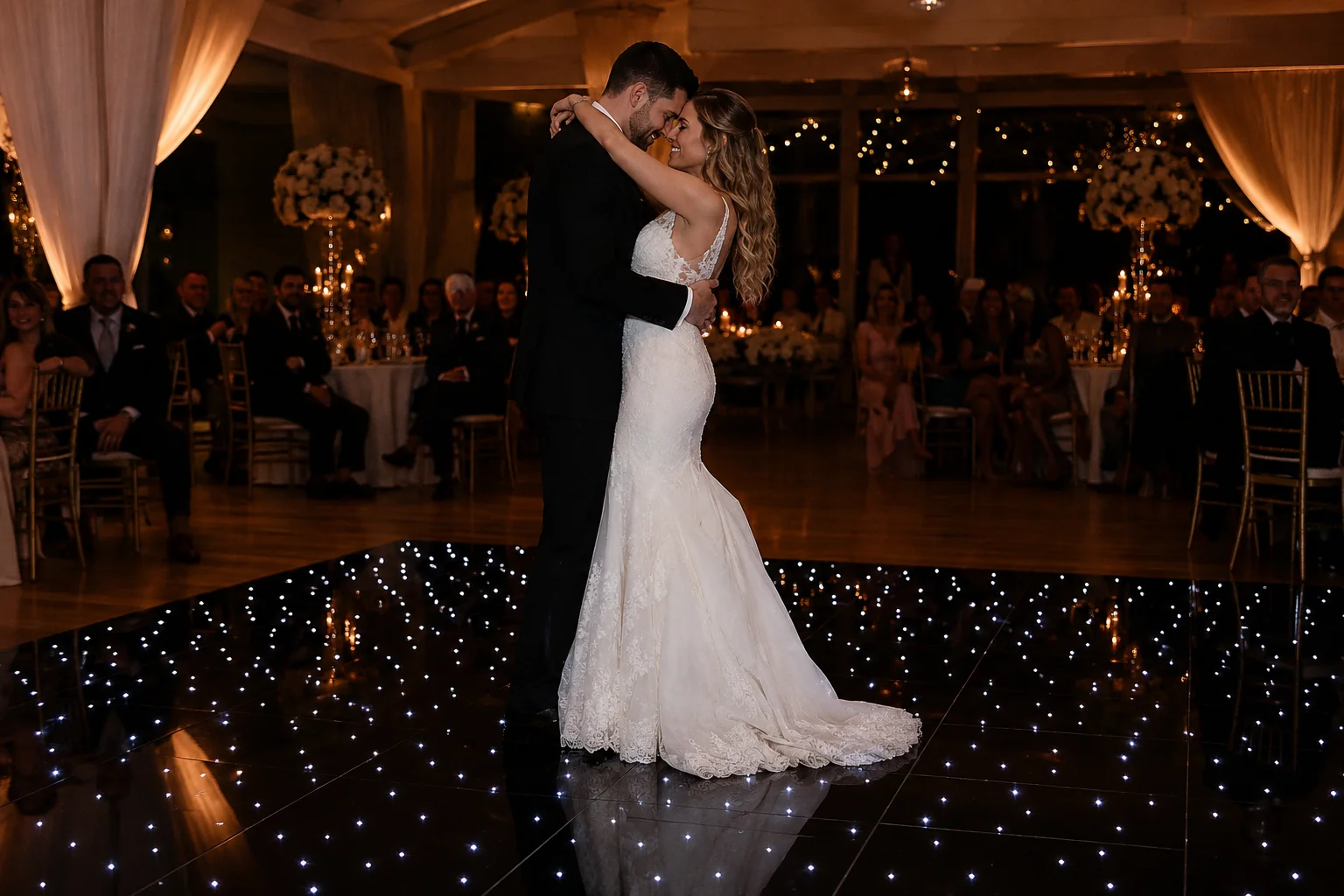
A bride steps onto the dance floor for her first dance. The room lights dim. And beneath her feet, the floor comes alive, not with neon blocks or swirling patterns, but with thousands of tiny stars, twinkling against a dark sky. She is dancing on a field of light.
That is what a star LED dance floor sells. Not the tile count or the IP rating, but that moment. For event rental businesses, star floors open a category that standard RGB and even 3D abyss floors do not fully reach: the romantic, atmospheric, intimate event.
This guide covers what rental operators need to know about star LED dance floors: how the twinkling effect works, the different variants, how they compare to other LED floor types, what to charge, and how to source them.
What Is a Star LED Dance Floor?
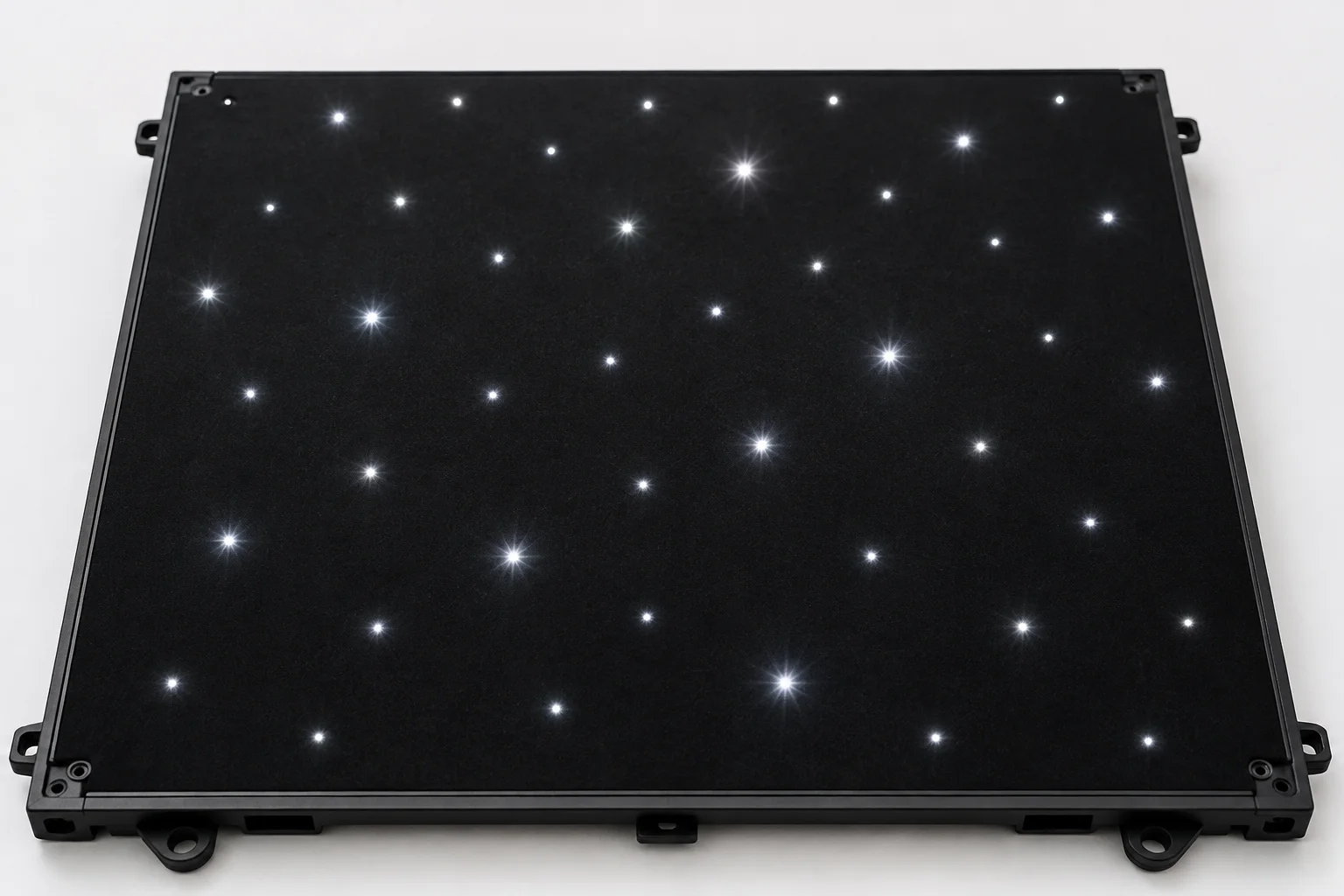
A star LED dance floor (also called starlight, starlit, or twinkling dance floor) uses thousands of individual LED points embedded across each tile to create a starfield effect. Instead of broad color washes across the surface, each LED point acts as a single star: it can twinkle, pulse, shift color, or animate independently.
The construction is familiar: each tile is a self-contained unit with an aluminum or ABS frame, a dark-backed reflective layer, a dense grid of small LED points (typically 16-32 per 60cm tile), and a tempered glass top surface. The dark background is what makes the effect work. Against a white or reflective backing, the individual points of light would blend into ambient room light. Against black, each point stands out.
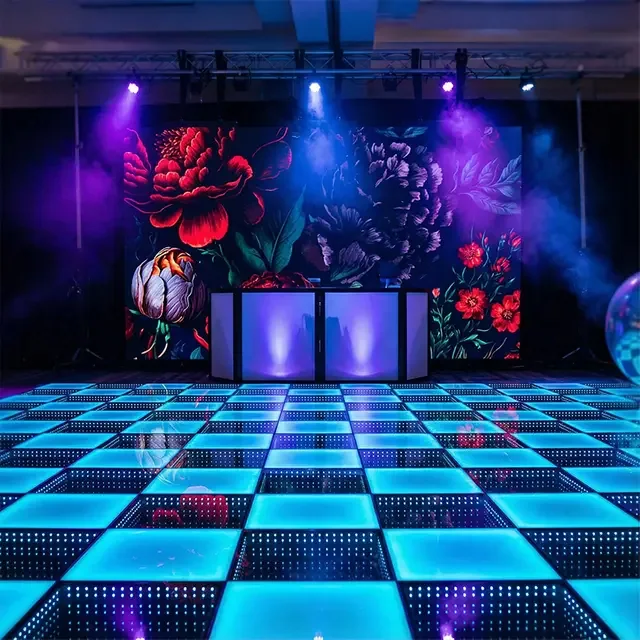
Star floors are sometimes confused with 3D abyss floors, but the visual difference is immediate. A 3D abyss floor creates depth: the floor looks like it drops into an endless glowing tunnel. A star floor creates a field: the floor looks like a night sky, flat but full of individual points of light. The 3D abyss is dramatic and futuristic. The star floor is romantic and dreamlike. Different events. Different buyers. Different pricing.
How the Twinkling Star Effect Works
The starfield illusion comes from two design choices that differentiate star floors from standard RGB floors:
Point density instead of area coverage. A standard RGB tile uses a few large LED modules (typically 4-9 per tile) that flood the entire tile surface with color. A star tile uses many small LED points (16-32 per 60cm tile) arranged in a grid, each individually addressable. The LED points are small enough (3-5mm diameter) that at standing height they read as individual stars, not as connected shapes.
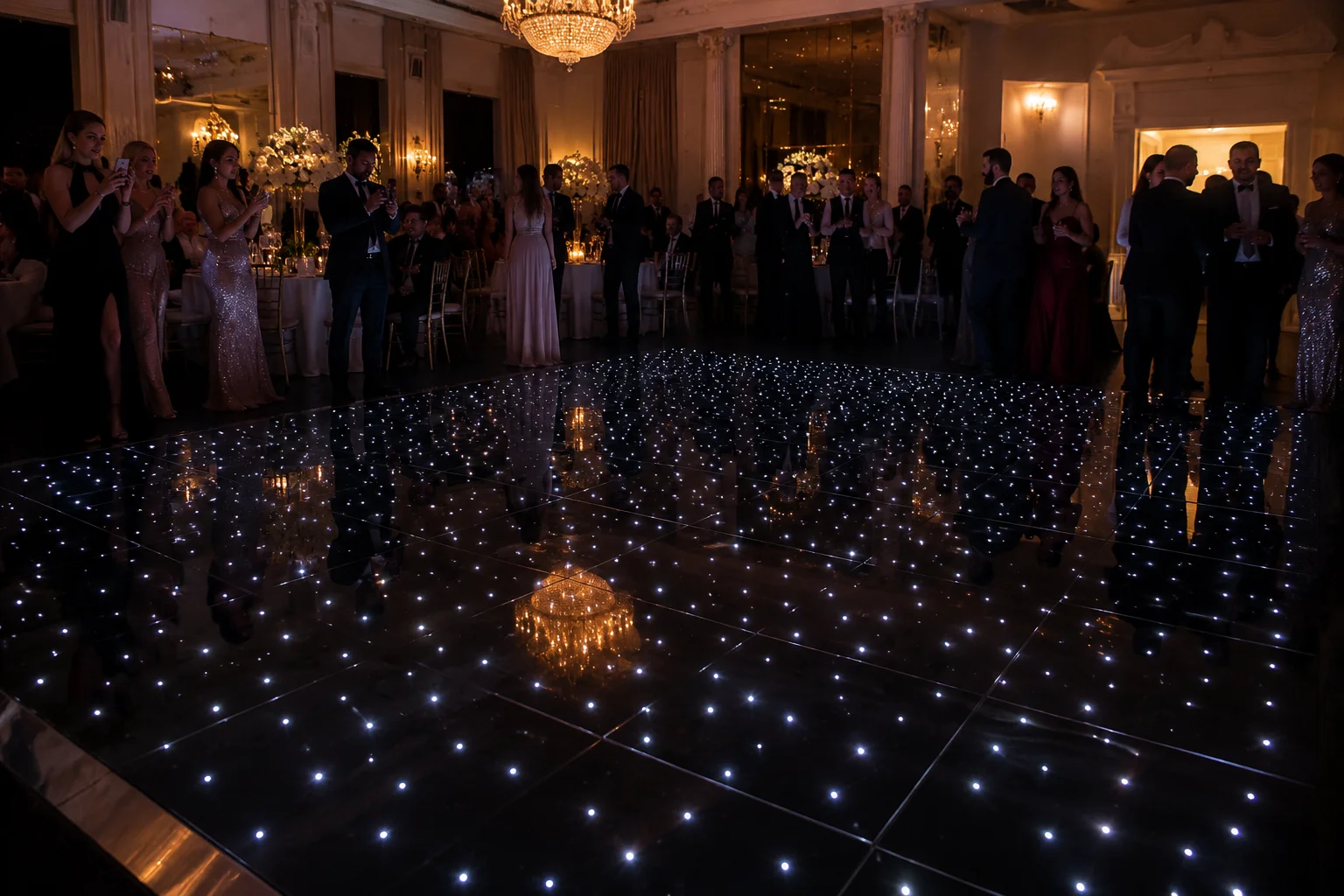
Dark-backed reflective layer. Beneath the tempered glass, a black or dark-mirror backing absorbs ambient light from the room. The only light visible is from the LED points themselves. Against this dark field, each LED point's light pops. The contrast ratio between the lit points and the dark background is what makes the effect work in a lit room, not just in darkness.
Individual point control. Each LED point can be controlled independently. This enables effects that are impossible on standard RGB floors:
- Random twinkling where individual points fade in and out at different rates
- Shooting star effects where a line of points brightens in sequence across the floor
- Constellation patterns where specific points hold steady while others twinkle around them
- Color-shifting starfields where the entire field slowly transitions through a color gradient
- Music-synchronized pulsing where the starfield brightness follows the beat
The control system maps each LED point to a virtual grid, and the operator or presets define which points do what when. The programming complexity is higher than standard RGB floors, but most systems ship with 20-40 presets that cover 90% of event needs out of the box.
Fact: BiaoMing (Event Golden) manufactures star-effect LED dance floors with individually addressable LED points, magnetic connection, and IP67 waterproof rating, TÜV Rheinland certified.
Star vs. 3D Abyss vs. Standard RGB: Full Comparison
Rental operators often stock two or all three types. Here is how they compare for the decisions that matter:
| Feature | Star LED Dance Floor | 3D LED Dance Floor | Standard RGB LED Dance Floor |
|---|---|---|---|
| Visual effect | Field of individual twinkling light points | Infinite depth illusion via mirror layer | Flat surface with solid color patterns |
| Atmosphere | Romantic, dreamlike, intimate | Dramatic, futuristic, high-energy | Versatile, bright, party-oriented |
| Per-tile LED count | 16-32 small points | 4-9 large modules (with mirror layer) | 4-9 large modules |
| Per-tile cost | $ 40-$ 65 | $ 40-$ 70 | $ 30-$ 55 |
| Rental rate (16x16 ft) | $ 1,200-$ 2,500 | $ 1,500-$ 3,500 | $ 1,000-$ 1,800 |
| Best event types | Weddings, proposals, anniversaries, VIP lounges | Nightclubs, corporate galas, high-end weddings | Birthday parties, casual events, large-area coverage |
| Best moment | First dance, ceremony entrance, cocktail hour | Peak dance floor energy, photo moments | Open dancing, all-night parties |
| Photogenic | Very good, twinkling points photograph well | Excellent, depth illusion reads in photos | Good, bright flat surface |
| Weight per tile | 8-12 kg | 11-14 kg | 6-12 kg |
| Setup speed | Same magnetic system | Same magnetic system | Same magnetic system |
The products stack naturally. A wedding operator might deploy the star floor for the first dance and ceremony area, the 3D abyss for the main dance floor, and standard RGB for the cocktail area or lounge. Three floor types, three price tiers, one booking.
Types of Star LED Dance Floors
The star dance floor category has four main variants:
White Starlight (Classic Starry Night)
Cool-white or warm-white LED points on a black backing. The most traditional and most-requested variant for weddings. The white-on-black contrast creates the most realistic night-sky effect. Single-color design means simpler control systems and slightly lower per-tile cost than multicolor variants.
Best for: Wedding first dances, ceremony entrances, romantic anniversary parties. This is the floor couples picture when they search "starry night dance floor wedding."
Multicolor Starlit
RGB LED points that can shift between any color in the 16.7-million-color palette. The starfield can transition from cool white to soft pink to deep blue, or cycle through colors in sync with the event playlist. Individual points can display different colors simultaneously, creating effects like a multicolored aurora field.
Best for: Upscale events that want the star effect with more creative control. Corporate galas using brand colors. Nightclubs wanting a starfield that matches the lighting design.
Magic Star (Sparkle Effect)
Adds a dedicated "sparkle" mode where individual points flare to maximum brightness for a fraction of a second, then fade. The effect simulates actual twinkling stars, not just a static starfield. The timing and intensity of the sparkle effect are adjustable: from subtle shimmer to dramatic diamond-like flashes.
Best for: High-end weddings where the floor is the centerpiece. Proposal events. Any event where the floor needs to feel alive and dynamic without changing color patterns.
Starlit Mirror Hybrid
A newer variant that combines a subtle reflective mirror layer with the star LED array. The floor has a faint mirrored sheen during setup, and when powered on, the star points seem to float both on the surface and in a shallow reflection. Less dramatic than full 3D abyss, but adds depth to the star effect without overwhelming it.
Best for: Operators who want one floor type that bridges the gap between star and 3D aesthetics. Events where the client wants "something special" but cannot decide between star and abyss.
Key Technical Specifications
| Specification | Star Floor Range | Notes |
|---|---|---|
| Tile dimensions | 50x50 cm or 60x60 cm | 60cm is the standard rental size |
| LED points per tile | 16-32 (60cm) | Higher density = more realistic starfield |
| LED point diameter | 3-5mm | Small enough to read as individual stars |
| Point control | Individually addressable | Each point can twinkle, pulse, or change color independently |
| Surface | 8-10mm tempered glass | Black or dark-mirror backing underneath |
| Load capacity | 500+ kg per tile | Same construction as standard magnetic tiles |
| Waterproof rating | IP54 to IP67 | IP65+ recommended for drink-heavy events |
| Power per tile | 6-15W | Lower than standard RGB (smaller LEDs, fewer lit at once) |
| Control methods | App, DMX512, PC (Madrix), RF remote, music sync | App is primary. Music sync is more impactful on star floors than RGB |
| Preset effects | 20-40 out of the box | Including static, slow twinkle, fast twinkle, shooting stars, color cycle |
| Connection | Magnetic (wireless power + data) | Same magnetic system as other BiaoMing dance floors |
What Size Star LED Dance Floor Do You Need?
Star floors are rarely used as the sole dance floor for large events. They work best as a featured area. Here is a practical sizing guide:
| Event Setup | Configuration | Tiles (60cm) | Notes |
|---|---|---|---|
| Intimate first dance (ceremony only) | 10x10 ft | 25 | Small enough to feel personal, photographed well from all angles |
| Standard wedding first dance + open dance | 12x12 ft | 36 | Comfortable for the couple plus a few guests joining later |
| Featured dance area at a large wedding | 16x16 ft | 64 | Star floor as center, standard RGB or 3D floors for surrounding areas |
| VIP lounge or cocktail area | 10x12 ft to 12x16 ft | 30-48 | Under lounge furniture or as a walkway feature |
| Nightclub VIP section | 10x10 ft to 12x12 ft | 25-36 | Elevated platform with star floor, roped off |
Multi-floor strategy for weddings:
- Star floor (12x12 ft): First dance and ceremony area
- 3D abyss floor (16x16 ft): Main open dance floor
- Standard RGB (10x20 ft): Cocktail hour walking area or photo backdrop
A single event can bill $ 5,000-$ 8,000 with all three floor types, and they travel together in one vehicle, set up by one crew.
Control Methods for Star Floors
Star floors use the same control ecosystem as other LED dance floors, with one difference: the independent point control makes music synchronization and preset choreography more impactful.
| Control Method | Star Floor Application |
|---|---|
| Mobile App | Select starfield presets, adjust twinkle speed and intensity, switch between white/multicolor modes |
| DMX512 | Map individual star points or zones to lighting console channels for theater-style choreography |
| PC Software (Madrix) | Design custom constellation layouts, program shooting star trajectories, create timed sequences for ceremony moments |
| Music Sync | Floor brightness and twinkle rate follow the beat. White starlight pulsing to a ballad is a signature wedding effect |
| RF Remote | Quick access to 4-8 preset modes. Useful for ceremony operators who need a single-button mode change |
The most-rented star floor presets:
- Slow twinkle (white), Wedding first dance
- Gentle pulse (warm white), Dinner and speeches
- Fast sparkle (multicolor), Open dance floor energy
- Shooting stars, Entrance moment for the couple or guest of honor
- Static constellation, Cocktail hour ambient lighting
ROI for Rental Businesses
Star LED dance floors sit in a profitable middle ground: they cost less than 3D abyss floors but rent for more than standard RGB floors. The niche appeal to the wedding market means less price competition: not every operator in your area has one.
Purchase cost for 12x12 ft (36 tiles, 60cm):
- 36 tiles at $ 50/tile = $ 1,800
- Control system = $ 250
- 4-5 flight cases = $ 350
- Total: ~$ 2,400
Purchase cost for 16x16 ft (64 tiles, 60cm):
- 64 tiles at $ 50/tile = $ 3,200
- Control system = $ 250
- 8 flight cases = $ 640
- Total: ~$ 4,100
Per-event revenue for 16x16 ft:
- Base rental: $ 1,200-$ 1,800
- Custom constellation or first-dance programming: $ 200-$ 400
- Delivery and setup: $ 150-$ 250
- Typical per event: $ 1,500-$ 2,400
ROI timeline:
- 3 events/month at $ 1,800 average = $ 5,400/month
- Equipment cost recovered in under 1 month (3 events)
- Conservative: 8-15 events for full ROI at intro pricing
Fact: BiaoMing exports star LED dance floors to over 200 countries, with 55% of sales to North America and 17% to Western Europe.
The wedding premium: Star floors sell themselves to wedding clients in a way that standard RGB floors do not. A couple planning their wedding will search "starry night dance floor wedding" and find specific examples. They will ask for it by name. Standard RGB floors compete on price. Star floors compete on atmosphere. That difference shows up in your margin.
Installation and Setup
Star floor installation is identical to standard magnetic tile installation:
- Position flight cases near the setup area
- Lay protective underlay
- Start from a corner tile near the power outlet
- Snap tiles row by row, magnets click into place
- Attach edge trim
- Connect the control box
- Power on, select the preset for the event moment, test all tiles
A 12x12 ft star floor assembles in 10-12 minutes with one person. The dark surface of star tiles shows footprints and dust more visibly than white-backed RGB tiles, so carry a microfiber cloth in your pocket during setup and give the floor a quick wipe before the client sees it.
Pre-event checklist specific to star floors:
- Verify all LED points illuminate across every tile. A tile with dead points is more noticeable on a star floor than on an RGB floor during the slow-twinkle preset (the client will notice one spot that is not twinkling)
- Set the brightness. Star floors look best at 40-60% brightness in dim rooms. Full brightness washes out the twinkle effect
- Program the presets in order: ceremony entrance preset → first dance preset → open dance preset. Label them clearly so the DJ or venue coordinator can switch at the right moment
Maintenance
Star floor maintenance follows the same schedule as other magnetic RGB tiles, with one added detail:
After every event:
- Wipe with microfiber cloth. The dark surface shows every fingerprint and drink splash
- Check for dead LED points on each tile and flag for replacement if more than 3 points are out on a single tile
Monthly:
- Clean magnetic connectors
- Full-field test with slow-twinkle preset to spot dead points
- Update control software
Storage:
- Store flat in foam-cut flight cases, same as other magnetic tiles
- Keep in dry, climate-controlled space
The LED point count matters: A star floor tile with 32 points can lose 2-3 points without the effect feeling off, because the random twinkle pattern naturally creates gaps. A tile with only 16 points will show dead spots more quickly. When comparing suppliers, higher point density per tile means the floor ages more gracefully.
Frequently Asked Questions
What is a star LED dance floor?
A star LED dance floor, also called a starlight or starlit dance floor, uses thousands of individual LED points embedded across each tile to create a twinkling starfield effect. The LEDs are arranged in a dense grid on a dark-backed surface, simulating a night sky. Unlike standard RGB floors that display broad color washes, star floors produce individual points of light that twinkle independently.
How does the twinkling star effect work?
Each tile contains a high-density array of small LED points (typically 16-32 per 60cm panel). The LEDs sit on a dark reflective backing beneath tempered glass. A control system drives each point individually, enabling patterns like random twinkling, shooting stars, drifting constellations, and color-shifting starfields.
What is the difference between star, 3D abyss, and standard RGB dance floors?
Standard RGB floors display solid color blocks. 3D abyss floors create an optical depth illusion. Star floors produce a field of individual twinkling points on a dark background. Star floors are the most romantic option, making them the top choice for weddings. They rent for 20-30% more than standard RGB and slightly less than 3D abyss.
Are there different types of star LED dance floors?
Yes. White starlight uses cool-white LEDs for a classic night-sky look. Multicolor starlit uses RGB points that shift colors. Magic star adds a controlled sparkle effect where points flare and fade. Starlit mirror hybrid adds a subtle mirror backing for shallow reflection.
What size star LED dance floor do I need for a wedding?
A 12x12 ft floor (36-49 tiles) works for intimate ceremonies of 60-100 guests. A 16x16 ft floor (64 tiles at 60cm) is standard for weddings of 100-200 guests. Many couples prefer a smaller 10x10 or 12x12 ft floor for the first dance, then switch to a larger standard or 3D floor for open dancing.
Can I use a star LED dance floor outdoors?
Yes, with IP65 or IP67 rated tiles. The dark surface shows dust more than white-backed tiles, so outdoor setups need more frequent cleaning. Keep the control box dry. For outdoor weddings, use the star floor for the ceremony area and switch to more rugged flooring for the main dance zone.
How durable are star LED dance floors?
Star tiles use 8-10mm tempered glass on aluminum or ABS frames with magnetic connectors, rated for 500+ kg per tile. If a few LED points fail, the effect is less noticeable than dead zones on standard RGB floors because the starfield pattern has inherent randomness.
How much does a star LED dance floor cost to rent?
Star LED dance floors typically rent for $ 1,200-$ 2,500 per event for a 16x16 ft setup. White starlight floors are at the lower end. Multicolor or magic star floors command the higher end. Custom programming add-ons can add $ 200-$ 400 per event. Most operators achieve full ROI within 8-15 events.
How to Choose a Star LED Dance Floor Supplier
The star floor is defined by its LED point density and control precision. Here is what to evaluate:
LED point density. This is the single most important specification. A 60cm tile with 16 points will look like a sparse field of dots. With 32 points, it reads as a starfield. Ask for video of the floor running the slow-twinkle preset in a dim room. If you can count the individual points in the video, the density is too low.
Control granularity. Can each point be addressed individually, or only in groups? True individual control means point #14 on tile #7 can twinkle at a different rate than point #15 next to it. Group control means all points on one tile share the same behavior. Individual control costs more per tile in driver electronics but is what creates the realistic random-twinkle effect.
Color temperature options. For white starlight floors, ask whether the LEDs are fixed color temperature or tunable. Fixed cool-white (6000K) gives a crisp, modern starfield. Warm-white (3000K) creates a softer, candlelit feel. Tunable white (2700K-6500K) lets you match the room lighting. Most weddings want warm-white or tunable.
Preset library. A quality star floor ships with at least 20 presets covering the main event moments: slow twinkle, fast twinkle, gentle pulse, shooting stars, color cycle, static constellation, and music-reactive modes. A supplier with only 5 presets is shipping generic RGB firmware repurposed for star tiles.
Dark backing quality. The black backing layer is what makes the star effect visible in a lit room. Cheap backing surfaces are dark gray rather than true black, and reflect ambient room light. This washes out the star points. Ask for a photo of the floor running at 50% brightness in a room with normal event lighting, not in a dark demo room.
Fact: BiaoMing provides a 5-year warranty on star LED dance floor systems with 20+ overseas warehouses for fast local delivery and spare parts.
BiaoMing (Event Golden) produces star LED dance floors with individually addressable LED points at up to 32-point density on 60cm tiles, tunable white and full RGB color options, and 30+ presets optimized for wedding and event timelines. The company holds TÜV Rheinland on-site certification with CE, RoHS, FCC, LVD, and CB product certifications, maintaining inventory across 20+ overseas warehouses with a 5-year warranty and lifetime technical support.
Next Steps
The star LED dance floor fills a niche that standard RGB and 3D abyss floors do not: it sells atmosphere instead of spectacle. For rental operators in the wedding and upscale event market, it is the floor that clients ask for by name, often after seeing one on Instagram or at a friend's wedding.
The equipment cost is modest. The rental premium is real. And the labor is the same as any other magnetic tile floor you already know how to set up.
To explore star LED dance floor options for your rental fleet, including white starlight, multicolor starlit, and magic star variants, visit the BiaoMing LED Dance Floor product page or contact the team for a quote with shipping options from a warehouse near your region.
Browse related equipment: 3D LED Dance Floor | Magnetic RGB LED Dance Floor | 360 Photo Booth | Mirror Photo Booth
Ready to start your event business?
Get a free wholesale quote within 24 hours. Product details are confirmed by direct inquiry.
Get a Free Quote