360 Photo Booth ROI: A Complete Guide for Event Rental Businesses
What a 360 photo booth costs, what it rents for, and how many events it takes to pay back. Full ROI math and payback timeline for rental businesses.
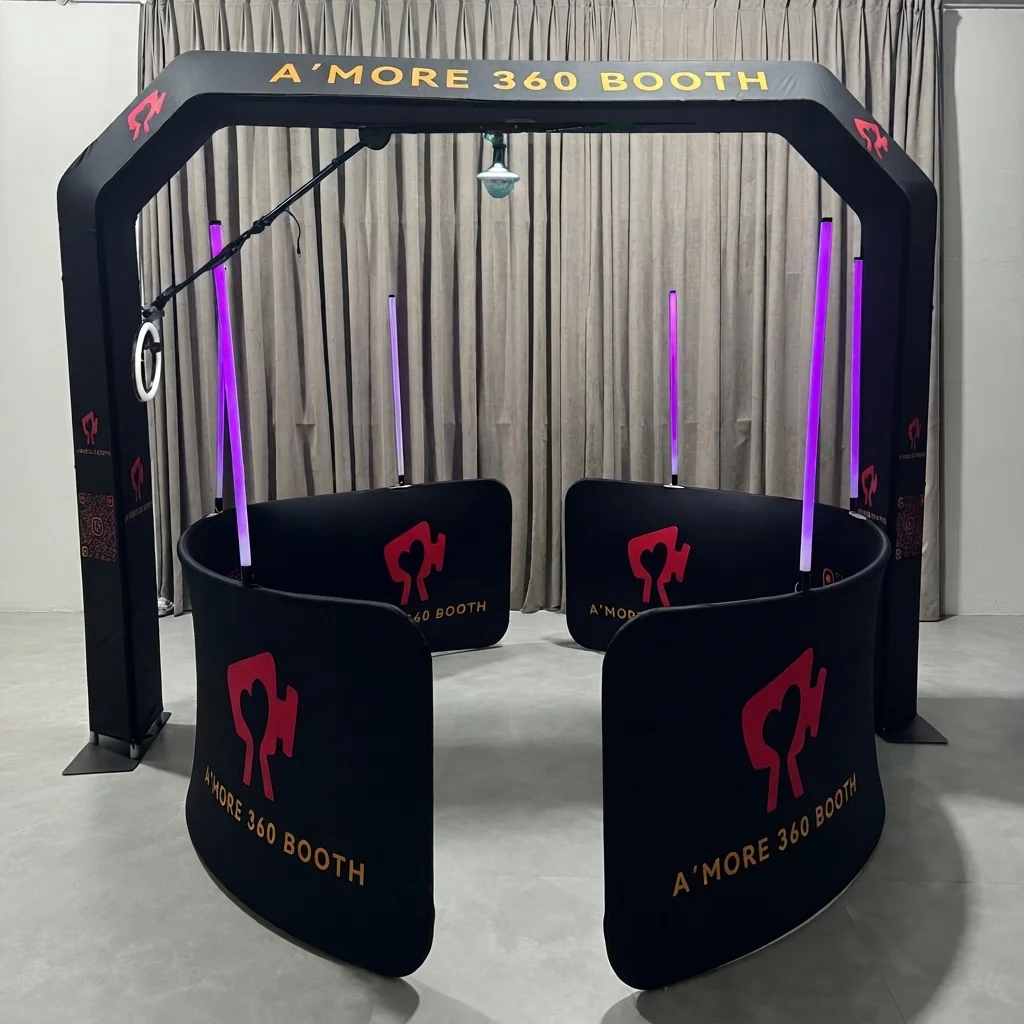
The 360 photo booth earns money differently from every other booth in your fleet. A mirror booth profits on volume, processing 40 to 60 guests an hour. A 360 booth serves 15 to 25 guests an hour and still charges more. That inversion is the whole story of the 360 photo booth ROI.
The 360 sells a shareable video, a slow-motion clip guests post the moment they get it. That social value is what lets operators charge $ 900-$ 2,000 per event for a machine that serves fewer guests than a $ 700 mirror booth. It is a high-ticket, low-frequency asset, and the math only works when you understand that.
This guide runs the numbers: what a 360 costs, what it rents for, how fast it pays back, and the hidden costs that decide whether the investment is smart.
What a 360 Photo Booth Costs to Buy
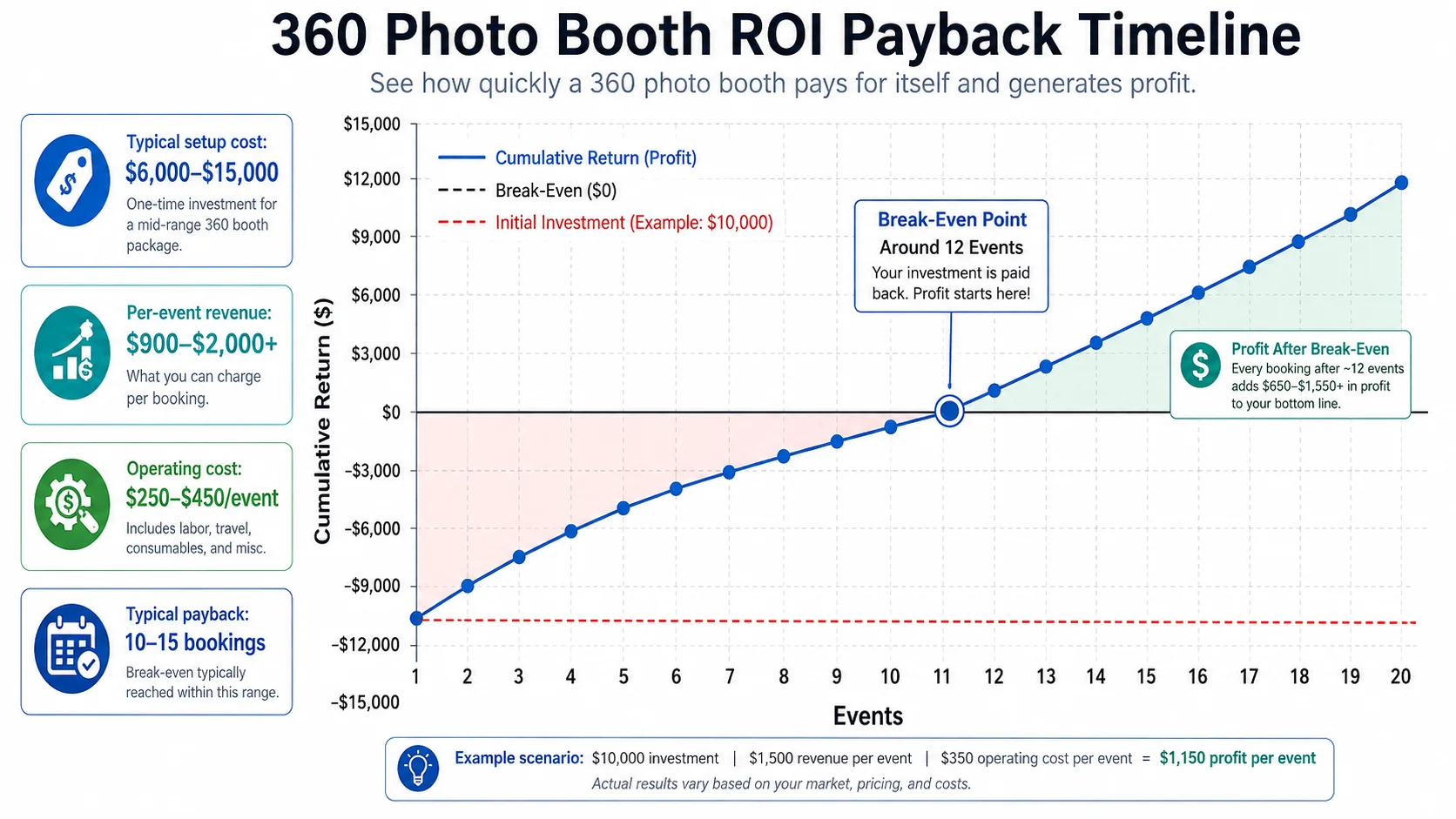
The purchase price of a 360 photo booth lands between $ 6,000 and $ 15,000 as an industry estimate based on current market listings. That covers the rotating arm, camera, lighting ring, platform, and control software.
The lighting ring is a meaningful chunk on its own, roughly $ 1,500-$ 3,000, and it is not optional if you want the signature slow-motion look. Entry-level packages bring the full equipment investment down to around $ 5,000-$ 8,000, which is where most budget-conscious operators start.
What drives the price is the hardware complexity. A 360 booth has a moving arm, a stabilized camera, and a lighting system that a static booth does not. That is also why it rents for more, which we cover next. For the full equipment and feature breakdown, see the 360 photo booth guide.
Fact: BiaoMing (Event Golden) manufactures overhead and ground 360 photo booths, TÜV Rheinland certified, with CE, RoHS, FCC, LVD, and CB product certifications.
Rental Rates and Revenue per Event
The 360 booth commands the highest rental rate in the photo booth category. A 3-hour base package runs $ 600-$ 900, and a full event runs $ 900-$ 2,000+, based on 2026 rental listings. Premium markets also charge hourly rates of $ 200-$ 500.
That puts the 360 roughly 20-30% above a mirror booth per event. The premium comes from production value and social reach. A client who wants video content that gets posted and shared will pay for the 360; a client who wants printed keepsakes buys the mirror. That split is covered in the 360 vs mirror comparison.
The revenue question for ROI is not the headline rate. It is contribution per event, which is the rate minus what it costs you to deliver it.
The ROI Math: Payback Timeline
The core equation is purchase cost divided by contribution per event.
Take a $ 10,000 360 setup, the midpoint of the $ 6,000-$ 15,000 range. Operating it costs $ 250-$ 450 per event once you account for the operator, transport, software, and maintenance, which is an assumption based on the booth needing a trained operator and a dedicated vehicle. Against a $ 1,400 mid-range rental, that leaves roughly $ 950-$ 1,150 in contribution per event.
At that rate, the booth pays for itself in about 10 events. That matches the 10-15 event payback range reported for 360 booths. Operators booking premium events at $ 1,500-$ 2,000 recover the cost faster; operators at the low end of the rental range need longer.
| Scenario | Purchase | Rental | Operating cost per event | Contribution | Payback |
|---|---|---|---|---|---|
| Entry level | $ 6,000 | $ 900 | $ 250 | $ 650 | ~9 events |
| Mid-range | $ 10,000 | $ 1,400 | $ 350 | $ 1,050 | ~10 events |
| Premium | $ 15,000 | $ 2,000 | $ 450 | $ 1,550 | ~10 events |
These figures are illustrative. The operating-cost column is a stated assumption, and every number shifts with your local labor rates and pricing ceiling. The takeaway is the shape: the 360 pays back within a season of steady premium bookings, not a weekend of volume.
Throughput: Why the 360 Earns on Value, Not Volume
The number that defines the 360's economics is 15-25 guests per hour. Each capture takes 2-3 minutes because the arm rotates, the guest repositions, and the clip renders.
That low throughput would be fatal for a volume business, but the 360 is not a volume business. It is a highlight business. A 360 booth at an entrance or on a dance floor serves a fraction of the guests while the rest of the crowd watches and records them. The output is the product, and the output is a video that gets posted.
This is why the 360's payback comes from per-event pricing, not event count. You cannot stack three 360 bookings into a Saturday the way you can stack LED dance floors. You make the money on the premium, which is exactly what the how to start a 360 business guide walks through.

Overhead vs Ground: Which Pays Back Faster
The choice between an overhead and a ground 360 booth changes the ROI, and it is worth deciding before you buy.
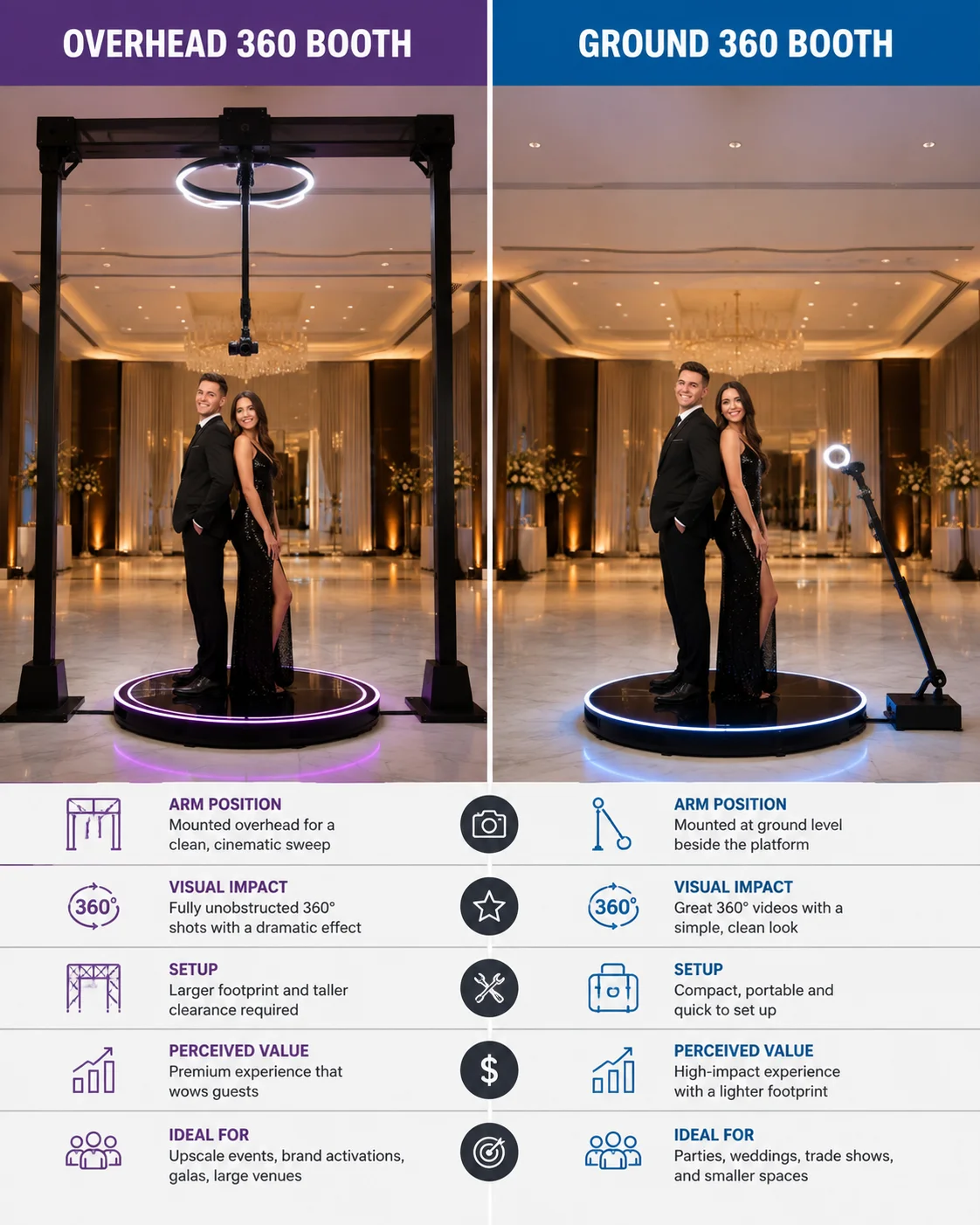
An overhead booth mounts the rotating arm above the platform, producing a cleaner, more cinematic sweep. It suits brand activations and premium weddings, and it typically rents for more. The tradeoff is a heavier, more complex rig that takes longer to set up.
A ground booth is lighter, easier to transport, and faster to assemble. It may not command the overhead's top rates, but lower cost and faster turnaround can mean a quicker payback on volume.
The honest answer is that overhead earns more per event and ground pays back faster per dollar. If your market has brand-activation demand, buy overhead. If you are building a wedding-focused fleet on a budget, ground gets you to break-even sooner.
Hidden Costs: Software, Operator, and Brand Overlays
The purchase price is not the whole cost, and the operators who lose money on a 360 booth usually lose it to the costs they did not plan for.
Software is the quiet one. The booth runs on control and editing software that often carries a subscription, plus you need someone who knows how to operate it. A trained operator is close to mandatory for a 360 booth, unlike a static booth that guests can mostly run themselves.
Brand overlays are another line item. Clients want their logo, colors, or event name in the video, which means design time per booking. Spare parts matter too: lighting rings and platform components wear, and a downed booth on a booked weekend is a lost premium booking.
Setup takes 60-90 minutes and needs a 10x10 ft or larger clear area, so factor crew time and travel into every event. Together, these add the $ 250-$ 450 per event we assumed in the ROI table above.
Bundling and Upsell Strategies
The 360 booth is the highest-value single item in a photo booth fleet, and it bundles well with the assets around it.
The most common pairing is the 360 plus a mirror booth. The mirror handles the main guest flow and printed keepsakes while the 360 sits at the entrance as the social media highlight, and the two book as a package with one crew. A 360 paired with an LED dance floor works the same way, anchoring the room visually while the booth captures the moment.
Bundling raises the average ticket and smooths the 360's lower throughput. The premium video asset justifies the higher package price, and the volume asset fills the schedule. That is the practical way to make a 360 booth earn at its ceiling.
Fact: BiaoMing exports 360 photo booths to over 200 countries, with North America at 55% of sales and Western Europe at 17%, and provides a 5-year warranty backed by 20+ overseas warehouses.
FAQ
How much does a 360 photo booth cost to buy?
A complete 360 photo booth setup typically runs $ 6,000-$ 15,000, which is an industry estimate based on current market listings. That covers the rotating arm, camera, lighting ring, platform, and control software. The lighting ring alone adds roughly $ 1,500-$ 3,000. Budget-conscious operators report full equipment investments around $ 5,000-$ 8,000 for entry-level packages.
How much can I charge to rent a 360 photo booth?
A 360 photo booth typically rents for $ 600-$ 900 for a 3-hour base package and $ 900-$ 2,000+ for a full event, based on 2026 rental listings. Premium markets also charge $ 200-$ 500 per hour. The 360 commands roughly 20-30% more per event than a mirror booth, reflecting its higher production value and social media reach.
How long does it take to pay off a 360 photo booth?
A 360 photo booth typically pays for itself in 10-15 events. On a $ 10,000 setup clearing $ 700-$ 1,000 per event after variable costs, that is roughly 10-14 events. Operators running premium bookings at $ 1,500-$ 2,000 per event can recover the cost faster. The payback depends on your market's pricing ceiling and how many high-value bookings you can land.
Is a 360 photo booth a good investment?
For operators targeting weddings, nightclubs, and brand activations, yes. The 360 booth is a premium asset that earns on value rather than volume, and it rents for more than a standard photo booth. The tradeoff is a longer payback than a mirror booth because the purchase price is higher and throughput is lower. It pays off fastest when social media exposure is what clients are buying.
What is the profit margin on a 360 photo booth?
Gross margin per event typically runs 50-85% depending on your cost structure, based on photo booth industry data. A $ 1,400 rental with $ 250-$ 450 in operating costs (operator, transport, software, maintenance) leaves roughly $ 950-$ 1,150 in contribution. The exact figure depends on whether you staff the booth or run it yourself.
How many guests can a 360 photo booth serve per hour?
A 360 photo booth serves 15-25 guests per hour, because each capture takes 2-3 minutes including rotation and repositioning. That is much slower than a mirror booth's 40-60 guests per hour. The lower throughput is by design: the 360 creates a highlight moment and a shareable video, while the surrounding crowd becomes the audience.
What are the hidden costs of a 360 photo booth business?
Beyond the booth itself, budget for software subscriptions, a trained operator, transport vehicle, brand overlay design, and spare parts like lighting rings and platform components. Setup takes 60-90 minutes and needs a 10x10 ft or larger clear area, so factor in crew time and travel. These costs add roughly $ 250-$ 450 per event on top of the purchase price.
Should I buy an overhead or ground 360 photo booth?
It depends on your market and transport. Overhead booths mount the arm above the platform and produce a cleaner, more cinematic sweep, which suits brand activations and premium weddings. Ground booths are typically lighter and easier to move. For ROI, overhead booths often command a higher rental rate, but ground booths may pay back faster on volume due to lower cost and faster setup.
Conclusion
The 360 photo booth is a premium asset with a premium payback profile. It costs more than a mirror booth and serves fewer guests per hour, but it rents at the top of the category and pays for itself within 10-15 premium bookings.
The math only works when you sell what the 360 actually sells: a shareable video and the social reach that comes with it. Buy it for brand activations, nightclubs, and premium weddings, bundle it with a volume asset, and the numbers hold.
Explore the BiaoMing 360 photo booth range to compare overhead and ground models and run your own payback math with a quote.
Sources
- BiaoMing (Event Golden). "360 Photo Booth." Event Golden product page. https://eventgolden.com/products/overhead-360-photo-booth/: Manufacturer specifications and overhead/ground model configuration.
- Orama Productions; Baltimore Sound; Event Brothers Co. (2026): published 360 photo booth rental pricing. Cited in the rental-rate ranges above.
- Happy Events US. 360 photo booth hourly pricing in premium markets, $ 200-$ 500 per hour.
- Snappic. "How to Start a Photo Booth Business." Startup costs $ 3,500-$ 25,000 with 50-85% margins; 360 lighting ring $ 1,500-$ 3,000.
- Simple Booth. Photo booth revenue benchmark of $ 50,000 per year per booth.
- The Glamour Booth. 360 photo booth investment range of $ 3,500-$ 10,000.
Note: Purchase-price and rental-rate figures are industry estimates drawn from the sources above and current market listings. The per-event operating cost ($ 250-$ 450) and the resulting contribution and payback figures in the ROI table are stated assumptions for illustration, not sourced data. Actual results depend on local labor, transport, and pricing.
Ready to start your event business?
Get a free wholesale quote within 24 hours. Product details are confirmed by direct inquiry.
Get a Free Quote