Mirror vs. iPad Photo Booth: Which Should You Buy First?
Mirror vs iPad photo booth compared: purchase cost, pricing model, portability, setup time, ROI timeline, and which events each fits best.
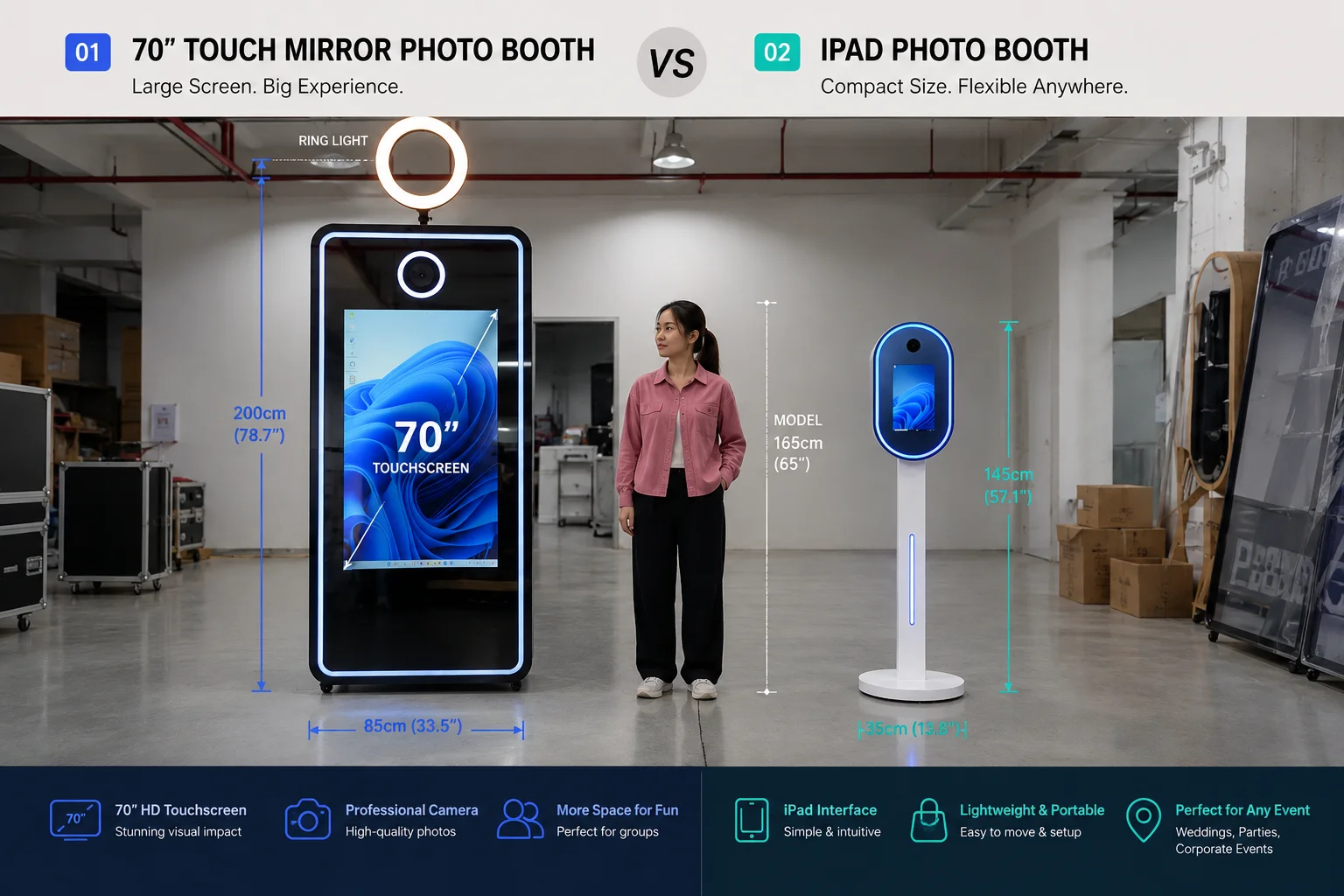
Ask a rental operator whether to buy a mirror booth or an iPad booth, and you get a version of "it depends." But it depends on something most comparison articles never name: these are two different business models, not two versions of the same product.
A mirror booth is a premium event centerpiece that books for $ 700 to $ 1,500 per wedding. An iPad booth is a portable social station that books for $ 100 to $ 150 an hour, four or five times a weekend. One earns more per booking. The other books more often.
This guide breaks down the real difference: purchase cost, pricing model, setup, portability, and ROI timeline, so you can decide which one to buy first.
Two Different Business Models
The mirror booth and the iPad booth sit at opposite ends of the photo booth market.
| Dimension | Mirror Photo Booth | iPad Photo Booth |
|---|---|---|
| Business model | Premium, per-event pricing | Volume, per-hour pricing |
| Purchase cost | $ 4,000 to $ 8,000 | $ 1,500 to $ 3,000 |
| Typical rental | $ 700 to $ 1,500/event | $ 400 to $ 1,000/event, or $ 100 to $ 150/hr |
| Setup time | 45 to 60 minutes | 15 minutes |
| Transport | Van or SUV, often two people | Fits in a car trunk |
| Centerpiece factor | High, interactive touchscreen | Low, social station |
| Best events | Weddings, galas, milestones | Birthdays, school events, trade shows |
The mirror booth is an experience. Guests gather around a 70-inch touchscreen, trigger animations with gestures, and leave with a printed photo. It commands premium pricing because it is the focal point of the event.
The iPad booth is a utility. Guests tap a screen, take photos, get digital files and GIFs. It books at a lower price but turns over fast, because setup is 15 minutes and transport fits in a car.
Fact: BiaoMing (Event Golden) manufactures mirror photo booths with 70-inch touchscreens and iPad photo booths supporting 12.9-inch iPad Pro, TÜV Rheinland certified.
What Each Booth Delivers
The hardware difference drives everything else.
Mirror photo booth. A large touchscreen set in a mirror-finish frame, with a built-in camera, studio lighting, and a dye-sublimation printer. Guests see their reflection, touch the screen to start, and are guided through animations, filters, and signing options. The output is a printed photo strip plus digital copies, and the gesture-driven interface is the selling point. Full spec details are in our Mirror Photo Booth guide.
iPad photo booth. An iPad Pro mounted in a shell or on a stand, paired with photo booth software. Guests tap through the app, take photos or boomerangs, and receive digital files, with optional printing via a connected printer. The iPad supplies the screen, camera, and processing, which is why the hardware is cheap and light. Setup and features are covered in our iPad Photo Booth guide.
Purchase Cost Comparison
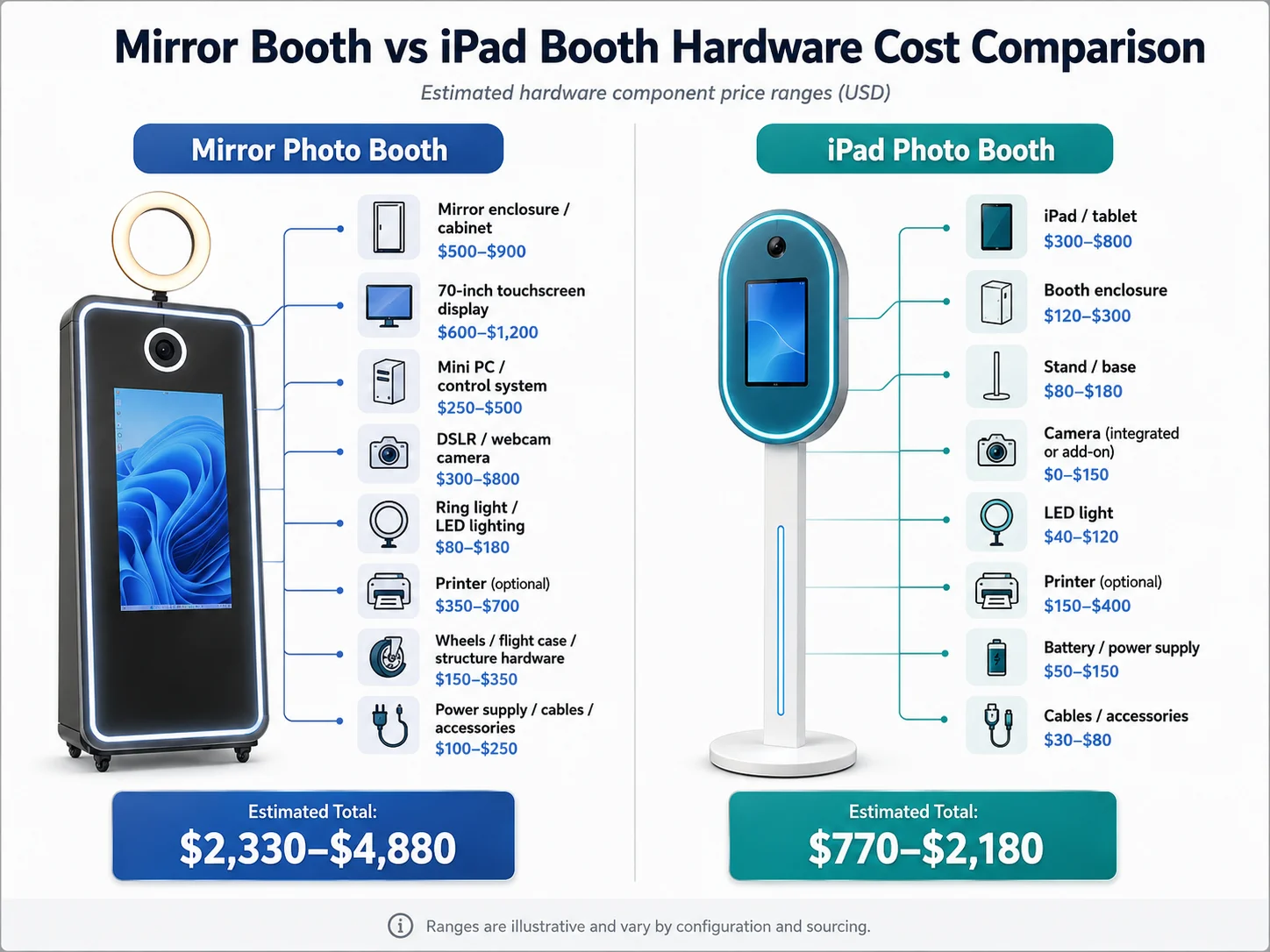
The price gap is the first decision driver.
| Item | Mirror Booth | iPad Booth |
|---|---|---|
| Core hardware | $ 4,000 to $ 8,000 | $ 1,500 to $ 3,000 |
| Touchscreen | Included (70-inch) | Customer-supplied iPad (12.9-inch) |
| Printer | Included (dye-sub) | Optional ($ 300 to $ 800) |
| Lighting | Built-in studio lighting | Optional ring light |
| Enclosure | Glass mirror frame | Shell or stand |
| Total to start | $ 4,000 to $ 8,000 | $ 1,500 to $ 3,000 + iPad |
The mirror booth is two to three times the cost, mostly because of the large touchscreen and the glass mirror surface. The iPad booth leans on the iPad for the expensive parts, which is exactly why it is the lower-risk entry point. Purchase price ranges are industry estimates based on current market listings; confirm exact quotes with suppliers.
Note the iPad cost is not included in the booth price, because most operators already own one or can buy a 12.9-inch iPad Pro separately. That shifts the effective start cost, but even adding the iPad, the booth is roughly half the price of a mirror.
Rental Pricing: Per-Event vs. Per-Hour
This is where the two models diverge hardest.
Mirror booths price per event. Industry data puts mirror booth rentals at $ 700 to $ 1,500 per event (Photobooth International, 2025). Clients book it as a premium feature for a 4 to 6 hour wedding or gala, and the price is set for the event, not the hour.
iPad booths price per hour or per event. iPad booth listings run $ 400 to $ 1,000 per event, or $ 100 to $ 150 per hour with a 3-hour minimum (r/Entrepreneur operator reports, 2023). The hourly model lets operators stack multiple short bookings in a single day.
The revenue difference in practice:
| Scenario | Mirror Booth | iPad Booth |
|---|---|---|
| One premium wedding | $ 1,200 | $ 800 (if booked at all) |
| One busy Saturday (3 events) | 1 event, $ 1,200 | 3 events, $ 900 total |
| One trade show day (hourly) | Not typical | 8 hours, $ 1,000 |
The mirror booth wins per booking. The iPad booth wins on volume and flexibility. Which matters more depends on your market: a wedding-heavy market favors the mirror; a party and corporate market favors the iPad.
Fact: BiaoMing exports mirror and iPad photo booths to over 200 countries, with 55% of sales to North America and 17% to Western Europe.
Setup, Portability, and Crew
Mirror booth setup: 45 to 60 minutes. Position the mirror, level it, connect the camera, printer, and lighting, calibrate the touchscreen. Transport needs a van or SUV, and the glass mirror means two people and careful handling. The booth cannot be rushed without risking the glass.
iPad booth setup: 15 minutes. Unfold the stand, attach the iPad, plug in power. Transport fits in a standard car trunk. One person handles the entire load-in and load-out.
The practical impact: an iPad booth lets you run three events in a day with one person and one car. A mirror booth means one event per vehicle and two people, which caps your daily volume.
Which Events Each Fits Best
| Event Type | Better Choice | Why |
|---|---|---|
| Wedding (upscale) | Mirror | Premium centerpiece, gesture interaction, printed keepsakes |
| Wedding (budget) | iPad | Lower cost, still delivers digital photos |
| Corporate gala | Mirror | Brand impression, premium experience |
| Birthday party | iPad | Fast setup, low cost, casual fun |
| School event / prom | iPad | High throughput, one operator |
| Trade show booth | iPad | Compact, hourly pricing, lead capture |
| Milestone party (50th, bar mitzvah) | Mirror | Premium keepsake the client will frame |
The practical play: most operators run both. The iPad booth handles the volume bookings, and the mirror booth takes the premium weddings. They rarely compete for the same booking because clients self-select by budget.
ROI Timeline Compared
Here is the payback math for each, using industry data.
iPad booth:
- Purchase: $ 2,200 (mid shell + ring light + printer)
- Net per booking: $ 500 (after labor and consumables)
- Payback: about 4 to 5 bookings
Mirror booth:
- Purchase: $ 6,000 (mid build with lighting and printer)
- Net per booking: $ 900 (after labor and consumables)
- Payback: about 7 bookings
| Metric | iPad Booth | Mirror Booth |
|---|---|---|
| Purchase cost | $ 1,500 to $ 3,000 | $ 4,000 to $ 8,000 |
| Net per booking | $ 400 to $ 600 | $ 700 to $ 1,100 |
| Bookings to payback | 3 to 6 | 6 to 10 |
| Cash velocity | Fast (low price, high volume) | Slower per unit, higher per booking |
The iPad booth pays for itself in fewer bookings, but each booking earns less. The mirror booth earns more per booking but needs more bookings to clear its higher price. Over a year, a mirror booth in a wedding-heavy market can out-earn an iPad booth; in a volume market, the iPad booth wins on total cash generated.
For the operator deciding what to buy first, the answer is usually the iPad booth: lower risk, faster cash, and it funds the mirror purchase later. The mirror booth is the right first buy only when your market already has strong, consistent wedding demand.
Fact: BiaoMing provides a 5-year warranty on mirror and iPad photo booths with 20+ overseas warehouses for fast spare parts delivery.
Frequently Asked Questions
What is the difference between a mirror and an iPad photo booth?
A mirror booth is a full-size interactive booth built around a 70-inch touchscreen, producing printed photos and digital shares with gesture-driven animations. An iPad booth is a lightweight station around a 12.9-inch iPad, producing digital photos and GIFs. The mirror is a premium centerpiece; the iPad is a portable social station.
How much does a mirror photo booth cost vs an iPad booth?
A mirror booth costs $ 4,000 to $ 8,000, driven by the large touchscreen and glass surface. An iPad booth costs $ 1,500 to $ 3,000 because it uses a customer-supplied iPad and a simple shell. The mirror is two to three times the price.
What rental rates can I charge for a mirror vs an iPad booth?
Mirror booths command $ 700 to $ 1,500 per event as a premium wedding feature. iPad booths rent for $ 400 to $ 1,000 per event, or $ 100 to $ 150 per hour with a 3-hour minimum. The mirror earns more per booking; the iPad books more often.
Which photo booth should I buy first for my rental business?
Most operators should start with an iPad booth: lower cost, fits in a car, 15-minute setup, wide event coverage. Add the mirror booth once you have consistent wedding and upscale bookings. Buy the mirror first only if your market is already strong on high-end weddings.
How long does each booth take to set up?
An iPad booth sets up in about 15 minutes. A mirror booth takes 45 to 60 minutes and often needs two people and a larger vehicle.
Which booth is more portable?
The iPad booth is far more portable, fitting in a standard car trunk. The mirror booth is a large glass unit needing a van or SUV and careful handling.
What events is each booth best for?
Mirror booths win at weddings, galas, and milestone parties. iPad booths win at birthdays, school events, trade shows, and budget weddings. Many operators run both: iPad for volume, mirror for premium.
What is the ROI difference between mirror and iPad booths?
The iPad booth pays for itself in 3 to 6 bookings but earns less each time. The mirror booth earns more per booking but takes 6 to 10 bookings to pay off. Over a year, a mirror booth can out-earn an iPad booth in wedding-heavy markets; the iPad booth is the faster-cash, lower-risk entry point.
How to Choose
The decision is a business-model decision, not a feature comparison.
Buy the iPad booth first if: you are new to the rental business, want low risk and fast cash, serve parties and corporate events, or need to run multiple events per day with one person and one car.
Buy the mirror booth first if: your market is already rich with upscale weddings, you can charge premium rates from day one, and you are building a premium brand rather than a volume operation.
The most common path: start with the iPad booth, prove the market, then add the mirror booth as the premium tier once wedding bookings justify it. The two booths then serve different clients at different price points, and neither cannibalizes the other.
To explore either booth for your fleet, visit the BiaoMing Mirror Photo Booth or iPad Photo Booth product pages, or contact the team for a quote.
Browse related: Mirror Photo Booth Guide | iPad Photo Booth Guide | Magazine Photo Booth | 360 Photo Booth
Sources
- Photobooth International. "Mirror Booth vs Traditional Photo Booth: Which Wins?" (2025). photoboothint.com, Mirror booth rates $ 700 to $ 1,500/event; traditional booths $ 400 to $ 1,000/event.
- r/Entrepreneur. "I run a photo booth rental business." (2023). reddit.com, iPad booth hourly pricing $ 100+/hour with 3-hour minimums.
- LA Photo Party. "Portable vs. iPad Photo Booths: Which Should You Buy?" (2026). laphotoparty.com, iPad booths are a lower-cost entry point; portable booths have a larger hardware stack.
Ready to start your event business?
Get a free wholesale quote within 24 hours. Product details are confirmed by direct inquiry.
Get a Free Quote