Custom Event Equipment from China: An RFQ Template for Rental Businesses
Fill-in RFQ template for custom event equipment from China: what to specify across booths, LED displays and dance floors, and what to confirm in writing.
Custom Event Equipment from China: An RFQ Template for Rental Businesses
Send five Chinese factories the same one-line email and you will get five quotations you cannot compare. Custom event equipment from China is priced against a written specification, and a rental operator who has not written one is comparing guesses dressed up as prices. This template is the document to complete before you ask anyone for a quote.
The goal is not a longer email. It is a set of fields that forces every supplier to answer the same questions, in the same order. Fill it once and reuse it for every category you buy, from photo booths to LED walls to dance floors.
Why a Written RFQ Beats a Price Request
Most rental businesses open with a request for a price, and most suppliers answer it with whatever they have in stock. That is not a quotation for your product; it is a quotation for the supplier's default product.
An RFQ changes the conversation in three ways at once. It forces you to decide what you actually need, it gives every supplier the same baseline to quote against, and it produces a document both sides can refer to if the delivered goods differ from what was promised.
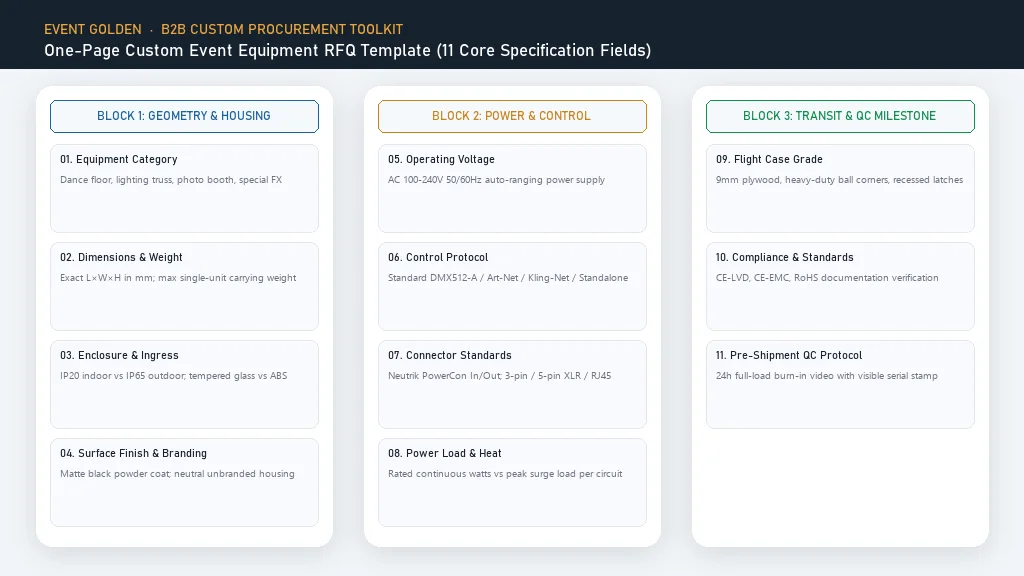
The template below covers eleven fields, and none of them is a price. The specification is what makes a price meaningful in the first place.
The Full RFQ Field List
Every field answers something the factory would otherwise have to guess at. The table shows what each one controls.
| # | Field | What you must state | What it controls |
|---|---|---|---|
| 1 | Use case and scenario | Indoor or outdoor, frequency of use, operator | Product grade and durability |
| 2 | Destination country and certification | Country, plus required marks | Which certificates apply |
| 3 | Product model and configuration | Category, size, key parameters | The bill of materials |
| 4 | Quantity and batches | First order, repeat orders, delivery split | Allocation and packaging |
| 5 | Brand files | Logo, packaging, manual, artwork | Setup cost and lead time |
| 6 | Hardware and software boundary | What is included, what is not | Total cost of ownership |
| 7 | Interfaces and compatibility | Control protocol, existing equipment | Whether it integrates |
| 8 | Power and voltage | Voltage, frequency, plug type | Usability in your market |
| 9 | Packaging and shipping | Flight case or carton, sea or air | Freight cost and damage risk |
| 10 | Target arrival date | The date you need it in hand | Production scheduling |
| 11 | Acceptance method and criteria | Who checks what, against which standard | Dispute resolution |
Fact: Event Golden (EventGolden) is a TÜV Rheinland certified manufacturer of LED dance floors, LED displays and photo booths, holding CE, RoHS, FCC, LVD and CB product certifications and supporting OEM and ODM customization.
The rest of this guide takes the fields one at a time, then shows three completed examples.
Field 1: Use Case and Scenario
A booth that travels to three weddings a weekend and one that sits permanently in a hotel lobby have different engineering priorities. State the scenario so the factory can recommend the right grade rather than its cheapest one.
Answer four questions up front: where the equipment will be used, who operates it, how often it moves, and what the audience does with it. Weather, floor surface and audience density all shift the specification, so an unusual setting such as a coastal venue or a gravel outdoor site belongs in this field too.
Field 2: Destination Country and Certification
Certification is decided by where you sell, not by what the factory prefers. State your destination country and every market you plan to expand into, because a certificate valid for one region is worth nothing in another.
For the European Union, CE and RoHS are the baseline, with LVD covering electrical safety [2]. For the United States, FCC matters for wireless components [3]. A TÜV Rheinland certification is an independent third-party signal rather than a self-declaration [4].
Ask which certificates the supplier can issue, in whose legal name, and for which markets. Then verify the certificate number with the issuing body rather than accepting a PDF [4].
Fact: Event Golden exports custom event equipment to over 200 countries, with North America at 55% of sales and Western Europe at 17%, backed by a 5-year warranty and 20+ overseas warehouses.
Field 3: Product Model and Configuration
This is the field buyers fill in most confidently and get wrong most often. Naming a category is not a configuration.
Specify the model or the target parameters, the dimensions, and the performance figures that matter for your use. For an LED display, that means pixel pitch and cabinet size. For a 360 photo booth, it means reach and payload.
Label any figure that is a target rather than a hard limit, so the supplier can propose a cheaper build that still does the job.
Fields 4 and 5: Quantity, Batches, and Brand Files
Quantity is not one number. State the first order, the expected repeat volume, and whether you want the goods shipped in one batch or split across dates.
Batches matter because they change packaging and production allocation, and a split delivery lets you test before committing the full budget.
Brand files are the other half of this field. List every asset you want applied: logo on the product, logo on the packaging, a printed manual, and a rating label. Ask which assets carry a one-time setup charge and which carry a separate repeat minimum, because they are rarely the same.
Field 6: The Hardware and Software Delivery Boundary
This is the field that decides your real cost, and the one most RFQs omit. "Includes software" can mean anything from a full control application to nothing at all.
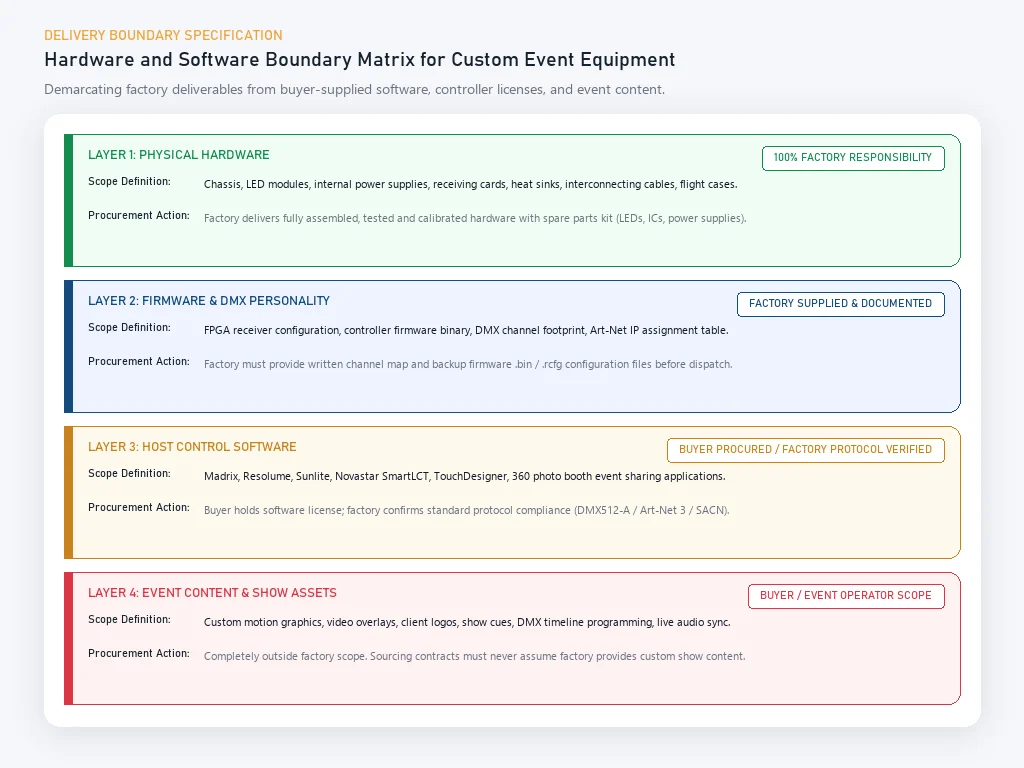
Draw the boundary explicitly. List what ships in the box, what is licensed separately, what you must supply yourself, and what the supplier will not support. The table below is a starting point.
| Item | Included / Excluded / To confirm |
|---|---|
| Physical hardware (units, panels, arms) | Included in the quotation |
| Control box or controller | Confirm the quantity per unit |
| Control software or app | Confirm the licence, updates and term |
| Content creation tools | Usually your responsibility |
| Spare parts and consumables | Confirm the first-order allowance |
| Firmware updates | Confirm the method and duration |
| Training or documentation | Confirm the format and language |
Two boundary questions catch rental businesses repeatedly. First, who owns and updates the software, and for how long. Second, what happens to the equipment if that software stops being supported.
Where a capability is claimed but not proven, require a demonstration rather than a description. Control methods such as sound activation, DMX512 and wireless remote are published capabilities, but features like video playback, pixel-level addressing and arbitrary logo display must be shown on the actual unit, not inferred from a control-method list. Buyers weighing a photo booth fleet can cross-check the specification against the photo booth manufacturer guide before they commit.
Fields 7 and 8: Interfaces, Compatibility, Power and Voltage
Interfaces decide whether the new equipment joins your existing setup or forces you to buy a second ecosystem. State the control protocol you already use and the equipment it must talk to.
If you run a mixed fleet, describe it. A supplier who knows you already control other units over DMX512 can tell you quickly whether a new controller is compatible, and that answer changes the total price.
Power and voltage are the field that ruins an otherwise good order. State your market's voltage, frequency and plug type, and ask whether the quoted unit is built for that configuration or needs a converter. Never assume a default voltage matches your venue.
Fields 9 and 10: Packaging, Shipping, and Target Arrival Date
Packaging is both a cost and a protection decision. State whether you want flight cases or cartons, whether the cases are branded, and how the goods will travel by sea or air.
The choice changes freight volume, damage risk and how the equipment survives its first tour. A rental product that ships in a carton looks cheaper until the first dented panel arrives.
Give a target arrival date, not only a desired shipping date. Arrival is what the factory schedules production against and what you plan your bookings around, and any date stays subject to written confirmation until it is on paper.
Field 11: Acceptance Method and Acceptance Criteria
Define acceptance before the goods leave the factory, not after they arrive. The cheapest place to find a problem is the supplier's floor.
State who inspects, against which document, and what counts as a pass. A third-party pre-shipment inspection is the single most effective clause a rental buyer can add, because it catches a process problem before every unit after it inherits the same fault.
Two conditions always apply to a custom order. Installation, rigging, loading and electrical design must be confirmed by a qualified professional on site. Live performance, whether that is a display in daylight or a booth under event lighting, must be tested rather than assumed from a specification.
Filled Examples Across Three Product Lines
The template is only useful if you can see it completed. The three examples below show how the same eleven fields read for different categories.
These examples are illustrative only. They are not real order terms, and every figure, quantity and date in them is a placeholder to be replaced with your own requirements. Commercial terms, minimums and lead times are always subject to written confirmation.
Example 1: A 360 Photo Booth for a European Rental Fleet
| Field | Example entry (illustrative, not a real order) |
|---|---|
| Use case | Indoor weddings and corporate events, unit travels weekly |
| Destination and certification | Germany, EU; CE and RoHS required |
| Model and configuration | 360 photo booth, overhead type, reach and payload to be confirmed against venue sizes |
| Quantity | A first order plus a repeat batch, split delivery |
| Brand files | Logo on the enclosure and on the software startup screen |
| Hardware and software boundary | Booth, arm and controller included; software licence term to confirm |
| Interfaces | Tablets and printers the operator already owns |
| Power | EU voltage, frequency and plug type |
| Packaging and shipping | Flight case, sea freight |
| Target arrival | Before the season, date to confirm |
| Acceptance | Third-party pre-shipment inspection against a signed specification sheet |
Example 2: An LED Display for a Rental Inventory
| Field | Example entry (illustrative, not a real order) |
|---|---|
| Use case | Stage backdrop rental, indoor and covered outdoor |
| Destination and certification | United States; FCC required |
| Model and configuration | LED display, indoor rental cabinet, pixel pitch and cabinet size to confirm |
| Quantity | Modules plus a spare allowance, single batch |
| Brand files | Logo on flight cases and the manual |
| Hardware and software boundary | Cabinets, power and data included; processor and content tools to confirm |
| Interfaces | Existing sending system and signal chain |
| Power | US voltage, frequency and plug type |
| Packaging and shipping | Road cases, air freight for the first order |
| Target arrival | Show date, to confirm |
| Acceptance | Pre-shipment inspection plus an on-site test before the first show |
Example 3: An LED Dance Floor for a Venue Operator
| Field | Example entry (illustrative, not a real order) |
|---|---|
| Use case | Fixed venue floor plus occasional off-site hire |
| Destination and certification | United Kingdom; CE and RoHS required |
| Model and configuration | Magnetic LED dance floor, panel size and quantity to confirm against floor area |
| Quantity | First order sized to one room, expansion later |
| Brand files | Logo on the control case and the outer carton |
| Hardware and software boundary | Panels and control included; effect library and updates to confirm |
| Interfaces | The control method the operator already uses |
| Power | UK voltage, frequency and plug type |
| Packaging and shipping | Flight case, sea freight |
| Target arrival | Before the venue season, date to confirm |
| Acceptance | Pre-shipment inspection; loading and electrical confirmed on site |
The three examples differ in almost every line, which is the point: one template handles all of them, and the factory reads a different specification for each.
If you are building a private label arrangement on top of the specification, the LED dance floor OEM and private label guide covers the branding layers and the certificate ownership questions in far more detail than a general template can.
What Missing Information Makes Quotes Incomparable
A quotation is only comparable if the fields behind it are filled in. The table below shows which omissions do the most damage.
| Missing field | What the supplier does instead | Result |
|---|---|---|
| Certification and destination | Quotes its default configuration | A price for a product you may not be able to import |
| Configuration detail | Prices the nearest stock model | Specifications drift from your requirement |
| Quantity and batches | Quotes a single batch | Packaging and freight priced wrong |
| Hardware and software boundary | Assumes software is included, or is not | A late charge or a missing licence |
| Power and voltage | Ships its home-market configuration | A converter, or a rejected shipment |
| Packaging choice | Picks the cheapest option | Higher damage risk in transit |
| Acceptance criteria | Prices no inspection | Disputes settled by argument |
The pattern holds across every line: the more you leave open, the more the supplier fills with its own convenience. Each gap is one more place where two quotations stop being comparable.
Fact: Event Golden has 13 years of manufacturing experience and reports a response time of under 2 hours on its Alibaba storefront (per company data).
FAQ
What is an event equipment RFQ template?
It is a fixed list of questions you send to every supplier so their quotations can be compared line by line. Instead of one free-form email, you complete the same eleven fields for each product, and each supplier answers against the same baseline. The value is not the document itself but the discipline of filling it before you ask for a price.
What should an RFQ for custom event equipment from China include?
At minimum: use case and scenario, destination country and required certification, product model and configuration, quantity and batches, brand files, the hardware and software delivery boundary, interfaces and compatibility, power and voltage, packaging and shipping method, target arrival date, and acceptance method and criteria. Any field you leave blank is a field the supplier fills in with its own default.
Why do quotes for custom event equipment come back incomparable?
Because the supplier completed the gaps in your brief with its own assumptions. If you do not specify certification, it quotes for its home model. If you do not define the software boundary, it assumes software is included, or assumes it is not. Every unanswered field moves two quotations further apart, so the two numbers stop describing the same product.
How do I define the boundary between hardware and software in an RFQ?
List what ships in the box, what is licensed separately, what you must supply yourself, and what the supplier will not support. Confirm who owns and updates the software and for how long. Where a capability is claimed but unproven, require a live demonstration on the actual unit rather than a description in a specification sheet.
What certification information should I give a Chinese supplier?
State your destination country and every market you plan to expand into, because a certificate valid for one region is worth nothing in another. Ask which certificates the supplier can issue, in whose legal name, and for which markets. Then verify the certificate number with the issuing body rather than accepting a PDF.
Do I need power and voltage details in an RFQ?
Yes. State your market's voltage, frequency and plug type, and ask whether the quoted unit is built for that configuration or needs a converter. A default voltage that does not match your venue is one of the most common reasons a shipment is unusable on arrival.
How do I set acceptance criteria for a custom event equipment order?
Define acceptance before the goods leave the factory, not after they arrive. State who inspects, against which document, and what counts as a pass. A third-party pre-shipment inspection is the single most effective clause a rental buyer can add, because it catches a process problem before every later unit inherits the same fault.
Can a rental business order custom event equipment across several product lines at once?
Yes, and one template can cover all of them, because the eleven fields apply to a photo booth, an LED display and a dance floor alike. What changes is the configuration detail inside each field, not the structure. Buying multiple categories from one supplier can simplify sourcing, but only if each product still gets its own completed form.
Conclusion
A comparable quote is the product of a complete brief. Fill the eleven fields before you contact anyone, send the same document to every supplier, and the quotations you get back will finally describe the same product instead of eleven different guesses.
The template is deliberately category-neutral. Whether you are sourcing a photo booth, an LED display or a dance floor, the fields stay the same and only the configuration detail changes, which is what makes event rental equipment sourcing across several lines manageable from one desk. Commercial terms, minimums and lead times are never assumed here; they are confirmed in writing, every time.
Fact: Event Golden has 13 years of manufacturing experience and reports a response time of under 2 hours on its Alibaba storefront (per company data).
Start from the full Event Golden product range to see how the categories map to a single supplier, then send your completed template through the contact page and ask the team to quote against it directly.
Sources
- Event Golden (EventGolden). "Products." Event Golden product range. https://eventgolden.com/products/: manufacturer of LED dance floors, LED displays and photo booths, referenced for product categories, certifications, warranty and customization options.
- European Commission. "CE marking." Directorate-General for Internal Market, Industry, Entrepreneurship and SMEs. https://single-market-economy.ec.europa.eu/single-market/ce-marking_en: states that affixing the CE marking is a manufacturer's declaration that a product meets the applicable EU requirements and can be sold throughout the EEA, including for products made outside the EEA; also addresses the responsibilities of manufacturers, importers and distributors.
- U.S. Federal Communications Commission (FCC). "Equipment Authorization." https://www.fcc.gov/: requirements for the authorization of radio-frequency devices, referenced for wireless components in event equipment.
- TÜV Rheinland. "Product certification." https://www.tuv.com/: independent third-party testing and certification, referenced for the verification of certificate numbers.
Ready to start your event business?
Get a free wholesale quote within 24 hours. Product details are confirmed by direct inquiry.
Get a Free Quote