LED Dance Floor OEM: How to Evaluate a Private Label Manufacturing Partner
How to evaluate an LED dance floor OEM or private label partner: what to specify, what to verify, and the terms to confirm with the factory in writing.
LED Dance Floor OEM: How to Evaluate a Private Label Manufacturing Partner
The obvious first question to put to a factory about OEM is whether it can make the product. Almost every factory answers yes, and that answer tells you very little. The question that decides whether the arrangement works is whether the factory can repeat that product under your brand, at your certification standard, without you inheriting liabilities you never priced in.
This guide is an evaluation framework rather than a program description. It sets out what an OEM arrangement actually covers, what to prepare before you ask for a quotation, the eight questions worth asking every candidate, and the terms that need to be in writing. Specific commercial terms are left as items to confirm with the factory, because the answer a factory gives you is the thing you are evaluating.
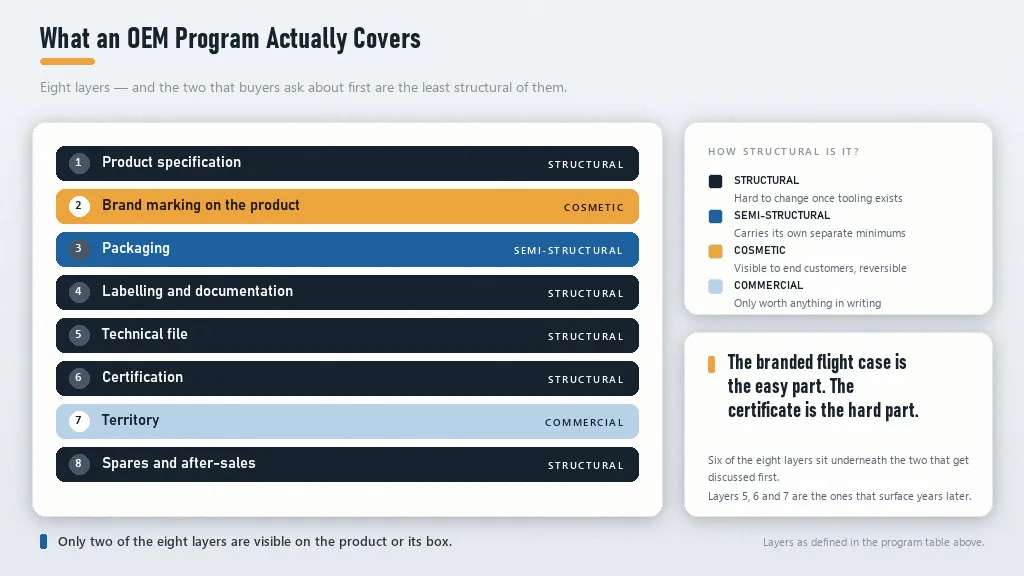
What an OEM or Private Label Program Actually Covers
The word OEM gets used to describe arrangements that differ enormously in scope. Sorting them into layers makes the difference visible, and shows which layers you can negotiate late and which ones have to be settled first.
| Layer | What it covers | How structural is it? |
|---|---|---|
| 1. Product specification | Panel type and size, pixel pitch, IP rating, control protocol, power design | Structural: hard to change after tooling |
| 2. Brand marking on the product | Panel silkscreen, control box badge | Cosmetic but visible to end customers |
| 3. Packaging | Flight cases, outer cartons, inserts, foam | Semi-structural: has its own minimums |
| 4. Labelling and documentation | Rating label, user manual, declarations | Structural: compliance-relevant |
| 5. Technical file | Test reports, declarations of conformity, drawings | Structural: you may need to hold it |
| 6. Certification | Which certificates exist, in whose name, for which markets | Structural: decides where you can sell |
| 7. Territory | Exclusivity scope and duration | Commercial: worthless unless written |
| 8. Spares and after-sales | Panel and connector supply, warranty administration | Structural: decides your reputation |
Two patterns are worth noticing. First, the layers people ask about most, branding and packaging, are the least structural ones. Second, the layers that cause problems years later, the technical file, the certification ownership and the exit terms for tooling, are the ones that are easiest to leave until later.
If you only remember one thing from this section: the branded flight case is the easy part, and the certificate is the hard part.
Prepare Your Spec Pack Before You Ask for Anything
A vague brief produces vague quotations, and vague quotations cannot be compared. Preparing a specification pack before you approach any candidate shortens the process and reveals which suppliers actually read it.
| Item | What you need to state | What happens if you leave it out |
|---|---|---|
| Product type | 3D, magnetic, star, or a combination | Suppliers quote their default, not your product |
| Panel size | 500 x 500 mm or 500 x 1000 mm | Panel count and packing change completely |
| Pixel pitch | Target pitch and acceptable tolerance | Price and viewing performance drift |
| IP rating | Required rating for the assembled cabinet, not the panel | Water ingress becomes a warranty dispute |
| Control protocol | What your existing control workflow uses | You inherit a second, incompatible ecosystem |
| Target markets | Countries you intend to sell into | Certifications get quoted for the wrong region |
| Branding scope | Which of the six branding layers you want | "Yes we do OEM" turns into a late surprise |
| Packaging | Flight case or carton, and whether branded | Freight volume and cost change materially |
| Volume and timing | First order size and when you need it | Lead time gets quoted without an allocation |
| Commercial requirements | Payment structure, inspection rights, warranty expectations | Terms are assumed rather than agreed |
Notice that only one line in that table is about price. The rest is about specification, and specification is what makes quotations comparable.
If you have not yet settled the panel size and quantity for your first build, the panel quantity and specification guide works through that arithmetic, and the type comparison covers the 3D, star and magnetic choice.
Fact: Event Golden manufactures magnetic RGB, 3D abyss and star LED dance floors, supports OEM customization, and holds TÜV Rheinland certification plus CE, RoHS, FCC, LVD and CB compliance.
The Eight Questions to Ask Every OEM Candidate
These are the questions that separate a factory capable of an OEM program from one that will apply a logo and hope for the best. Ask all eight of every candidate, and score the answers rather than the tone they are delivered in.
| Question | A strong answer looks like | A warning sign |
|---|---|---|
| 1. Is the manufacturing in-house, and can I see it live? | A scheduled live walkthrough of the production line and test area, offered without hesitation | A recorded promotional video, or a video call showing only a showroom |
| 2. What is customizable: branding only, or the specification? | A specific list of what can change and what cannot, with reasons | "Anything you want" with no follow-up engineering questions |
| 3. Which certifications can be issued under my brand, and for which markets? | Named certificates, named markets, and a clear statement of what is not possible | A general claim of "all certifications available" |
| 4. Who is named as manufacturer on the certificate and the rating label? | A direct answer naming the legal entity | A deflection, or confusion between the trading name and the legal entity |
| 5. What is the order minimum, and how is it structured? | A written structure: per model, per panel size, per colour, per artwork, per order | A single verbal number, or "low order quantity" with no structure |
| 6. What happens to tooling, artwork and stock if we stop working together? | A clear ownership statement for each asset | Silence, or "that will never be a problem" |
| 7. How do spares and warranty reach my customers? | A described process with lead times and a named contact route | A promise that "we will support you" with no process |
| 8. What territory protection are you offering, in writing? | A stated scope, duration and any performance conditions | Verbal assurance of exclusivity |
Question 4 carries the most consequence of the eight, because it determines who holds the compliance obligation. The next section explains why.
Who Is the Manufacturer of Record?
This part of an OEM arrangement rarely comes up in the sales conversation, and it regularly matters later. It is worth understanding before you sign anything.
Start from what a CE mark is. Under EU rules, affixing the CE marking is a manufacturer's declaration that the product meets the applicable legal requirements and can be sold throughout the EEA, and this applies to products made outside the EEA as well [1]. The mark is a declaration by the manufacturer, not an approval issued by the EU or any authority, and it does not indicate the product's origin [1].
Two practical consequences follow. First, a statement that a product is "CE certified" tells you nothing about where it was made or who made it [1], so it cannot be used as a substitute for the question about the named manufacturer. Second, obligations attach to the entities placing the product on the market, which EU guidance addresses to manufacturers, importers and distributors [1].
That second point is where private label buyers get caught. If the product carries your brand and you are the entity bringing it into the EEA, you may be acting as the importer, which carries duties that a domestic buyer would never see. The EU reference for how product rules are implemented is the Blue Guide, cited by the Commission's own CE marking guidance [1].
So ask explicitly: who holds the technical file, who signs the declaration of conformity, and whose name and address appears on the rating label. Then confirm whether that answer is consistent with the sales arrangement you thought you were agreeing to.
Terms You Must Get in Writing
Verbal terms are not terms. Each item below is a question to put to the factory, and the answer is what you compare across candidates.
| Term | What to require in writing | Why it matters |
|---|---|---|
| Order minimum | The number and its structure, plus whether branded packaging has a separate minimum | A minimum quoted per colour is a very different commitment from one quoted per order |
| Customization scope | Which specific layers carry your brand, and which do not | Prevents discovering at shipment that branding means the carton only |
| Certification | Which certificate, issued to which legal entity, valid for which markets | Decides whether you can legally sell the product in your market |
| Tooling and artwork ownership | Named ownership for silkscreens, moulds, artwork files and custom fixtures | Determines the real cost of switching suppliers later |
| Spare parts policy | Availability period, price basis and lead time for panels, connectors and control units | Sets the limit of what you can promise your own customers |
| Warranty administration | Term, coverage, who pays freight, and who handles the end customer | A warranty you cannot administer is not a warranty |
| Territory | Exclusivity scope, duration, and what happens if volume targets are missed | Verbal exclusivity has no value in a dispute |
| Lead time and peak allocation | Written lead time, and how orders are sequenced during peak season | Peak allocation decides whether you can deliver in season |
| Payment and inspection | Payment milestones, and the right to a third-party pre-shipment inspection | Inspection rights are worth more than a discount |
Two of these are worth pushing harder on than the rest. Territory, because exclusivity claims are the easiest thing to say and the hardest to enforce. And inspection rights, because the ability to check a shipment before it leaves is the single mechanism that catches a process problem while it is still cheap to fix.
Certification and Quality Systems: What to Verify, Not What to Accept
A certificate is a claim until it is checked, and checking takes minutes. What follows is the sequence that turns a stack of PDFs into something you can rely on.
Separate the product certificate from the factory audit
These are two different things and suppliers often present them as one. A product certificate says a sample of a product passed a set of tests. A factory audit says a production site was inspected against a standard.
Both are useful, and they answer different questions. The product certificate answers "does this design comply?" The factory audit answers "is this a real production site with controlled processes?" A supplier who has the first but not the second can still be a trading company reselling someone else's compliance paperwork.
Verify the quality system, not just the product
Ask what quality management system the production line runs, who certified it, the scope of that certification and its validity period. ISO 9001 is the widely used standard for quality management systems, published by ISO and maintained by its technical committee on quality management, and it covers process control rather than the performance of any individual product [2].
That last distinction is the useful part. A product certificate tells you about a sample. A management system tells you whether the process that produced it is repeatable. For an OEM relationship, repeatability is the thing you are actually buying.
Confirm certificate numbers with the issuing body
Certificate numbers can be checked independently rather than accepted on faith. Certification bodies maintain public records for this purpose. TÜV Rheinland, for example, publishes certificate and test-mark records in its Certipedia database, so a claimed number can be looked up rather than trusted [5].
Three details to check while you are there: the legal entity the certificate was issued to, the validity dates, and whether the scope covers the product you are ordering rather than a related range.
Specify the IP rating at the cabinet level
For outdoor use, and for any floor that will be laid near bars or entrances, the rating to specify is the assembled cabinet's, not the individual panel's. The IP code's first digit covers protection against solid objects and the second covers liquids, under IEC 60529 [3].
Water enters at the joints, which is precisely where a per-panel rating tells you nothing. Ask for the rating of the assembled floor and for the test basis behind it.
Check the hazardous substances scope
If you sell into the EU, restriction of hazardous substances requirements apply to electrical and electronic equipment under the RoHS Directive [4], and this is a compliance area rather than a marketing one. Ask which entity holds the supporting test documentation and whether it covers the exact model you are ordering.
Fact: Event Golden operates its own production as an integrated manufacturer rather than reselling finished goods, with 13 years of manufacturing experience and an in-house export team.
Packaging, Branding and the Costs That Hide in Them
Branding a product is not one decision, it is a chain of them, and each link has its own cost and its own minimum.
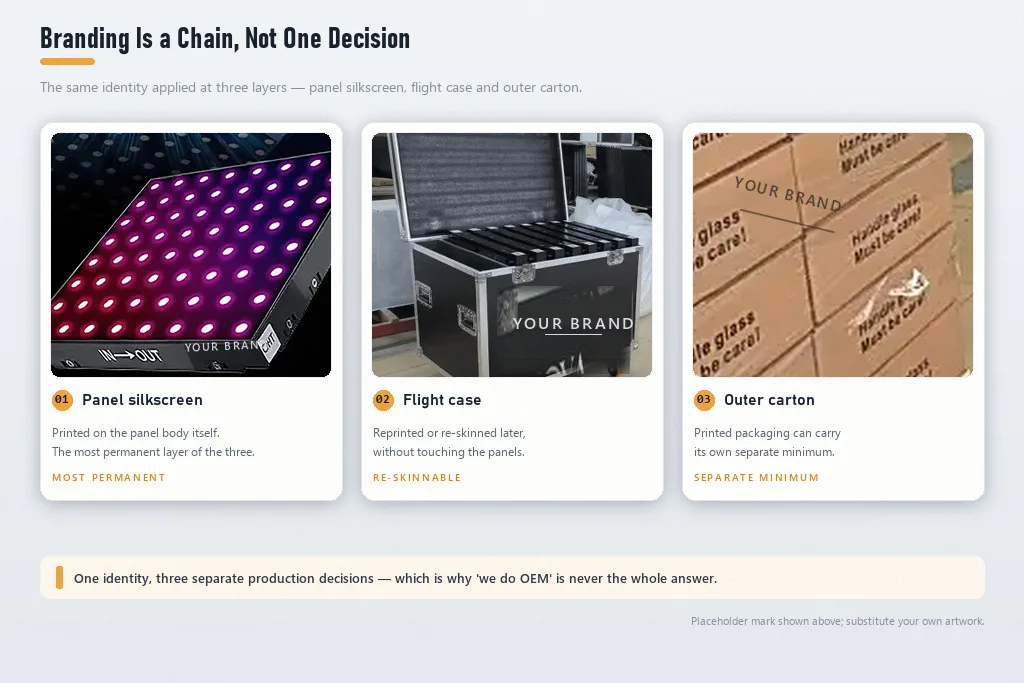
The chain runs from the product outward. Panel silkscreen is the most visible and the most permanent. The control box badge is next. Then the flight case, the outer carton, the printed manual and the rating label.
Two costs hide in that chain. The first is artwork set-up: silkscreens, print plates and case branding are prepared once and charged once, and the question is whether that charge recurs if you change your logo or brand name later. The second is minimums, because branded packaging can carry a separate minimum order from the panels themselves. Ask both questions explicitly rather than assuming a single order minimum covers everything.
There is one design decision worth making early. Apply your brand at the least permanent layer you can live with, unless the visibility is genuinely worth the permanence. A branded flight case can be re-skinned. A panel silkscreen cannot.
Run a Pilot Before You Commit
An OEM relationship is a process relationship, and processes are only tested at volume. Three stages, each with a different question.
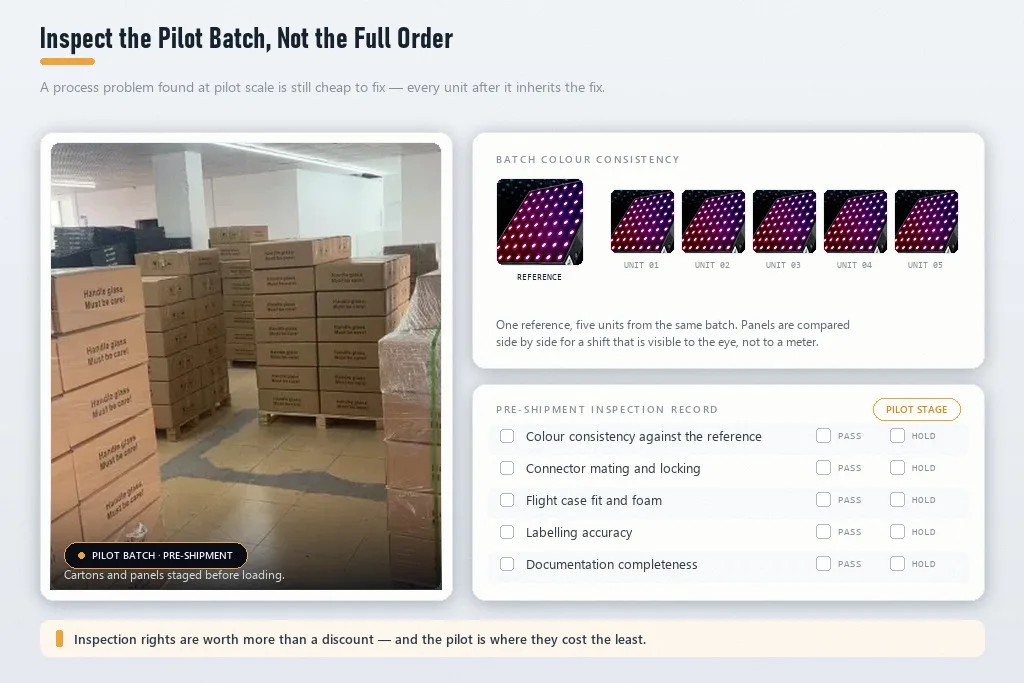
Stage one: a sample. Order one or two panels. The sample answers a single question: is this the product the specification described? Test connector mating, colour consistency against your reference, control software behaviour and physical dimensions.
Stage two: a pilot batch. Order enough units to expose a process rather than a product. The pilot batch answers the question the sample cannot: can this factory repeat it? Colour uniformity across units, flight case fit, labelling accuracy and documentation completeness all appear at pilot scale and not before.
Stage three: scale. Only now does the full order make sense, and by this point you should have already made the decisions that are expensive to change.
Run a third-party pre-shipment inspection on the pilot batch rather than on the first large order. The pilot is exactly where a process problem is cheapest to find, and every unit after it inherits the fix.
Red Flags in an OEM Relationship
None of these signals proves bad faith on its own. Together they predict an arrangement that becomes expensive after the deposit clears.
"We can do anything" without a single engineering question. A factory that does not ask about your panel size, IP requirement, control protocol or target market is not planning your build, it is planning to send its standard one.
An order minimum quoted verbally and never in writing. If a number cannot be put on paper, treat it as unagreed rather than as a term you can rely on.
Uncertainty about who is named on the certificate. If the entity holding the certificate is unclear, the compliance position is unclear.
Branding scoped as "the packaging" only. Confirm the other five layers at the same time, or you will discover the limit at shipment.
No answer on tooling and artwork ownership. Ownership that is not settled before the first order tends to be contested after the last one, when your influence is at its lowest.
A warranty routed "through the distributor" with no described process. Ask who receives the claim, who pays the freight and what the turnaround is.
Exclusivity promised verbally. Ask for the scope and duration in writing, because an exclusivity arrangement that exists only in conversation cannot be relied on when a second buyer appears in your territory.
Refusal of a pre-shipment inspection. A supplier who controls what you are allowed to see during production is also controlling what you are able to find out.
Your OEM Evaluation Scorecard
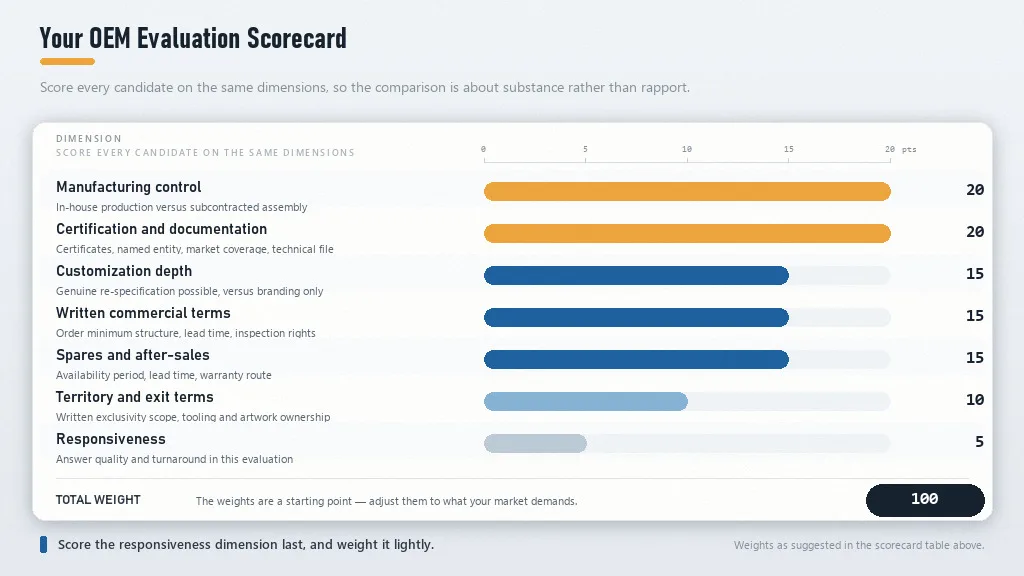
Score every candidate on the same dimensions so the comparison is about substance rather than rapport. The weights below are a starting point; adjust them to what your market demands.
| Dimension | What you are scoring | Suggested weight |
|---|---|---|
| Manufacturing control | In-house production versus subcontracted assembly, and live verification | 20 |
| Certification and documentation | Certificates, named entity, target market coverage, technical file ownership | 20 |
| Customization depth | Genuine re-specification possible, versus branding only | 15 |
| Written commercial terms | Order minimum structure, lead time, payment milestones, inspection rights | 15 |
| Spares and after-sales | Availability period, lead time, warranty administration route | 15 |
| Territory and exit terms | Written exclusivity scope, tooling and artwork ownership | 10 |
| Responsiveness | Answer quality and turnaround during the evaluation itself | 5 |
Score the responsiveness dimension last and weight it lightly. It feels important during the courtship and matters least afterwards.
Fact: Event Golden exports to over 200 countries, with North America at 55% of sales and Western Europe at 17%, and backs its products with a 5-year warranty and 20+ overseas warehouses.
Buyers who want the product-side detail before opening an OEM conversation can start from the 3D, magnetic and star floor guides, and the ROI guide covers what the product earns once it is in service.
FAQ
What does OEM mean for an LED dance floor?
OEM means a factory builds the product for you to sell under your own brand rather than theirs. On an LED dance floor that can range from a simple logo on the flight case to a fully re-specified panel range, and the two ends of that range are very different commercial relationships. The first thing to establish with any candidate is where on that range they actually operate, because most factories can do branding and far fewer can do genuine re-specification.
What is the difference between OEM and private label?
In everyday use the terms overlap, but the distinction is useful when you are comparing suppliers. Private label usually means the product is built to an existing design and your brand is applied to it. OEM usually implies the product is built to your specification, which may include panel size, colour behaviour, control protocol, packaging and documentation. If a supplier uses both terms interchangeably, ask which one they mean and get the answer in writing.
What order quantity should I expect for a private label LED dance floor?
There is no universal figure, and any supplier who gives you one without asking about your configuration is guessing. What matters more than the number is its structure: is the minimum per model, per panel size, per colour, per branding artwork, or per order? A single order minimum is far easier to meet than a per-colour minimum. Ask for the structure in writing and confirm whether branded packaging carries its own separate minimum.
Can I put my own brand on the panels and packaging?
Usually yes, but the layers differ in cost and permanence, so confirm each one separately rather than accepting a general yes. The layers are panel silkscreen, control box, flight case, outer carton, printed manual and rating label. Ask which of those carry your brand, which carry the factory's, and whether any artwork file or tooling stays with the factory if the relationship ends.
Who is responsible for CE marking when the product carries my brand?
Under EU rules, responsibility for placing a product on the EEA market falls on the manufacturer, the importer and the distributor, and CE marking is a manufacturer's declaration of conformity rather than an approval issued by any authority [1]. If your brand is on the product and you bring it into the EEA, you may be acting as the importer and carrying obligations you did not plan for. Establish in writing who holds the technical file and who signs the declaration.
What certifications should my OEM partner hold?
At minimum, ask for the product certifications your target markets require, the certificate numbers, the issuing bodies, and the name of the entity the certificate was issued to. Also ask about the quality management system behind the production line, since ISO 9001 certification covers process control rather than any single product [2]. Verify certificate numbers with the issuing body rather than accepting a PDF, and remember that a certificate proves a sample passed a test, not that every unit will.
How do I protect my brand and design if I change suppliers?
Settle ownership before the first order, not after a dispute. Ask who owns the artwork files, silkscreens, moulds and any custom tooling, and get the answer in writing. If the factory owns the tooling, your practical cost of switching suppliers includes recreating it. If you have developed a genuinely new design, deal with design protection in your own market through the relevant intellectual property office rather than relying on a supplier agreement alone.
Should I start with a sample or a full order?
Start with a sample, then a pilot batch, then scale. The sample tells you whether the product is what the specification promised. The pilot batch tells you whether the factory can repeat it: colour consistency across units, packaging fit, labelling accuracy and documentation completeness all show up at pilot scale and not at sample scale. Run a pre-shipment inspection on the pilot rather than the full order, because that is the cheapest place to find a process problem.
Conclusion
An OEM arrangement is mostly decided by the questions that get asked before the first quotation, and by which of the answers end up in writing. Work the eight questions against every candidate, score the answers rather than the pitch, and settle the certificate, the tooling and the territory terms while you still have the influence that comes with being a prospective buyer.
If you are evaluating suppliers, the manufacturer checklist covers the factory verification layer in more depth, and the same framework applied to the other product line is set out in the photo booth manufacturer guide. To discuss a private label or OEM configuration against your own specification, send your requirements through the contact page or start from the LED dance floor product range. Buyers comparing supply routes can also review buy an LED dance floor and the factory buying guide hub.
Sources
- European Commission. "CE marking." Directorate-General for Internal Market, Industry, Entrepreneurship and SMEs. https://single-market-economy.ec.europa.eu/single-market/ce-marking_en: states that by affixing the CE marking a manufacturer declares the product meets all legal requirements for CE marking and can be sold throughout the EEA, and that this applies to products made in other countries sold in the EEA. Also states that the site addresses the responsibilities of manufacturers, importers and distributors when placing a product on the EEA market; that the CE marking does not indicate that a product has been approved as safe by the EU or any other authority, and does not indicate the product's origin; and that the Commission points to the Blue Guide for guidance on implementing EU product rules.
- International Organization for Standardization (ISO). "ISO 9000 family: Quality management." https://www.iso.org/iso-9001-quality-management.html: describes the ISO 9000 family, of which ISO 9001 is the standard for quality management systems, published by ISO/TC 176; sets out the seven quality management principles underpinning the family, including customer focus and a process-oriented approach. Cited for quality management systems being a process control standard rather than a product performance standard.
- International Electrotechnical Commission (IEC). "IP ratings." https://www.iec.ch/ip-ratings: the IP code uses two numerals, the first for protection against solid objects (0-6) and the second for protection against liquids (0-9), with full test conditions defined in IEC 60529.
- European Parliament. "Revision of EU rules restricting the use of hazardous substances in electronics (RoHS Directive 2011/65/EU)." https://www.europarl.europa.eu/legislative-train/theme-a-european-green-deal/file-revision-of-eu-rules-restricting-the-use-of-hazardous-substances-in-electronics?sid=8801: Directive 2011/65/EU restricts the use of hazardous substances in electrical and electronic equipment.
- TÜV Rheinland. "Certipedia, certificate and test-mark register." https://www.tuv.com/: the certification body's public register, used to verify a claimed certificate number, the entity it was issued to, and its validity period.
- Event Golden. "LED Dance Floor." https://eventgolden.com/products/led-dance-floor/: manufacturer specifications, OEM customization support, certifications and warranty terms referenced in the Fact Blocks (per manufacturer specifications).
Ready to start your event business?
Get a free wholesale quote within 24 hours. Product details are confirmed by direct inquiry.
Get a Free Quote