How to Choose a Photo Booth Manufacturer: A Buyer's Checklist
An 8-point checklist for vetting photo booth manufacturers: certifications, warranty, OEM/ODM customization, order quantity, lead time, and after-sales support.
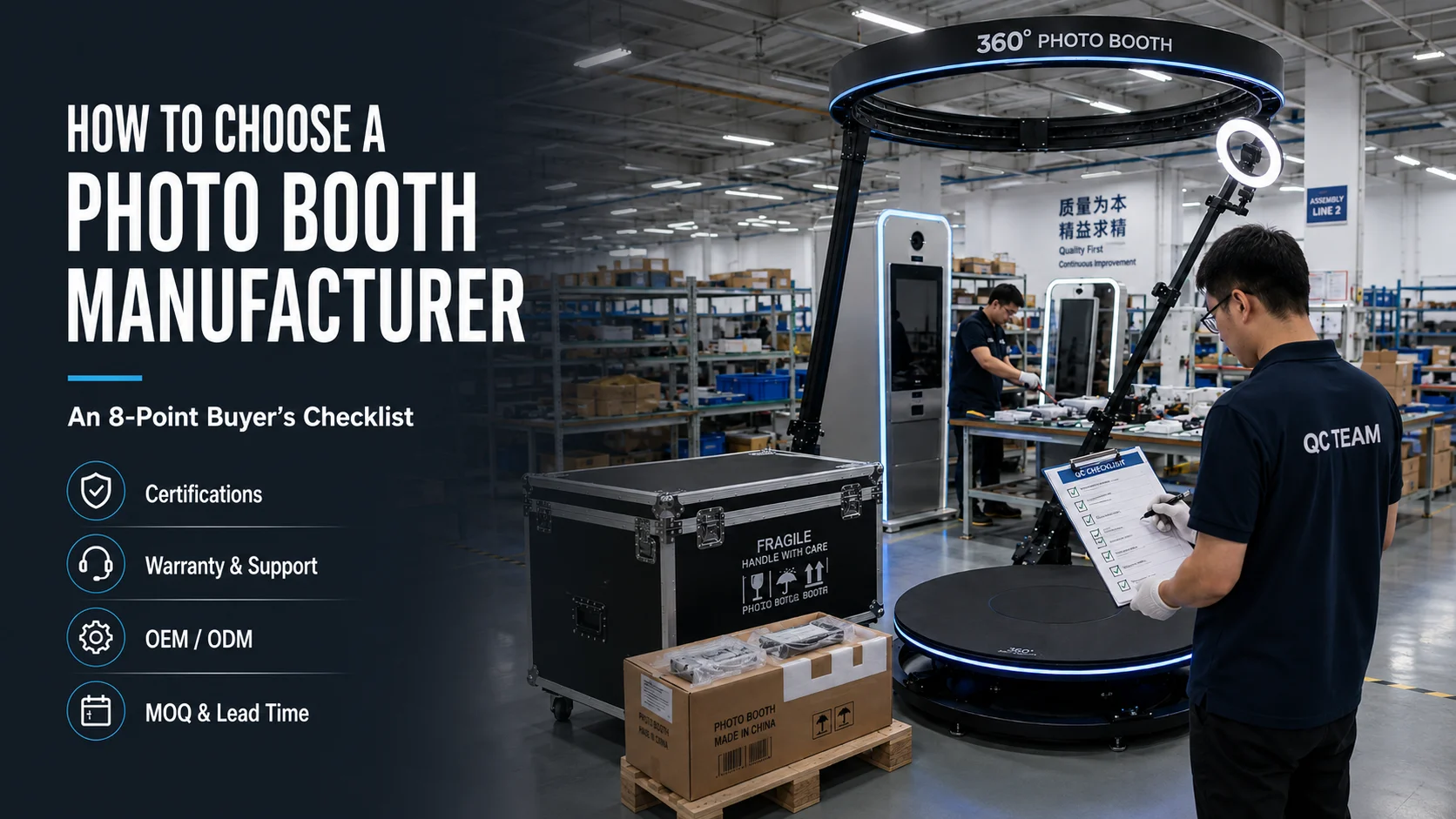
The photo booth you buy is only as good as the factory behind it. A booth with great specs and no support behind it becomes a paperweight the first time a motor fails on a booked Saturday. This is why choosing the manufacturer matters more than choosing the model.
Most buyers approach this backwards. They compare booth features and prices first, then pick a supplier almost as an afterthought. The better sequence is the reverse: qualify the manufacturer first, then choose the model from what a qualified factory offers.
This guide is the checklist I would use. It covers the eight things that separate a real manufacturer from a trading company, and the questions to ask before you send money.
Certifications and Compliance First
Start with compliance because it is the one thing you cannot fix after the fact. If a booth is not certified for your market, it can be held at customs or rejected by a venue with an electrical safety inspection.
For the European market, CE and RoHS are the baseline. LVD covers electrical safety. For the US, FCC matters for the wireless components that connect the booth to a tablet or printer. A TÜV Rheinland certification is a strong extra signal because it means an independent body tested the product rather than the factory self-declaring.
The key is verification, not a logo. Ask the manufacturer for the actual certificate and the certificate number, then check that number against the issuing body's public database. A manufacturer that hesitates to share certificate numbers is telling you something.
Fact: BiaoMing (Event Golden) is a TÜV Rheinland certified photo booth manufacturer with CE, RoHS, FCC, LVD, and CB product certifications covering the 360, iPad, mirror, and magazine booth lines.
If you have not decided which booth type fits your market yet, start with the 360 photo booth guide, the iPad photo booth guide, and the mirror photo booth guide. Knowing the category before you qualify suppliers saves you from asking the wrong questions.
Warranty and After-Sales Support
A photo booth is electro-mechanical. The rotating arm on a 360 booth, the motors on a magazine printer, the touch surface on a mirror booth: all of these move, and moving parts fail. The warranty is what decides whether a failure is a nuisance or a lost booking.
Look for a multi-year warranty with clear terms. Five years is a strong offer in this category, but the number only matters if you can act on it. What you actually need is spare parts reachable in days, not weeks.
That is where overseas warehouses change the equation. If a manufacturer keeps parts in your region, you replace a failed component in a couple of days instead of shipping the whole unit back and waiting for a round trip. A manufacturer with 20+ overseas warehouses has made a real investment in keeping your fleet running.
Ask three specific questions: what does the warranty cover, how long does a claim take, and where does a replacement part ship from. Vague answers to those three are a reason to move on.
OEM vs ODM: Customization That Fits Your Brand
If you are building a rental brand rather than just buying machines, customization is not optional. You need your logo on the enclosure and your branding in the software. The question is how much customization a manufacturer can actually deliver.
OEM means you bring the design and the factory builds to your spec. ODM means the factory has a proven base product that they re-skin with your colors, logo, and interface. For most rental operators, ODM is the faster and cheaper path because you start from a design that already works.
What varies most between manufacturers is software. Some only change the enclosure color and print a logo. Others can re-skin the entire user interface and the photo delivery flow. If you plan to send guests branded galleries or sell print packages under your own name, confirm software customization before ordering. Retrofitting it later is expensive.
For context on how the different booth types compare before you commit to one, see the 360 vs mirror comparison and the magazine photo booth guide.
order quantity, Lead Time, and Logistics
Three numbers decide your cash-flow math: the minimum order quantity, the production lead time, and the shipping time. Get all three in writing before you compare prices, because a low quotation detail with a high order quantity is not a low price.
order quantity varies by model and by how much you customize. Off-the-shelf models often start in the low single digits. Full OEM projects and custom enclosures push the number up. If you are starting a fleet, ask whether the manufacturer lowers the order quantity on repeat orders or when you bundle multiple booth types.
Lead time splits into production and shipping, and some quotes blur the two. Stock models can ship in weeks. Customized builds take longer, especially when you add branded overlays or specific software. Ask for a written production schedule and confirm what the quoted lead time actually covers.
Fact: BiaoMing exports photo booths to over 200 countries, with North America at 55% of sales and Western Europe at 17%, backed by a 5-year warranty and 20+ overseas warehouses.
Manufacturing Experience and Track Record
A trading company can quote you a booth. A manufacturer can show you how it is made. The difference shows up in the first technical question you ask.
Thirteen years in the category means the factory has seen the failure modes. It knows which motors burn out, which connectors loosen, and which software builds frustrate operators. That experience lands in the product, not in the marketing.
Track record is the other half. A manufacturer exporting to 200+ countries has passed customs and compliance in markets with very different requirements. Regional sales data matters too: a factory that ships heavily to North America and Western Europe already understands those buyers' expectations for packaging, documentation, and support.
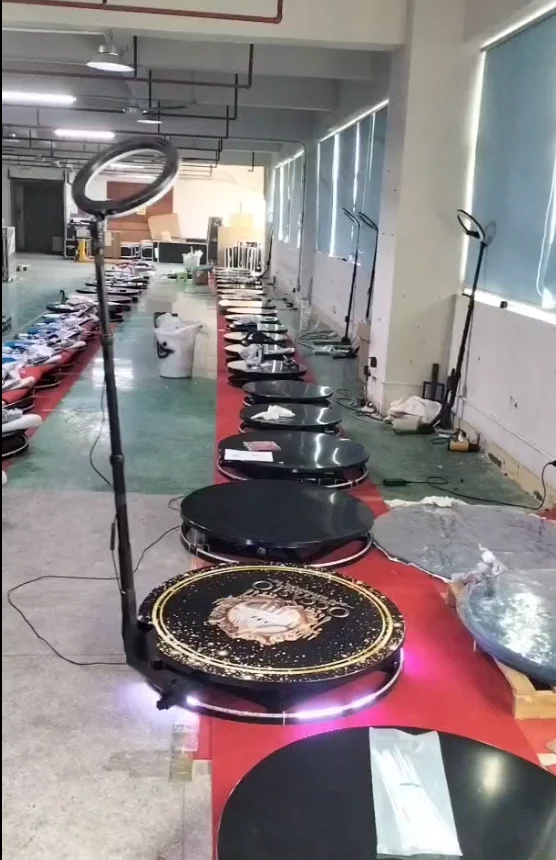
Verify the claim. Ask for factory photos, request a video tour of the production line, and see if the answers to technical questions are consistent. A real manufacturer can take you to the floor; a trader changes the subject.
Hardware, Software, and Consumables Quality
The booth is three things bolted together: hardware, software, and the consumables that wear out. Buyers obsess over the hardware and ignore the other two, which is a mistake.
Hardware quality shows in the moving parts and the enclosure. A 360 arm that wobbles, a printer door that jams, a shell that cracks in the van: these are the difference between a booth that lasts years and one that lives in the repair queue.
Software is where operators feel the pain daily. Slow interfaces, crash-prone apps, and rigid print flows waste event time. Ask to see the software in action, not screenshots. A manufacturer that demos a live app is confident in it; one that only sends a spec sheet is not.
Consumables are the recurring cost. Print paper and ink for a magazine booth, backup batteries, spare cables, and spare acrylic or glass panels. A manufacturer should sell you these without drama. If spare parts are hard to order after the sale, the booth is a one-time purchase with an expiry date.
The 360 photo booth ROI guide breaks down the full operating cost, including the consumables and spares most first-time buyers forget to budget for.
The 8-Point Buyer's Checklist
Print this. Walk down it with every manufacturer you shortlist.
| # | Check | How to verify |
|---|---|---|
| 1 | Certifications | Request certificate numbers, check against TÜV/CE/FCC databases |
| 2 | Warranty terms | Confirm years, coverage (parts/labor), and claim process |
| 3 | After-sales reach | Ask where replacement parts ship from and how fast |
| 4 | OEM/ODM depth | Confirm enclosure vs software customization before ordering |
| 5 | order quantity | Get the number for the exact model and customization level |
| 6 | Lead time | Split production vs shipping, ask for a written schedule |
| 7 | Track record | Factory video tour, export countries, regional references |
| 8 | Consumables | Confirm spare parts are orderable after the sale |
FAQ
How do I choose a photo booth manufacturer?
Work down a checklist, not a price sheet. Verify certifications, confirm warranty terms and after-sales support, check OEM/ODM customization capability, and ask for a track record with buyers in your region. A manufacturer that passes all four is rare; one that fails any will cost you more later in repairs and missed bookings.
What certifications should a photo booth manufacturer have?
For EU markets, CE and RoHS are the baseline, with LVD for electrical safety. For the US, FCC matters for wireless components. TÜV Rheinland certification is a strong signal of independent third-party testing. Ask to see actual certificates, not a logo on a website, and check the number against the issuing body's database.
What is the difference between OEM and ODM photo booths?
OEM means you provide the design and the factory builds to your spec. ODM means the manufacturer has a base product that they customize with your logo, colors, and software. For most rental businesses, ODM is faster and cheaper because you start from a proven design. OEM suits buyers who need a unique enclosure or a proprietary feature.
What is the order quantity for photo booths?
order quantity varies by manufacturer and model, commonly starting in the low single digits for off-the-shelf models and rising for custom enclosures or full OEM projects. Confirm the order quantity early, because it changes your cash-flow math. Some manufacturers lower the order quantity on repeat orders or when you bundle multiple booth types.
How long does photo booth manufacturing and delivery take?
A typical lead time runs from a few weeks for stock models to several weeks for customized builds, plus shipping. Custom enclosures, branded overlays, and specific software add time. Ask for a written production schedule and confirm whether the lead time covers production only or production plus shipping.
What warranty should a photo booth manufacturer offer?
Look for a multi-year warranty on hardware with clear terms. A 5-year warranty with 20+ overseas warehouses for spare parts means you can replace a failed component fast instead of shipping the whole unit back. Confirm whether the warranty covers parts, labor, or both, and how claims are processed.
How do I verify a photo booth supplier is legitimate?
Request the business license and certificates, then verify them independently. Check how many countries they export to and whether they have overseas service points. A real manufacturer shows factory photos, allows a video tour, and gives consistent technical answers. Be wary of traders who cannot take you to a production line.
Can I customize a photo booth with my own branding?
Yes. Most manufacturers offer custom enclosure colors, logo printing, and software branding. The depth varies: some only change the shell, while others re-skin the entire interface and print flow. If you plan to build a recognizable rental brand, confirm software customization before ordering, because retrofitting it later is expensive.
Conclusion
Choose the manufacturer before you choose the machine. Certifications, warranty reach, customization depth, and a verifiable track record are the four legs the booth stands on, and the booth is only as stable as the weakest one.
A TÜV-certified manufacturer with 13 years of experience, a 5-year warranty, 20+ overseas warehouses, and export reach across 200+ countries has already answered most of the questions on this checklist. The rest is confirming the specifics for your market and your order quantity.
Fact: BiaoMing has 13 years of photo booth manufacturing experience and supports both OEM and ODM customization across its booth range.
Walk the 8-point checklist against your shortlist, then explore the BiaoMing photo booth range to see how a factory that passes all eight actually builds them.
Sources
- BiaoMing (Event Golden). "Photo Booth." Event Golden product page. https://eventgolden.com/products/overhead-360-photo-booth/: Manufacturer specifications, certifications, warranty, and customization options referenced throughout.
- European Commission. "CE marking." https://single-market-economy.ec.europa.eu/single-market/ce-marking_en: baseline compliance requirements for EU market entry.
- TÜV Rheinland. "Product certification." https://www.tuv.com/: third-party testing standards referenced for certification verification.
- U.S. Federal Communications Commission (FCC). "Equipment Authorization." https://www.fcc.gov/: requirements for wireless components in photo booths and similar devices.
Ready to start your event business?
Get a free wholesale quote within 24 hours. Product details are confirmed by direct inquiry.
Get a Free Quote