How to Start an Event Rental Business in 2026: The Complete Guide
A complete guide to starting an event rental business: two business models, equipment selection, startup costs by tier, pricing, break-even, and scaling.
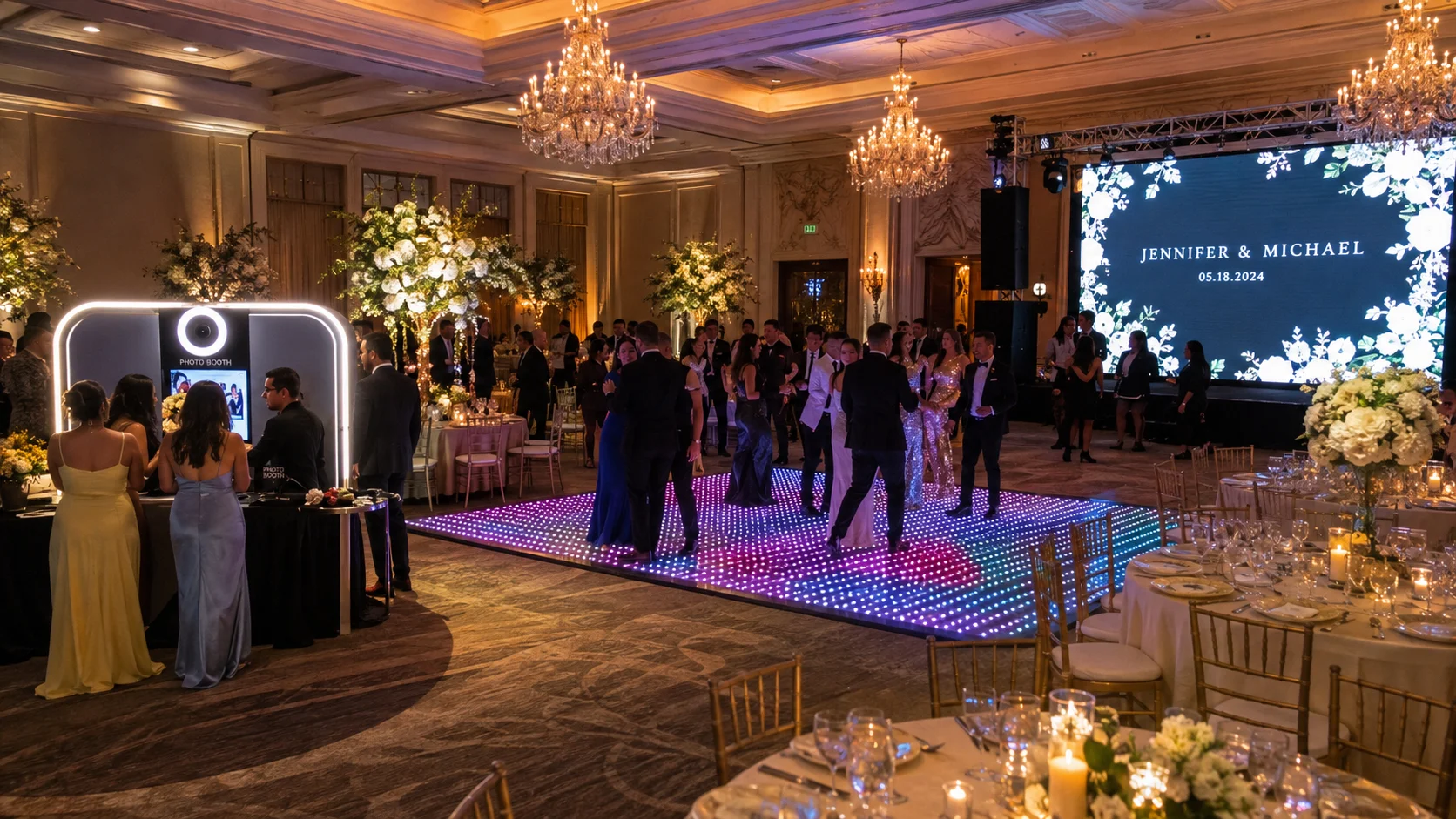
Event rental is one of the most accessible service businesses to start, because the equipment earns repeatedly. A $ 4,000 photo booth does not get used once and depreciate, it gets booked weekend after weekend, generating $ 500 to $ 1,000 profit per event. That repeated earning is what makes event rental different from selling products.
But there is a fork in the road that most guides do not mention. You can start a general party rental business with tables, chairs, and tents, competing on price with every other local operator. Or you can start an entertainment-tech rental business with photo booths, LED dance floors, and LED displays, competing on experience instead of price.
This guide covers the second path, the one that fits BiaoMing's product line, and walks through equipment selection, startup costs, pricing, break-even, and scaling.
Why Event Rental Is a Strong Business in 2026
Three forces make event rental attractive right now.
Demand is durable. Weddings, corporate events, and milestone parties happen regardless of the economy. The party supply rental market was valued at $ 15.2 billion in 2023 and is projected to reach $ 32.0 billion by 2030 (Grand View Research, 2024). People do not cancel birthdays and weddings when times are hard; they adjust the budget, and photo booths are one of the last things cut because guests expect them.
Equipment earns repeatedly. Unlike a product business where each sale is one transaction, rental equipment generates revenue every time it goes out. A photo booth booked 4 times a month at $ 800 per event generates $ 3,200 monthly from a $ 4,000 asset.
Low operational complexity. One person and one vehicle can run a photo booth booking. There is no inventory to manage, no perishable stock, and no retail space required. The business can run from a home office and a storage unit.
The catch is that the barrier is not capital, it is differentiation. The tables-and-chairs market is crowded and price-driven. The entertainment-tech market has fewer players and commands premium pricing.
Two Paths: General Party Rental vs. Entertainment Tech Rental
The choice of niche shapes everything downstream.
| Dimension | General Party Rental | Entertainment Tech Rental |
|---|---|---|
| Equipment | Tables, chairs, tents, linens, tableware | Photo booths, LED dance floors, LED displays |
| Startup cost | $ 10,000 to $ 50,000 (warehouse + inventory) | $ 5,000 to $ 25,000 (a few high-value items) |
| Per-event margin | Low ($ 100 to $ 300 typical) | High (50% to 85%) |
| Differentiation | Low, competes on price | High, competes on experience |
| Storage | Warehouse required | Storage unit or garage |
| Transport | Box truck | Van or SUV |
| Scaling | Add more inventory SKUs | Add higher-value equipment |
General party rental is a volume and logistics business. You need a warehouse, a truck, and dozens of inventory items to fill a single event order. Margins are thin because tables and chairs are commodities.
Entertainment-tech rental is an experience business. You need a few high-value items and the skill to run them. Margins are high because a photo booth or LED dance floor is not a commodity, it is the memorable part of the event.
Fact: BiaoMing (Event Golden) supplies photo booths, LED dance floors, and LED displays to event rental businesses in over 200 countries, TÜV Rheinland certified.
What Equipment to Start With
The equipment path below is the sequence most successful entertainment-tech rental businesses follow.
Step 1: One photo booth ($ 2,500 to $ 8,000). The photo booth is the entry point because it covers the broadest range of events with the lowest cost. An iPad booth is the cheapest and most portable option. A mirror booth commands higher rates and works for upscale weddings. Both are covered in depth in our photo booth guides.
Step 2: A second photo booth type ($ 2,500 to $ 15,000). Once the first booth proves the market, add a second type to upsell and cover more event styles. A 360 booth generates social media reach, while a magazine booth produces premium printed keepsakes. Compare your options with our Mirror Photo Booth and 360 Photo Booth comparisons.
Step 3: An LED dance floor ($ 4,500 to $ 12,000). The dance floor transforms the party into a visual centerpiece and bundles naturally with photo booths. It earns $ 1,000 to $ 3,500 per event and opens the wedding and nightclub market. See the 3D LED Dance Floor guide for the full ROI model.
Step 4: An LED display ($ 15,000 to $ 25,000). The display is the highest-ticket item, for conferences, trade shows, and corporate production. It earns $ 300 to $ 600 per square meter per day and is the natural progression once corporate bookings justify the investment. Start with the LED Rental Display guide.
The sequence is deliberate: each step is funded by the cash flow of the previous one, and each addition expands the events you can serve.
Startup Costs by Tier
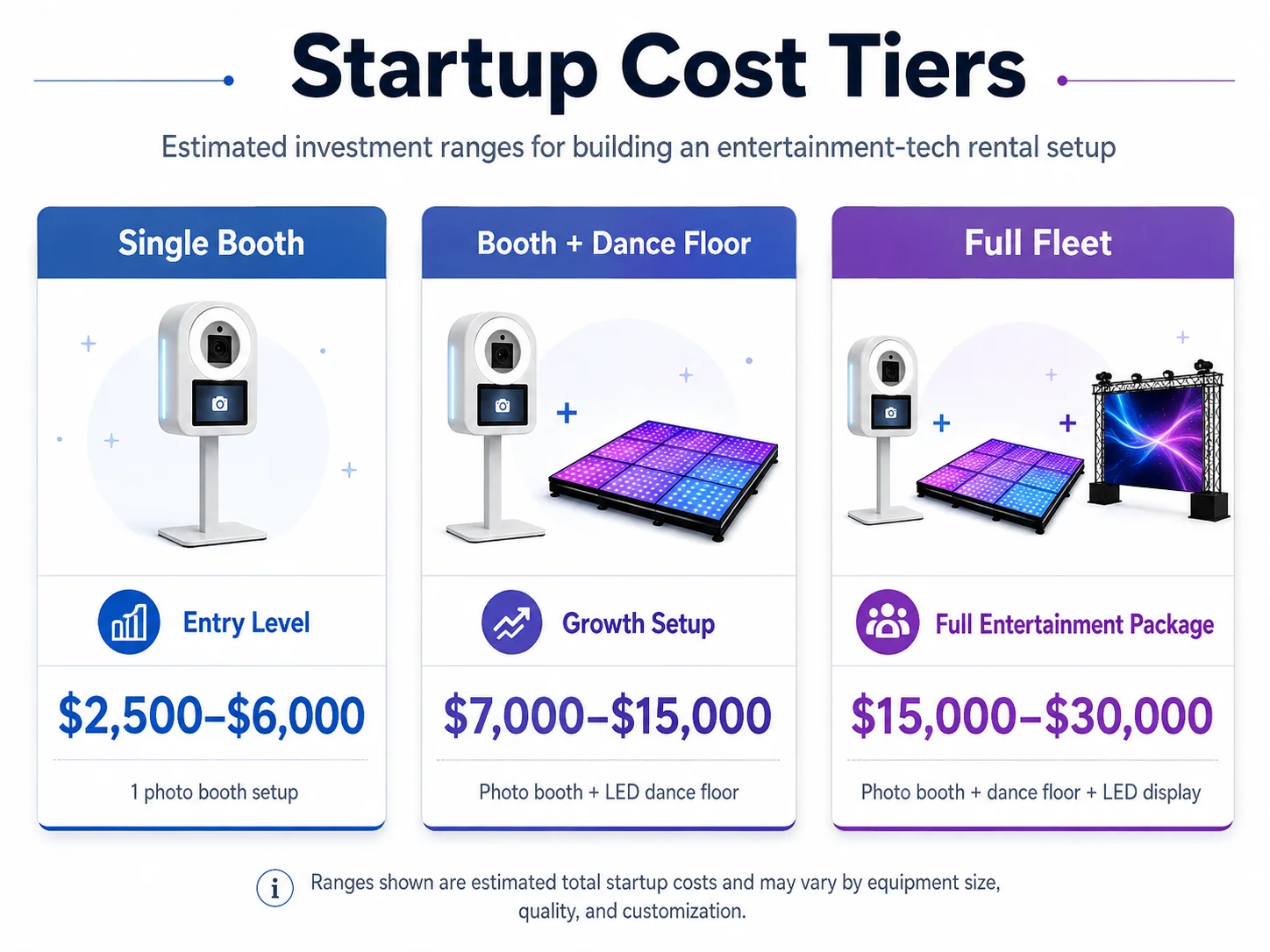
Startup costs scale with the ambition of the fleet. Here are three realistic tiers.
| Cost Item | Tier 1: Single Booth | Tier 2: Booth + Dance Floor | Tier 3: Full Fleet |
|---|---|---|---|
| Equipment | $ 3,500 to $ 8,000 | $ 8,000 to $ 20,000 | $ 25,000 to $ 60,000 |
| Vehicle | Existing car | Van or SUV ($ 8,000 to $ 20,000) | Box truck or van |
| Insurance | $ 500 to $ 1,000/yr | $ 800 to $ 1,500/yr | $ 1,500 to $ 3,000/yr |
| Marketing | $ 500 to $ 2,000 | $ 1,000 to $ 3,000 | $ 2,000 to $ 5,000 |
| Website + software | $ 300 to $ 1,000 | $ 500 to $ 1,500 | $ 1,000 to $ 3,000 |
| Total | $ 5,000 to $ 10,000 | $ 12,000 to $ 25,000 | $ 30,000 to $ 70,000 |
Industry startup data puts photo booth businesses at $ 3,500 to $ 25,000 (Snappic, 2026). The tier totals above are industry estimates based on current equipment and service pricing; confirm exact costs with suppliers. The tier you choose depends on your market and your risk tolerance. Tier 1 is the low-risk proof-of-market entry. Tier 2 is where the bundle strategy kicks in. Tier 3 is a full production operation.
Pricing Your Rentals
Pricing is per event, with a base rate for a set number of hours plus add-ons.
| Equipment | Typical Rental Rate |
|---|---|
| iPad photo booth | $ 400 to $ 1,000/event, or $ 100 to $ 150/hr |
| Mirror photo booth | $ 700 to $ 1,900/event |
| 360 photo booth | $ 900 to $ 2,000/event |
| Magazine photo booth | $ 1,500 to $ 3,500/event |
| LED dance floor | $ 1,000 to $ 3,500/event |
| LED display | $ 300 to $ 600/m²/day |
Set the base rate to cover your costs, then add margin:
- Labor: $ 25 to $ 40/hour for the attendant
- Transport: $ 50 to $ 150 per event
- Consumables: $ 30 to $ 80 per event (print media)
- Insurance and storage amortized: $ 20 to $ 40 per event
Add-ons are pure margin. Custom branding, extra hours, branded backdrops, photo guestbooks, and social sharing stations each add $ 100 to $ 500 per event with almost no marginal cost. The bundle is the highest-margin move: a photo booth plus a dance floor sells for more than the sum of its parts because it solves the client's whole problem.
Break-Even and ROI
The break-even formula is simple: divide total startup cost by net profit per event.
Example, Tier 1 (single mirror booth):
- Startup cost: $ 8,000
- Net profit per event: $ 700
- Break-even: about 11 events
Example, Tier 2 (booth + dance floor):
- Startup cost: $ 18,000
- Net profit per event: $ 1,200 (bundled bookings)
- Break-even: about 15 events
| Tier | Startup Cost | Net/Event | Break-Even |
|---|---|---|---|
| Tier 1 | $ 5,000 to $ 10,000 | $ 500 to $ 900 | 8 to 16 events |
| Tier 2 | $ 12,000 to $ 25,000 | $ 900 to $ 1,500 | 10 to 20 events |
| Tier 3 | $ 30,000 to $ 70,000 | $ 1,500 to $ 3,000 | 15 to 30 events |
Most single-booth operators reach break-even in 3 to 6 months. Multi-product fleets take 6 to 12 months, but their ceiling is higher because they can book multiple equipment items to the same event.
Marketing and Booking
The highest-converting channels for event rental are local and visual.
Wedding directories. The Knot and WeddingWire drive consistent photo booth and dance floor bookings. Listing fees are modest relative to the bookings they generate.
Google Business Profile. Most event rental bookings start with a local search like "photo booth rental near me." A complete profile with real photos, reviews, and correct service areas is the highest-ROI marketing asset you can build.
Instagram. This is a visual business. Post photos and videos of your equipment at actual events, tagged with the venue and location. Couples and planners browse Instagram before they browse directories.
Referral partners. Wedding planners, venue coordinators, DJs, and caterers book recurring events. A 10% referral commission turns them into a steady booking channel that costs nothing until it pays.
The rule across all channels: show real work, not stock images. One photo of your dance floor packed with guests outperforms ten stock photos of an empty floor.
Operations: Transport, Setup, Insurance
The operational side is what separates a business from a side gig.
Transport. Photo booths fit in a car or small SUV. Dance floors and displays need a van. Budget for fuel and vehicle wear at $ 30 to $ 100 per event.
Setup and staffing. One person runs a photo booth booking. Dance floor and display setup needs one to two people. The setup time is 15 to 90 minutes depending on the equipment.
Insurance. General liability insurance ($ 40 to $ 80/month) is non-negotiable, venues require it. Inland marine insurance covers equipment in transit and on site. Together they cost under $ 150/month and protect a fleet worth tens of thousands.
Booking software. A scheduling tool prevents double-bookings and manages deposits. Photo booth software handles contracts, payments, and client communication. This is a $ 30 to $ 100/month expense that pays for itself in avoided mistakes.
Fact: BiaoMing provides a 5-year warranty and 20+ overseas warehouses, so new rental businesses can start with reliable equipment and fast spare parts.
Scaling: Adding Products to Your Fleet
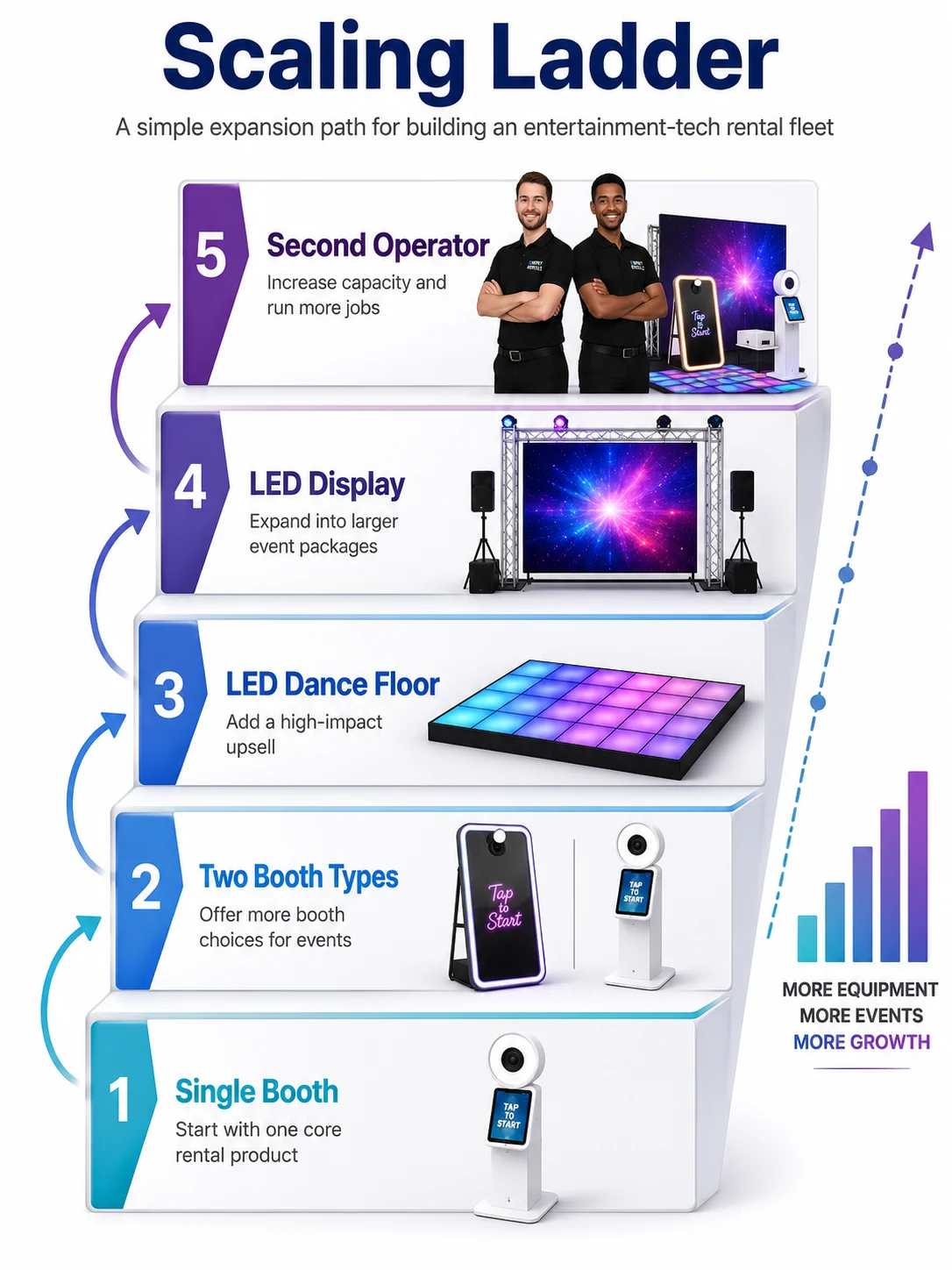
Scaling an event rental business is not about doing more of the same, it is about adding equipment that raises your per-event ceiling.
The scaling ladder:
- Single photo booth (solo, weekends)
- Two booth types (upsell and cover more event styles)
- Add LED dance floor (bundle, $ 4,000+ packages)
- Add LED display (corporate and production, $ 5,000+ packages)
- Hire a second operator (run two events simultaneously)
Each rung is funded by the previous rung's cash flow. The full fleet lets you book a single wedding for $ 7,000 to $ 12,000 across a photo booth, dance floor, and display, with one crew and one vehicle.
The businesses that scale successfully share one trait: they add equipment that solves a real client problem, not equipment that looks impressive in the warehouse. Every new item should answer the question "which event am I currently turning down that this would let me book?"
Frequently Asked Questions
How much does it cost to start an event rental business?
Startup costs range from $ 3,500 for a minimal single-booth operation to $ 25,000 or more for a multi-product fleet. A practical entry point is $ 5,000 to $ 10,000 for one or two photo booths plus marketing and insurance. A full entertainment-tech fleet runs $ 25,000 to $ 60,000.
Is an event rental business profitable?
Yes. Photo booth margins run 50% to 85% per event. A single booth earning $ 500 net per event, booked 4 times a month, generates $ 2,000 monthly profit. LED dance floors and displays earn more per event but cost more to buy. Most operators recover equipment cost in 20 to 40 rentals.
What equipment do I need to start an event rental business?
The minimum viable setup is one photo booth. Most operators start with an iPad or mirror booth because they are affordable and versatile. From there, add a second booth type, then an LED dance floor, then an LED display. Each addition expands the events you can serve.
Should I start with a photo booth, an LED dance floor, or an LED display?
Start with a photo booth. It has the lowest purchase cost, the broadest event coverage, and the fastest cash cycle. Add the dance floor second and the display when corporate bookings justify it.
How do I price my event rentals?
Price per event with a base rate plus add-ons. Photo booths rent for $ 400 to $ 1,500 per event. LED dance floors rent for $ 1,000 to $ 3,500. LED displays rent for $ 300 to $ 600 per square meter per day. Cover labor, transport, and consumables in the base rate, then add margin.
What is the break-even point for an event rental business?
Break-even equals total startup cost divided by net profit per event. A $ 8,000 startup earning $ 500 net per event breaks even at 16 events. At $ 900 net per event, break-even drops to 9 events. Most single-booth operators break even in 3 to 6 months.
How do I market an event rental business?
Wedding directories, Google Business Profile, and Instagram are the highest-converting channels. Wedding planners and venue coordinators are the most valuable referral source. Post real photos of your equipment at actual events. Optimize local SEO for "photo booth rental near me."
Do I need insurance for an event rental business?
Yes. General liability insurance ($ 40 to $ 80/month) is required by venues. Inland marine insurance covers equipment in transit and on site. Together they cost under $ 150/month and protect a fleet worth tens of thousands.
Next Steps
Event rental rewards the operator who picks the right niche and builds the fleet deliberately. The entertainment-tech path, photo booth first, dance floor second, display third, out-earns the crowded tables-and-chairs market because it competes on experience, not price.
Start with a single photo booth. Let its cash flow fund the dance floor. Add the display when corporate demand appears. And at every step, buy equipment you can keep booked, because a photo booth in storage earns nothing.
To explore equipment for your new event rental business, including photo booths, LED dance floors, and LED displays, visit the BiaoMing product lineup or contact the team for a startup equipment bundle quote.
Browse related: 360 Photo Booth Guide | Mirror Photo Booth Guide | 3D LED Dance Floor | LED Rental Display
Sources
- Grand View Research. "Party Supply Rental Market Size & Share Report, 2024-2030." grandviewresearch.com, Market valued at $ 15.2B (2023), projected $ 32.0B by 2030.
- Snappic. "How to Start a Photo Booth Business (2026 Guide)." snappic.com, Startup costs $ 3,500 to $ 25,000.
- Photobooth International. "Is a Photo Booth Business Profitable? Real Numbers." (2026). photoboothint.com, Break-even = total startup cost ÷ profit per event.
- Rentman. "How to start a party rental business in 10 steps." rentman.io, Traditional party rental profit ~$ 190/event, pricing methodology.
Ready to start your event business?
Get a free wholesale quote within 24 hours. Product details are confirmed by direct inquiry.
Get a Free Quote