LED Display ROI: How Much Can a Video Wall Make for Your Rental Business?
What an LED display costs, what it rents for, and how many events it takes to pay back. Full ROI math and payback timeline for rental businesses.
How Much Can a Video Wall Make for Your Rental Business?
An LED display is one of the highest-ticket assets you can put in a rental fleet. It is also one of the most misunderstood when it comes to payback, because people fixate on the sticker price and ignore the two numbers that actually decide the return: contribution per event and booking frequency.
The wall does not pay for itself on a single big booking. It pays for itself when it is rented again and again at a price that clears your labor and transport costs. This guide runs the math on that, dimension by dimension.
What an LED Display Costs to Buy
LED panels are priced per square meter, and pixel pitch is the main driver of price. A P3.91 panel is the rental workhorse: bright, durable, and the most affordable per square meter, typically $ 800 to $ 1,500. A P2.6 panel steps up in sharpness and price. A P1.9 panel is near-retina and the most expensive of the three.
A common starter wall is 10 by 6 feet, roughly 6 square meters. At P3.91 that lands around $ 5,000 to $ 9,000 before you add a processor, cabling, cases, and a spare module or two. Budget the accessories separately; they are a real line item that first-time buyers forget.
These are industry estimates. Actual pricing varies by brand, cabinet design, brightness, and whether you buy direct or through a distributor. For a full breakdown of what to look for in a rental screen, the LED rental display guide covers specs, cabinets, and build quality.
Rental Rates and Revenue per Event
What you can charge depends on your market, the wall's size and pitch, and the kind of event. As a working range, a P3.91 wall commonly rents for $ 1,000 to $ 2,000 per event, a P2.6 wall for $ 1,500 to $ 2,500, and a P1.9 wall for $ 2,000 or more. Corporate work and premium markets sit at the top of those ranges.
The useful framing is contribution per event, not headline price. If a wall rents for $ 1,200 and costs $ 300 in labor, fuel, and wear, the wall contributes about $ 900 per event. That contribution is what pays off the purchase and, later, becomes profit.
For the other half of the decision, whether LED or projector is the right investment for your market, the LED video wall vs projector comparison walks through the tradeoffs.
The ROI Math: Contribution and Payback
Run the numbers on a realistic P3.91 starter wall.
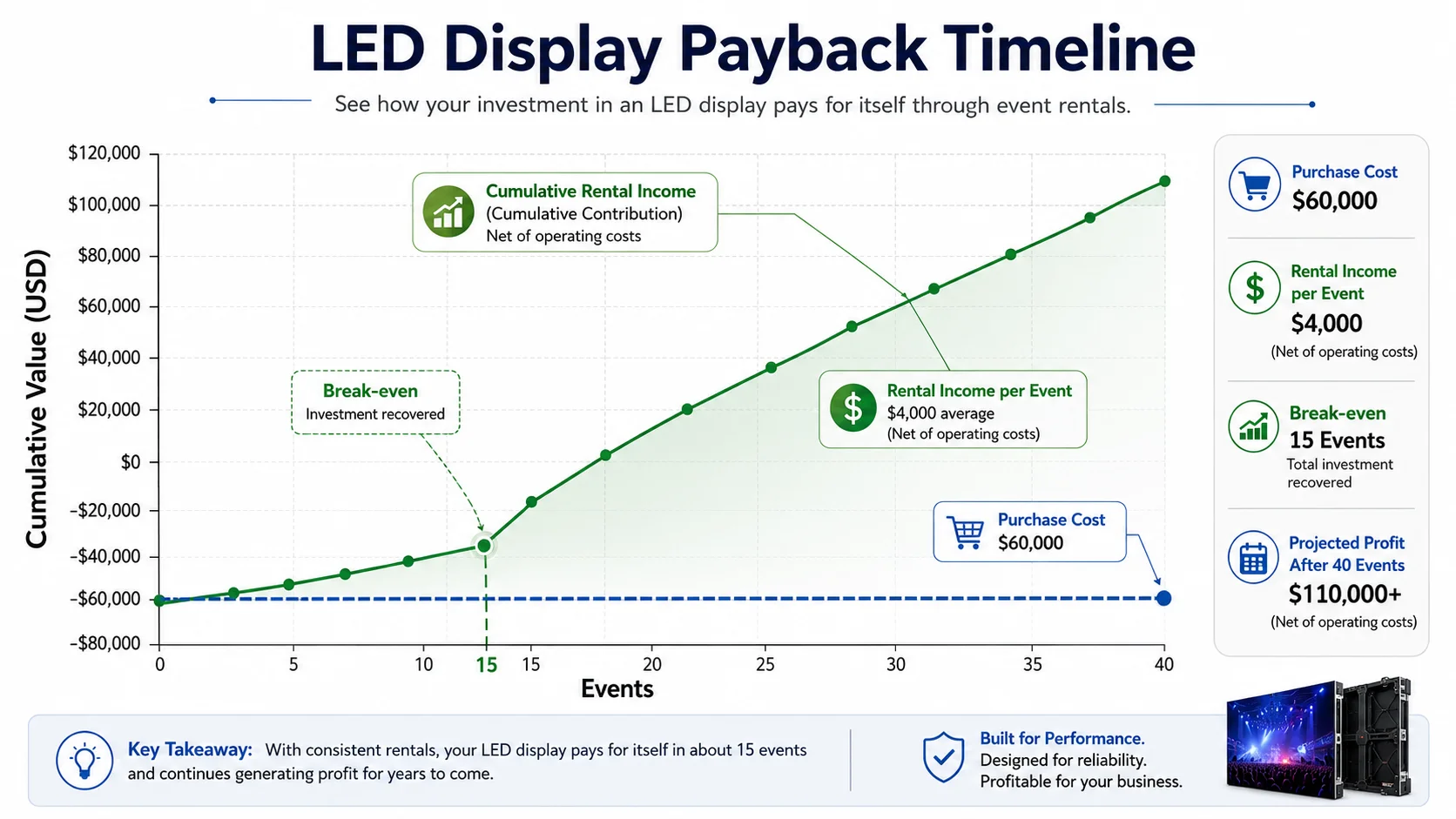
Assume a purchase price of $ 6,000, a rental rate of $ 1,200 per event, and variable costs of $ 300 per event for labor, transport, and wear. The contribution is $ 900 per event. At that rate the wall is fully paid back in about 7 events, and everything after that is profit.
The conservative case uses the bottom of the ranges: a $ 9,000 wall renting for $ 1,000 with $ 400 in costs contributes $ 600 and pays back in about 15 events. The aggressive case uses the top: a $ 5,000 wall renting for $ 2,000 with $ 200 in costs contributes $ 1,800 and pays back in about 3 events.
Both extremes are real, which is why the honest answer to "how long to pay back" is 8 to 15 events for a P3.91 wall under normal bookings. The operating-cost figure here is an assumption for planning, not a universal number; your labor rates and travel distances change it.
| Pitch | Purchase (est.) | Rental per event (est.) | Contribution (est.) | Payback (est.) |
|---|---|---|---|---|
| P3.91 | $ 800-$ 1,500/㎡ | $ 1,000-$ 2,000 | $ 700-$ 1,700 | 8-15 events |
| P2.6 | Higher | $ 1,500-$ 2,500 | Higher | Similar |
| P1.9 | Highest | $ 2,000-$ 3,000+ | Highest | Market-dependent |
Setup and Labor: The Hidden Cost
Labor is the cost that quietly decides whether an LED wall is profitable.
A projector takes minutes and one person. An LED wall takes a crew, a frame, and careful panel alignment. A 6-square-meter wall typically needs two people and a couple of hours for a clean build, more for a curved or hanging configuration. Every hour of setup is money out of the per-event contribution.
This is why the rental operators who do well treat setup efficiency as seriously as the purchase price. Faster rigging means more events per weekend, and more events per weekend is what actually compounds the return. The LED rental display guide explains what a typical build-out requires so you can plan labor before you buy.
Which Pitch Pays Back Fastest
The three pitches pay back on different schedules.
P3.91 pays back fastest because the upfront cost is lowest and the rental market for it is the broadest. It is the volume play.
P2.6 and P1.9 cost more per square meter, so they need the higher end of the rental range to keep payback in the same window. They earn their keep on close-viewing jobs where a coarse pitch would look soft: lobbies, press walls, stage upstage, and premium corporate work.
The practical rule is to start with P3.91 for volume and add a finer pitch once the demand for close-viewing jobs is proven. Do not buy the finest pitch first and hope the premium market appears; buy the pitch your bookings already justify.
Fact: EventGolden exports LED displays to over 200 countries, with North America at 55% and Western Europe at 17%, backed by TÜV Rheinland certification, a 5-year warranty, and 20+ overseas warehouses.
Hidden Costs
Four costs catch first-time buyers off guard.
Transport and cases. An LED wall travels in heavy flight cases, and the wall plus cases plus frame does not fit in a small vehicle. Trucking or a van is part of the per-event cost.
Spare modules and parts. LED walls fail module by module, and a dead module in the middle of an event is a reputation problem. Carry spares and count them as part of the purchase.
Content and processors. The wall needs a video processor and cabling, and someone has to build content for the client. That is either your time or a line item.
Insurance and storage. A $ 6,000 wall is worth insuring, and it needs clean, dry storage between jobs. Both are small but real monthly costs.
None of these break the model, but they all reduce the per-event contribution, which is why the 8-to-15-event payback range is wider than people expect.
Bundling and Upsell
The fastest way to raise an LED wall's effective ROI is to stop renting it alone.
An LED wall pairs naturally with a dance floor for weddings and with a photo booth for corporate activations, and a bundled quote raises the total ticket while sharing transport and setup labor across two assets. That shared labor is the point: one crew, one truck, two revenue streams.
If you already run a dance floor or photo booth, the wall is an upsell rather than a new business. If you are starting from the wall, the reverse works too. Either way, the wall's ROI improves the moment it shares logistics with something else.
FAQ
Is an LED wall rental profitable?
Yes, when the wall is booked often enough. A typical P3.91 rental wall earns $ 1,000 to $ 2,000 per event, and after roughly $ 200 to $ 400 in labor, transport, and wear, it contributes $ 700 to $ 1,700 per event. At that rate a $ 5,000 to $ 9,000 wall pays for itself in about 8 to 15 events. Profitability comes from booking frequency, not from a single high ticket.
How much does an LED video wall cost?
Rental-grade LED panels are typically priced per square meter. A P3.91 panel commonly runs $ 800 to $ 1,500 per square meter, a P2.6 panel costs more, and a P1.9 panel is the most expensive. A common 10x6 foot wall, roughly 6 square meters, lands around $ 5,000 to $ 9,000 for P3.91. These are industry estimates and vary by brand, cabinet design, and region.
How much can I charge to rent an LED wall?
Rental rates vary by market, size, and pixel pitch. A P3.91 wall commonly rents for $ 1,000 to $ 2,000 per event, a P2.6 wall for $ 1,500 to $ 2,500, and a P1.9 wall for $ 2,000 or more. Premium markets and corporate work command the top of those ranges. Treat these as directional figures, not a rate card.
How long does it take for an LED wall to pay for itself?
Most operators recover the purchase price in 8 to 15 events, assuming a P3.91 wall and steady bookings. Finer pitches cost more upfront but can carry a higher rental rate, so their payback is similar or slightly longer. The single biggest lever on payback is setup efficiency, which cuts the labor cost that eats into each event's profit.
What is the ROI on an LED display?
ROI depends on the ratio of per-event contribution to purchase price. On a $ 6,000 P3.91 wall contributing $ 1,000 per event after costs, the wall is fully paid back in about 6 events and pure profit after that. Over a 50,000-hour panel lifespan, a wall that is booked weekly can return many times its purchase price.
How much does it cost to rent an LED screen per day?
Daily rates are the per-event rate divided across the booking, and they typically fall in the $ 500 to $ 1,500 range for a standard rental wall depending on size, pitch, and market. Multi-day bookings usually discount the daily rate. Use the per-event figure for planning, since transport and setup are charged per job rather than per day.
Is LED display rental a good business?
It is a strong add-on for an existing event rental company because it raises the average ticket and cross-sells with dance floors and photo booths. As a standalone business it is harder, because the wall needs steady bookings, skilled setup labor, and storage to justify the upfront cost. Most successful operators attach the wall to an existing fleet.
What is the profit margin on LED wall rentals?
Gross margin per event is high once the wall is paid off, because the main ongoing costs are labor and transport rather than consumables. With a $ 1,200 rental against $ 300 in variable cost, the contribution is about $ 900 per event, a 70%-plus margin before fixed overhead. The catch is that the wall must be booked consistently to reach that state.
Conclusion
An LED display is a compounding asset, not a one-off purchase. Its return comes from booking frequency and per-event contribution, and the wall pays for itself in roughly 8 to 15 events when the pitch matches the bookings.
Start with P3.91 for volume, protect the per-event contribution by keeping setup efficient, and bundle the wall with your existing inventory to share logistics. Do that, and the wall stops being a cost the week it breaks even.
Fact: EventGolden's LED display line spans P1.9, P2.6, and P3.91 rental screens plus indoor and outdoor advertising panels, built for both rental and fixed installation.
Explore the EventGolden LED display range to compare P1.9, P2.6, and P3.91 panels and run your own payback math with a quote.
Sources
- EventGolden (Event Golden). "LED Display." Event Golden product page. https://eventgolden.com/products/led-display/: Manufacturer specifications for P1.9, P2.6, and P3.91 rental screens. Purchase, rental, and payback figures marked "typical" are industry estimates, not manufacturer quotes.
- ViewSonic. "Large Venue Display Solutions: Direct View LED vs Projectors." https://www.viewsonic.com/library/tech/large-venue-display-solutions-direct-view-led-vs-projectors/: total-cost and lifespan comparison reference.
- Planar. "LED Video Walls." https://www.planar.com/products/led-video-walls/: LED panel specifications and pixel-pitch guidance.
Ready to start your event business?
Get a free wholesale quote within 24 hours. Product details are confirmed by direct inquiry.
Get a Free Quote