LED Video Wall vs Projector: Which Should You Use for Your Event?
LED video wall vs projector compared: brightness, pixel pitch, cost, setup, and lifespan. Which fits your event?
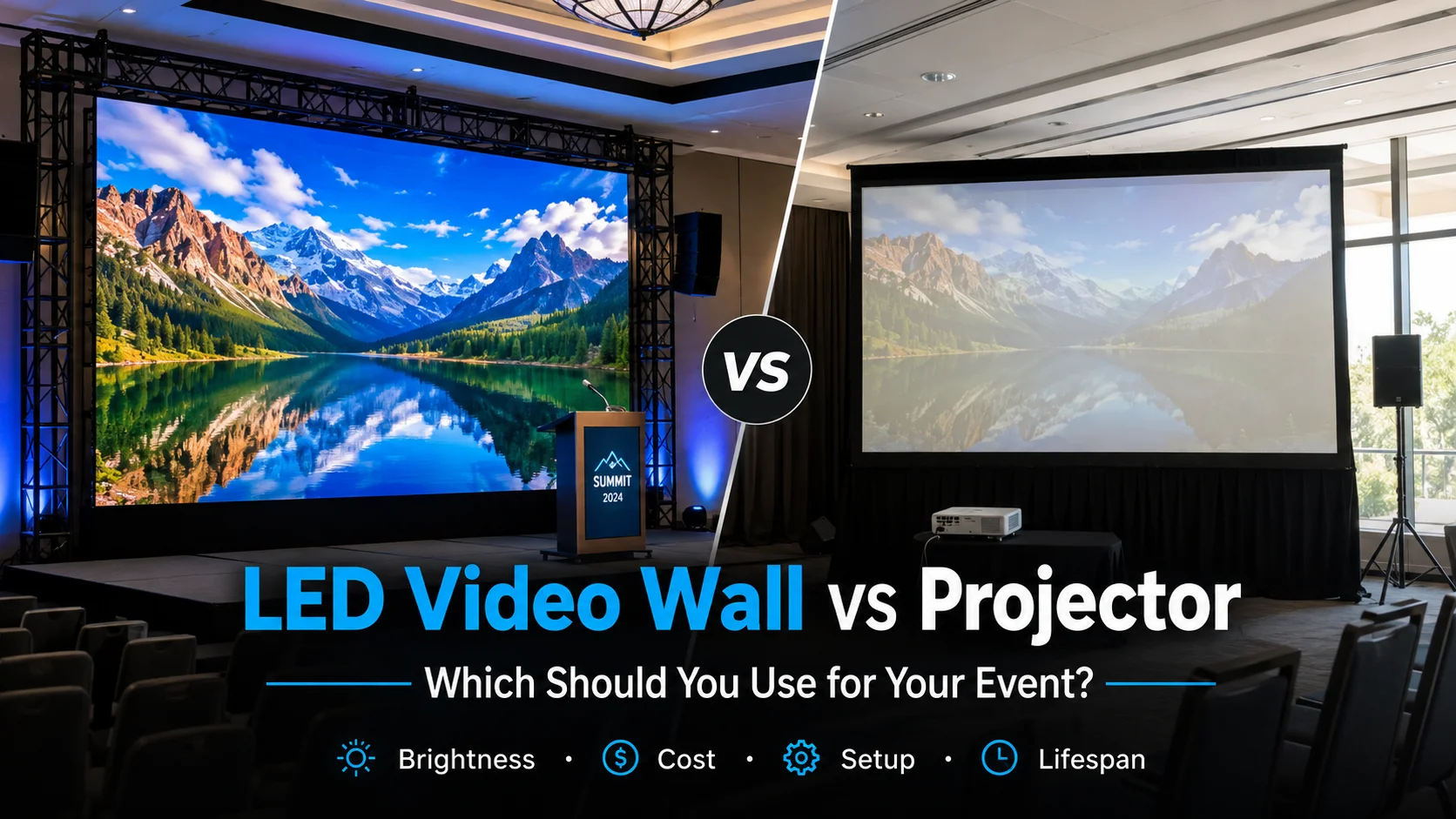
Which Should You Use for Your Event?
An LED video wall and a projector solve the same problem: making sure everyone in the room can see the content. They do it in opposite ways, and picking the wrong one shows up the moment the house lights come up or the sun hits the screen.
This is a decision about environment, not just about technology. The venue, the light, the budget, and how often you will use the equipment decide the winner more than any spec sheet does.
Here is the comparison I would make, dimension by dimension, ending with a clear rule for which to choose.
Brightness: The Deciding Factor in Ambient Light
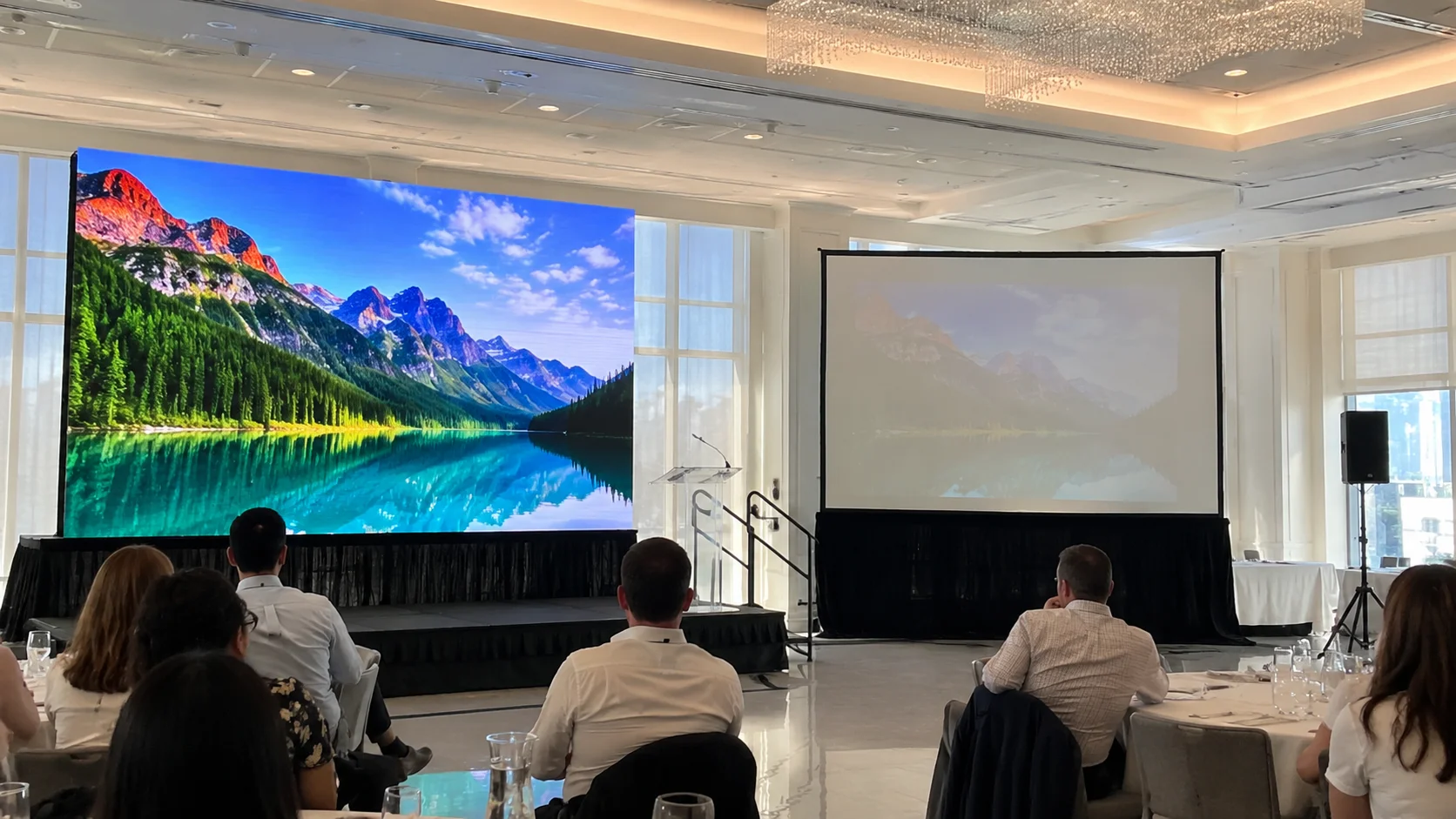
If there is one number that settles this debate, it is brightness. A projector depends on reflected light, so it loses contrast the moment ambient light hits the screen. An LED wall emits light directly from each pixel, so it holds up in conditions that would flatten a projector.
The units differ, which makes direct comparison confusing. LED panels are rated in nits, with a typical indoor panel running 1,000 to 2,000 nits and outdoor panels going 4,000 nits and higher. Projectors are rated in lumens, and even a bright 10,000-lumen unit struggles against daylight or strong house lights.
The practical rule: if the room has windows, bright uplighting, or is outdoors, the LED wall wins. If the room can be made genuinely dark, a projector can look great. For a deeper look at indoor versus outdoor requirements, the indoor vs outdoor LED display guide breaks down brightness thresholds by environment.
Resolution and Pixel Pitch
Resolution is where people get LED walls wrong. An LED wall's sharpness depends on pixel pitch, the distance between the centers of adjacent LEDs, measured in millimeters. A smaller number means a tighter, sharper image.
A P3.91 panel is a rental workhorse: bright, affordable, and fine for viewing from 4 meters or more. A P2.6 panel steps up sharpness for mid-distance viewing. A P1.9 panel is near-retina and suits close viewing in lobbies, stages, or press walls.
The key is matching pitch to viewing distance. Buy or rent a finer pitch than you need and you pay for resolution nobody sees. Go too coarse and the image looks blocky up close. The LED rental display guide explains how to pick a pitch for your typical event size.
A projector, by contrast, has a fixed native resolution such as 1080p or 4K. It looks sharp at any viewing distance as long as the room is dark, but it cannot scale its brightness the way a coarse-pitch LED wall can.
Cost: Purchase, Operating, and Lifetime
The sticker price tells only a third of the story. You also have operating cost and lifetime cost.
A projector is cheaper upfront. A solid 1080p or 4K unit can cost a fraction of an equivalent-size LED wall, and the screen is inexpensive. That makes projectors the default for one-off events and small venues.
An LED wall costs more per square meter to buy, and it is not subtle about it. But the operating math flips over time. LED panels run 50,000 to 100,000 hours with no lamp to replace, while projector lamps commonly last 2,000 to 20,000 hours and dim as they age. Every lamp swap is a recurring cost a projector owner keeps paying.
For a rental fleet, the lifetime view favors LED. The wall earns revenue across hundreds of bookings, and its brightness and reliability support a higher rental rate. For a single event, renting either option beats buying, and a projector usually rents cheaper. Prices here are industry estimates and vary by pitch, brand, and region, so treat them as directional rather than exact.
Setup and Rigging
Setup time is a hidden cost that hits rental operators hardest.
A projector is fast to deploy. Mount it or set it on a table, raise the screen, focus, and you are done in minutes. One or two people can handle a single-projector setup, which keeps labor costs low.
An LED wall is modular. Each cabinet or panel clips onto a frame and locks to its neighbors, and the wall is built to the exact width and height the event needs. It takes more people and more time than a projector, but it also scales to shapes a projector cannot do: curved walls, tall columns, or a full stage backdrop.
The tradeoff is labor versus capability. A projector wins on setup speed; an LED wall wins on shape and size flexibility. If you are building a rental fleet, the LED rental display guide covers what a typical build-out actually requires.
Outdoor and High-Ambient-Light Use
This is the LED wall's home turf, and the comparison stops being close.
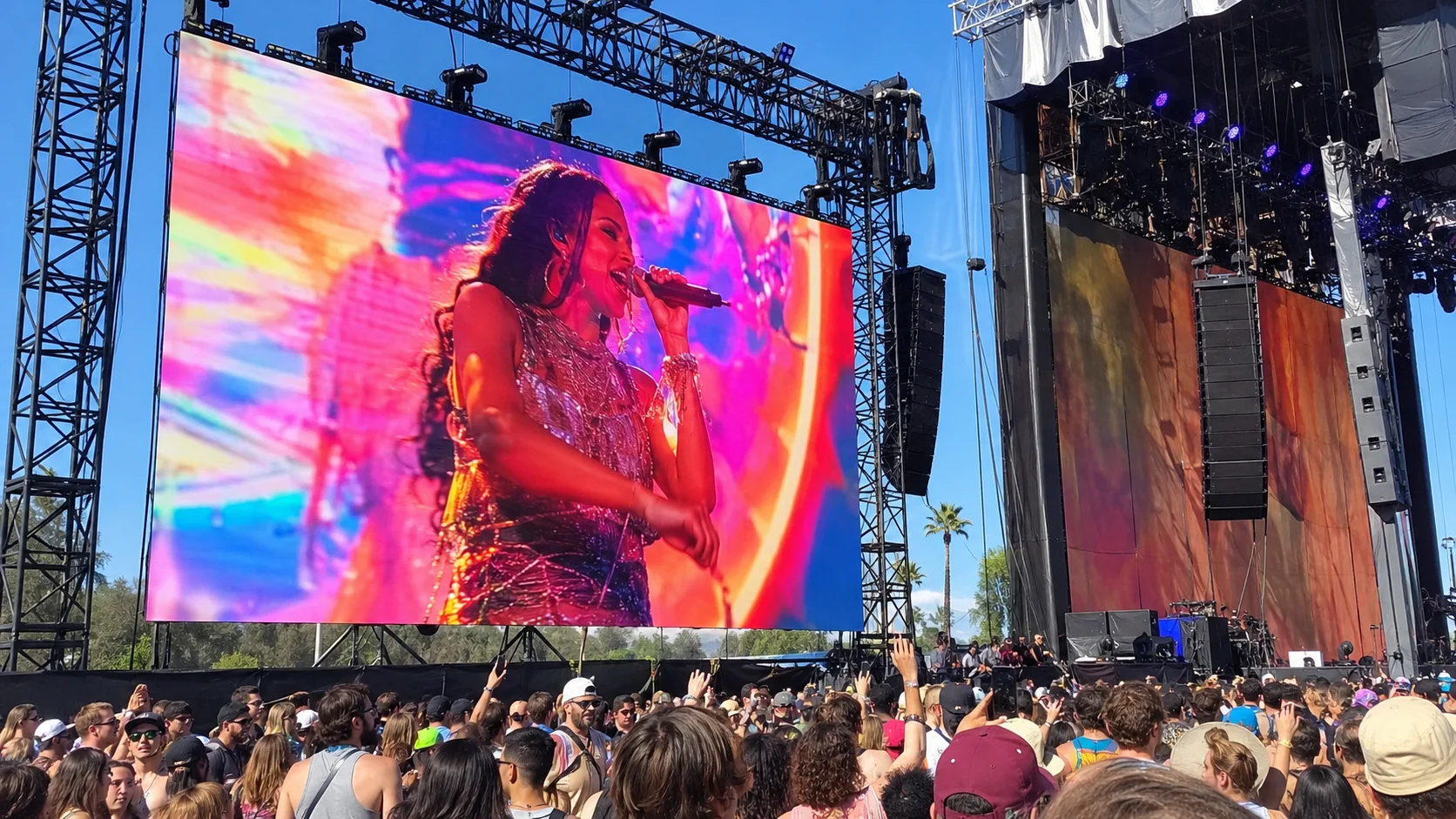
A projector outdoors needs darkness and a large shade structure to be readable at all. Even then, wind moves the screen, and any stray light kills contrast. An outdoor-rated LED wall is built for daylight, with high-brightness panels and weather-sealed cabinets.
If the event is daytime, open-air, or has unavoidable windows, the decision is already made. LED is the only option that stays visible.
Lifespan and Maintenance
Both technologies need care, but the failure points differ.
LED panels are rated for 50,000 to 100,000 hours, and failures are usually isolated to individual modules. When a module dies, you replace that module, not the wall. That modularity keeps a rental fleet running through years of abuse.
A projector's weak point is the lamp and, over time, dust on the optics. Lamps are consumable and dim as they age, so a projector loses brightness gradually until you swap the lamp. Laser projectors stretch lamp life to 20,000 hours or more, but the upfront cost rises accordingly.
For a business that books equipment every weekend, the LED wall's durability and per-module repair usually win. For occasional use, a projector's simplicity is hard to argue with.
Head-to-Head Comparison
| Dimension | LED Video Wall | Projector |
|---|---|---|
| Brightness | 1,000-2,000 nits indoor; 4,000+ outdoor | 3,000-20,000 lumens, washes out in ambient light |
| Resolution | Pixel pitch (P1.9-P3.91) matched to viewing distance | Fixed native (1080p/4K), sharp in dark rooms |
| Upfront cost | Higher per square meter | Lower |
| Operating cost | No lamps; module-level repair | Recurring lamp replacements |
| Lifespan | 50,000-100,000 hours | 2,000-20,000 hours per lamp |
| Setup | Modular, more labor, any shape | Fast, limited by screen |
| Best for | Bright rooms, outdoors, large venues, repeat rental | Dark controlled rooms, one-off, budget, quick setup |
Which Should You Choose?
Match the tool to the job, not the other way around.
Choose an LED wall when the event is bright, outdoor, or large, when you need a seamless image behind a stage or press wall, or when the equipment will be booked repeatedly. The higher purchase price is justified by brightness, durability, and rental revenue.
Choose a projector when the room can be made dark, when the budget is tight, when setup needs to happen in minutes, or when the event is a one-off. The projector wins on speed and upfront cost and still looks excellent in a controlled environment.
For most event rental businesses, the answer is both, acquired in that order. Start with the LED wall for your headline events, then add a projector for the dark, small, and budget-conscious bookings.
Fact: EventGolden's LED display line spans P1.9, P2.6, and P3.91 rental screens plus indoor and outdoor advertising panels, built for both rental and fixed installation.
FAQ
Is an LED wall better than a projector?
It depends on the room and the light. In a bright room or outdoors, an LED wall wins because it stays visible where a projector washes out. In a dark, controlled venue with a large throw distance and a tight budget, a projector is often the better value. Match the tool to the environment instead of asking which one is better in general.
LED wall vs projector cost: which is cheaper?
A projector is usually cheaper upfront, especially for a large image. An LED wall costs more to buy per square meter, but it lasts far longer and needs no bulb replacements, so the lifetime cost per event can be lower. For one-off events a projector often wins on price; for a rental fleet or permanent install, the LED wall pays back over time.
Which is brighter, an LED wall or a projector?
LED walls are brighter in practice because they emit light directly and hold up under ambient light. A typical indoor LED panel runs 1,000 to 2,000 nits, and outdoor panels go 4,000 nits and higher. Projectors are rated in lumens, and a bright 10,000-lumen unit still loses contrast the moment house lights or daylight hit the screen.
Can LED video walls be used outdoors?
Yes, and this is where they pull away from projectors. High-brightness outdoor LED panels are built to handle daylight and weather. A projector outdoors needs a dark environment and a large shade structure to be readable at all. If the event is daytime or open-air, an LED wall is the practical choice.
How long do LED walls last compared to projectors?
LED panels are typically rated for 50,000 to 100,000 hours of use, which is years of continuous operation. Projector lamps commonly run 2,000 to 20,000 hours depending on the technology, and they dim as they age. Over a long ownership period, the LED wall's durability offsets its higher purchase price.
Is an LED video wall worth the cost for events?
For a rental business, yes, because the wall earns revenue across many events and its brightness and reliability justify a higher rental rate. For a one-time event, renting is usually smarter than buying either option. The LED wall becomes worth it when it is an asset you can book repeatedly rather than a cost you absorb once.
What is the difference between LED and LCD video walls?
An LED wall is built from individual LED modules tiled together, so it is seamless, bright, and scalable to almost any size. An LCD video wall is made from flat panels with visible bezels between them and is better suited to indoor, controlled lighting. For events and large venues, LED is the more common choice because of brightness and seamlessness.
LED wall vs projector for weddings: which should I rent?
If the reception is indoors with controlled lighting and you want a large soft image on a budget, a projector works. If the room has windows, bright uplighting, or you need a crisp image behind the couple during a daytime event, an LED wall holds up far better. Many wedding pros rent an LED wall for the main visual and keep a projector as a backup.
Conclusion
An LED video wall and a projector are not competitors in every room. They are the right tools for different rooms.
The LED wall is the asset for bright, outdoor, large-scale, and repeat-rental work, where its brightness, seamless build, and 50,000-hour lifespan justify the higher price. The projector is the fast, affordable tool for dark rooms, tight budgets, and one-off events.
Most rental businesses end up owning both. If you are starting with one, start with the wall.
Fact: EventGolden exports LED displays to over 200 countries, with North America at 55% and Western Europe at 17%, backed by TÜV Rheinland certification, a 5-year warranty, and 20+ overseas warehouses.
Explore the EventGolden LED display range to compare P1.9, P2.6, and P3.91 panels and get a quote for your next event.
Sources
- EventGolden (Event Golden). "LED Display." Event Golden product page. https://eventgolden.com/products/led-display/: Manufacturer specifications for P1.9, P2.6, and P3.91 rental screens and indoor/outdoor panels. Brightness, lifespan, and cost figures marked "typical" are industry-standard ranges, not manufacturer quotes.
- ViewSonic. "Large Venue Display Solutions: Direct View LED vs Projectors." https://www.viewsonic.com/library/tech/large-venue-display-solutions-direct-view-led-vs-projectors/: brightness, resolution, and total-cost comparison reference.
- Planar. "LED Video Walls." https://www.planar.com/products/led-video-walls/: LED panel specifications and pixel-pitch guidance for viewing distance.
Ready to start your event business?
Get a free wholesale quote within 24 hours. Product details are confirmed by direct inquiry.
Get a Free Quote