Photo Booth Private Label: How a Branded Booth Line Actually Works
What a photo booth private label or ODM program covers: hardware branding, software splash screens, print templates, packaging, certification and launch.
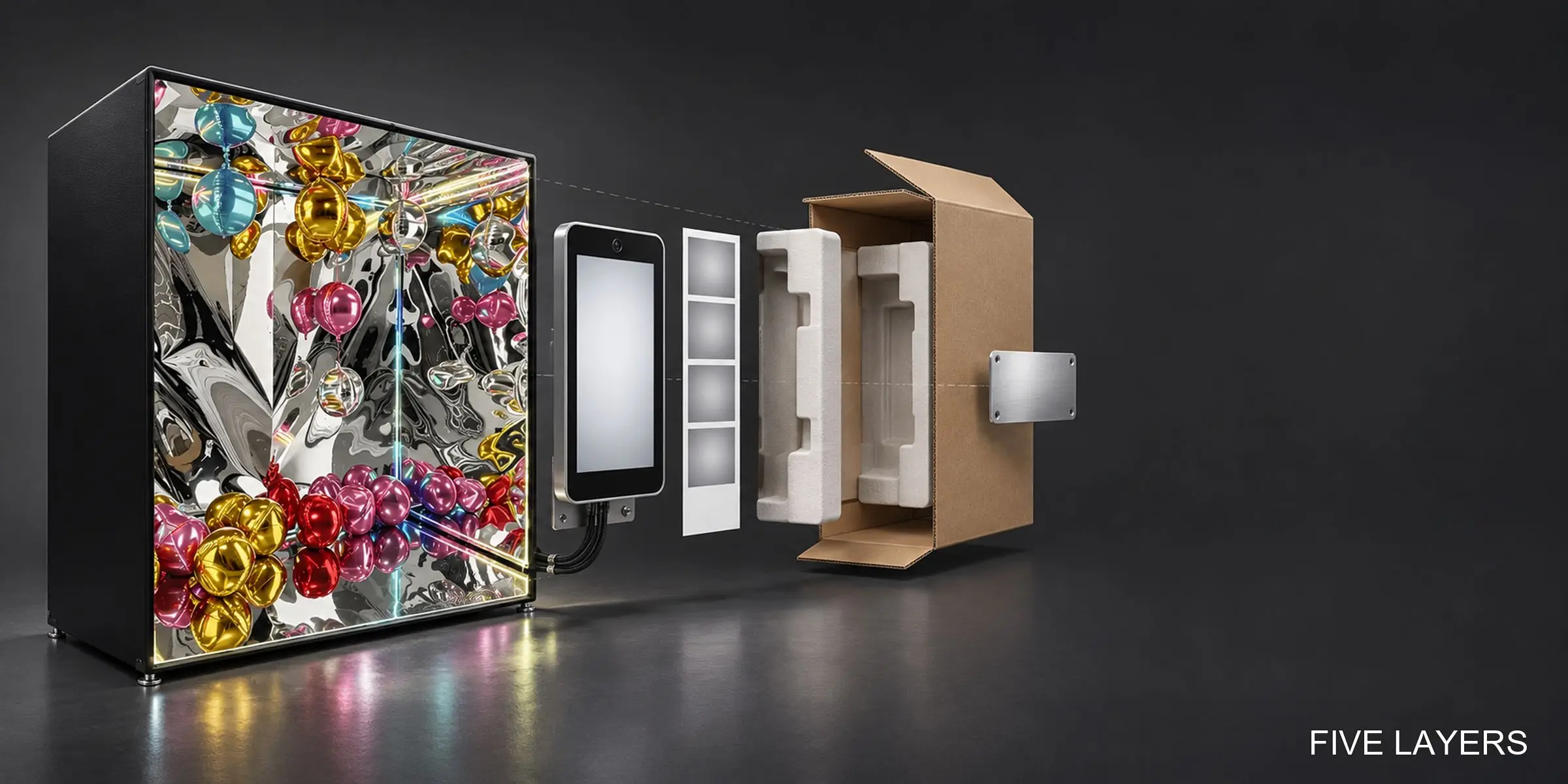
Photo Booth Private Label: How a Branded Booth Line Actually Works
A photo booth private label enquiry usually gets answered with a price list and a sentence about putting your logo on the shell. The parts that decide whether the line survives its second year sit behind it. Who owns the app your guests touch? Does an update wipe your start screen? Whose company name is printed on the rating label, and who signs the declaration behind it?
This guide covers the five branding layers a booth program contains, how each is set up and repeated, how software branding breaks, and what a first order looks like when the product carries someone else's name.
It is not a factory selection guide. Comparing candidate suppliers and reading a capability profile is covered in the photo booth manufacturer guide. What follows assumes you have a shortlist and now need to describe, price and control a branded program.

What a private label booth program actually covers
The word branding hides five layers that behave differently. The shell is a finishing decision. The software is a licensing decision. The print template is an artwork ownership decision. The packaging is a print run decision. The rating label is a legal decision.
Suppliers quote them as one bundle because that is easier to sell. It is much harder to control that way, and a program with a beautiful shell and a factory logo on the start screen reads as unfinished to every guest.
| Layer | What it covers | Typical owner | Question that decides it |
|---|---|---|---|
| Shell and hardware | Paint or powder coat colour, wrap, silkscreen, badge plates, anodized extrusion | Factory finishing line | Is this a stock finish or a new setup, and who holds the artwork |
| Software | App name, start screen, share page, watermark, gallery domain | Software rights holder | Can it be changed by you, and does an update revert it |
| Print output | Template layout, frame, logo placement, paper and ink supply | Whoever draws the artwork | Do you receive an editable file, and is media locked to one supplier |
| Packaging and documents | Carton print, inserts, manual languages, warranty card | Factory print buyer | What is the print run, and who approves the proof |
| Legal identity | Rating label, declaration of conformity, importer details, origin marking | The entity placing the product on the market | Whose name and address appear, and who signs |
Only one of those five is genuinely about appearance, and three are documents rather than objects. Documents are cheap to change before printing and expensive to change after, which is the single most useful fact in this article.
Fact: Event Golden manufactures 360 overhead and platform booths, mirror booths, iPad booths and magazine box booths, supports OEM and ODM customization, and holds TÜV Rheinland certification plus CE, RoHS, FCC, LVD and CB compliance.
One scope question sits above the layers. Are you rebranding an existing model, or commissioning a variant? The first is a finishing and documentation job, the second a development job with tooling and new test reports.
Shell and hardware branding
Four finishing methods cover most booth work, and they are not interchangeable. Each changes how long the branding lasts, how much setup it needs, and how easily you can change your mind.
Powder coating is the durable choice for steel frames. It needs a batch large enough to justify a dedicated coating run, and colour drift between runs is the thing to check. Vinyl wrap reaches full photographic coverage fastest and has the shortest life, because heat, handling and flight cases lift edges.
Silkscreen puts flat marks on flat panels, so the cost per unit is low once the screen exists but the screen itself must be stored and remade. Anodized aluminium with laser marking gives colour inside the metal rather than on it, with a limited palette.
| Method | Best suited to | Durability in rental use | Setup implication | Watch for |
|---|---|---|---|---|
| Powder coat | Steel frames and bases | High | Dedicated coating run per colour | Batch-to-batch colour drift |
| Vinyl wrap | Full-graphic coverage, fast launch | Low to medium | Print and laminate per set | Edge lift, reorder colour match |
| Silkscreen | Logos and model names on flat panels | Medium to high | Screen made once per artwork | Screen storage and remake cost |
| Anodized plus laser | Visible aluminium frames | High | Anodizing batch per colour | Limited palette, mark contrast |
Two details decide whether the finish survives rental use. The first is where the logo sits relative to hands and flight cases, since a mark on a high-traffic panel fails first whatever the method. The second is touch-up: a program with no answer for a scratched shell turns a small mark into a retired asset.
Badge plates, control box labels, connector panels and case hardware also carry marks, and each is a separate part number at reorder time.
Software branding and the splash-screen problem
Software is where branded programs fail quietly. The booth looks right, the guests queue up, and the screen says the factory's name. Fixing that is not a design task, it is a rights question.
Four ownership models turn up. The factory writes and owns its own app. The factory licenses a third party app with limited rebranding rights. You supply and configure your own app on their hardware. Or the booth runs a general tablet app you control.
Only the first and last give you real control. The second is the trap, because the sales conversation describes the app as theirs while the licence says otherwise.
| Software model | Who can rename it | Start screen editable | Survives update | Practical risk |
|---|---|---|---|---|
| Factory-owned app | Factory, on request | Usually yes | Depends on build process | Branding reverted by an update |
| Licensed third party app | Licence holder only | Rarely | Not applicable | A rebrand promise that cannot be delivered |
| Your app on their hardware | You | Yes | Yes, under your release process | You own testing and support |
| Generic tablet app | You | Yes | Yes | Fewer booth-specific features |
The mechanism is worth understanding. If your branding is compiled into a released application package, any update must be rebuilt with it included. If it loads as a separate asset on the device, an update may overwrite the folder holding it. Ask which applies, and what the update does to files it did not create.
Three questions expose the answer faster than a specification sheet. Can you film the branded start screen on a demo unit today? Which version number is on that unit? After the next update, will the screen still be there?
Get that in writing with a version reference attached, because a verbal yes is worth little a year later.
The same logic covers everything downstream of the camera. Share pages, gallery domains, QR destinations, watermarks and email templates are all branding surfaces, and several are hosted rather than stored on the device. Ask where the images go, who administers that account, and what happens to guest photos if you change suppliers.
Fact: Event Golden has 13 years of manufacturing experience, runs its own production rather than reselling finished goods, and keeps 20+ overseas warehouses.
One test before signing: ask for the branding change to be shown on a unit already in production, not a development sample. Development units are configured by engineers who know where the files live.
Print templates and consumables
The print is the part guests take home, which makes it the most visible branding surface and the layer most often left undefined in a supply agreement.
Start with file ownership. A template delivered as a flattened image is a picture of your design. A template delivered as an editable layered file is an asset you can adapt. Ask for the layered source, the application version it needs, and permission to modify it without approval.
Then establish who draws it. Some factories drop your logo into a stock frame, which is fast and looks like everyone else's. Others build a layout to your brief, which needs a proof cycle and a decision about who approves the final print.
Consumables raise a commercial question that is easy to miss. Some booths accept standard dye sublimation media from several suppliers, while others are configured for a specific media size or a chipped cartridge.
| Item | Owned by you | Owned by factory | Why it matters later |
|---|---|---|---|
| Editable template | Adapt whenever you like | Changes need a request | Seasonal campaigns stall |
| Flattened template | Usable as delivered | Effectively locked | New formats mean new artwork |
| Media supply | Open market | Single source | Running cost and continuity risk |
| Ink or ribbon | Open market | Single source | Margin depends on one supplier |
Test the print path before the pilot. Print your template on the media you intend to buy and check how skin tones and dark backgrounds read on paper.
Packaging, manuals and rating labels
Packaging is a print run, and print runs have minimums. That reshapes a branded program, because a carton with your logo may only be economical above the number of booths you plan to sell in a quarter.
Decide early between retail and transit packaging. A rental business shipping between venues needs a carton that survives repeated handling and a case that protects the booth in a van. A distributor selling into retail needs shelf presentation and a barcode.
A branded manual has to match the configuration actually shipped, in the languages of your markets, with the safety information each market requires. A translated manual describing a different model is worse than no manual, because it is evidence of a documentation failure.
Rating labels are the smallest printed item and the most consequential. A label usually carries the model designation, electrical ratings, the manufacturer or importer name and address, the CE mark where applicable, and any waste or battery symbols the market requires.
| Document | What it must match | Common failure |
|---|---|---|
| Outer carton | Model, quantity, gross weight, origin marking | Artwork approved before the model code was final |
| Manual | Shipped configuration and market language set | Translated from an older model version |
| Rating label | Declaration of conformity and importer details | Factory name left on a product sold under your brand |
| Warranty card | The entity that will actually honour it | Card names a party with no service route |
Serial numbers deserve their own line. If your brand is on the label, your support desk needs to identify a unit from its serial alone: build date, configuration, software version at shipment. Ask how the numbering works and whether the factory supplies a shipment-level serial list.
Bundling booths with other equipment adds a packaging complication, because mixed shipments change carton counts, weights and documentation sets. The bundling guide covers how those combinations are usually structured.
Certification: whose name goes on the label
This is the layer branded programs get wrong most often, because the commercial conversation is about logos and the regulatory one is about liability. They meet on the rating label.
Under EU rules the manufacturer carries out the conformity assessment, sets up the technical file, issues the EU declaration of conformity and affixes the CE marking. CE marking is that declaration. It is not an approval granted by an authority, and no EU certificate proves a booth compliant [1].
The same EU guidance adds the sentence that matters here. If importers or distributors market products under their own names, they take over the manufacturer's responsibilities and must hold enough design and production information to carry them [2]. A branded booth sold into the EEA is therefore a different legal object from the same booth sold under the factory's name.
The United States works differently with a similar effect. Radio frequency devices need equipment authorization before marketing or importation, through certification or a supplier's declaration of conformity. Under certification the responsible party obtains a registration number and grantee code, and the FCC ID is issued to that grantee [3]. A reseller rebranding a booth does not inherit that identity, so label and manual text have to be handled deliberately.
| Obligation | Who acts | Document involved | Ask before printing |
|---|---|---|---|
| EU conformity assessment | The entity that is manufacturer in law | Technical file, declaration of conformity | Which entity signs, and who keeps the file |
| Affixing the CE mark | Manufacturer, or importer taking over that role | Declaration of conformity | Does the branded version stay inside the tested configuration |
| US RF authorization | Responsible party named in the filing | Grant or supplier's declaration, test report | Certification or SDoC, and whose grantee code |
| US labelling and user information | Responsible party | Label artwork, compliance statement in manual | Are label and manual included in the change |
| Quality management | Factory | ISO 9001 certificate | Issued to which site, valid until when |
| Origin marking | Importer | Marked country of origin | Where substantial transformation occurs |
Two clarifications prevent expensive confusion. ISO 9001 certifies a quality management system, not a product, so it describes how production is controlled and says nothing about whether a booth meets a safety standard [4]. Country of origin marking is also separate from any brand claim, which is why FTC guidance dwells on the gap between a product made abroad and one marketed as domestic [5].
If your plan changes the radio module, the power architecture or the enclosure around the antenna, treat certification scope as open until a lab confirms it in writing. Cosmetic changes usually sit inside an existing report. Functional ones usually do not.

Setup cost vs repeat minimum
Branded programs get priced badly because one-off charges and per-batch charges arrive as a single figure. Split them and the economics become visible.
Setup costs only make sense at volume: tooling, screens, artwork adaptation, sample builds, extra test work, packaging plates. Batch costs repeat: units, cartons, labels, manuals, freight. A third category is neither, and pretending otherwise is how disputes start.
| Cost type | Examples | Behaviour as volume rises | How to handle it |
|---|---|---|---|
| One-time setup | Tooling, screens, artwork adaptation, branded sample | Spread thinner per unit | Ask for it as a separate line, amortised or not |
| Per batch | Units, cartons, labels, manuals, freight | Scales with quantity | Confirm what triggers a new batch minimum |
| Written confirmation | order quantity structure, lead time, payment terms, exclusivity, territory | Varies by configuration | Never accept a verbal figure, ask for it in the offer |
The minimum order question needs more care than it gets. A per-order minimum is easy to meet. A per-model, per-colour or per-artwork minimum multiplies, and branded packaging often carries its own separate minimum above the product minimum.
Ask for the structure rather than the number. "What is your order quantity" invites a figure that may not apply to your configuration. "Which minimums apply to one branded model in one colour with printed cartons" invites a plan. The RFQ template sets out the fields that make those answers comparable across suppliers.
Launch sequence and first-order checklist
A branded line launches in a fixed order if you want to avoid reprinting anything. The sequence below front-loads decisions that are expensive to reverse.
- Define the brand architecture: which models carry your name, and whether it appears alone or beside a "manufactured by" line.
- Choose the platform before the finish, because a 360 booth and a magazine box booth present very different branding surfaces.
- Request a branded sample with the production software build, not a development build.
- Settle asset ownership in writing: artwork, screens, tooling, template files, app signing keys.
- Confirm the certification position for each destination market before any packaging is printed.
- Approve carton, manual and label proofs against the final model code.
- Run a pilot batch and inspect it before shipment.
- Build content assets from the pilot units, so photography shows what customers receive.
The first-order checklist is short and unglamorous. Model code and configuration. Software version and branding behaviour after update. Artwork received and archived. Tooling ownership documented. Carton and manual proofs signed. Label content matched to the declaration. Serial range recorded. Spare parts and warranty route confirmed.
For a 360 program, the factory direct guide explains how 360 photo booth wholesale orders are structured and where branding decisions land in that flow. Buyers still comparing formats often start with the overhead 360 platform and the magazine box booth, because branding surface area differs sharply between them.
Fact: Event Golden exports to more than 200 countries, with North America at 55% of sales and Western Europe at 17%, and backs its equipment with a 5-year warranty.

FAQ
What does a photo booth private label program include?
Five layers: shell and hardware finish, software, print template, packaging and documentation, and the legal identity on the rating label. Suppliers often quote only the first two. Each layer carries its own setup cost, its own ownership question and its own failure mode, so specify them one at a time rather than agreeing a single branding package at the start.
Can I put my own brand on the booth software?
Only if the software rights allow it. A factory that writes its own app can usually rename it and change the start screen. A factory licensing a third party app may have no rebranding right at all. Ask which model applies, ask to see the settings screen on a demo unit, and ask what a software update does to your branding afterwards.
What is the difference between a photo booth ODM manufacturer and a private label supplier?
A private label supplier applies your brand to a product it already designs. A photo booth ODM manufacturer designs a product or variant around your requirement, then builds it under your brand. The difference shows up in tooling, documentation and certification, because a genuine design change can move the product outside the factory's existing test reports.
Who is responsible when the booth carries my brand in the EU?
If you place the product on the EEA market under your own name, EU guidance states that you take over the manufacturer's responsibilities, including the technical file and the declaration of conformity. CE marking is a manufacturer's declaration rather than an authority approval, so confirm in writing which entity signs it and who holds the documentation.
Do I need a new FCC authorization for a branded booth?
Not for a cosmetic change, and usually yes for a change to the radio module, antenna or the enclosure around it. The FCC ID belongs to the grantee that filed it, so a reseller cannot print its own ID on the label. Ask whether the product is authorized by certification or supplier's declaration, and get the grantee name before printing packaging.
Does ISO 9001 mean the booth is certified?
No. ISO 9001 certifies a quality management system, meaning the factory has documented processes for control, traceability and improvement. It says nothing about whether a specific booth meets a specific safety standard. Ask for the product test reports and certificate numbers alongside the management certificate, and check which site the certificate covers.
How much does a branded booth program cost?
No honest figure exists before the five layers are specified, because setup cost sits mostly in artwork, tooling, sample builds and re-issued documentation rather than in units. Ask for a quotation separating one-time setup from per-batch charges. Treat any total given before that split as incomplete, and confirm every amount in writing against your specification.
Should the first order be a sample or a full container?
Neither. Run one branded sample, then a pilot batch large enough to expose repetition problems such as colour match across shells, carton fit, label accuracy and manual language. Inspect the pilot before it ships, since that is the cheapest point at which a process fault can still be corrected. Scale after it passes your checklist.
Conclusion
A branded booth line is a documentation project wearing a finishing job. The shell is the part everyone remembers to specify. The app name, print template, carton proof and declaration decide whether the line can be sold and renewed without renegotiating anything.
Start with the five layers, split setup from per-batch cost, and put ownership of files and tooling in writing before the first purchase order. Everything else is a scheduling problem once those are settled.
Event Golden builds 360 overhead and platform booths, mirror booths, iPad booths and magazine box booths, and supports OEM and ODM programs across them. To scope a branded line, send your target markets, the models you are considering and the branding surfaces you need.
Contact Event Golden to start a branded program, or review the magazine box booth if you are launching into a crowded rental market.
Sources
- European Commission. "CE marking." https://single-market-economy.ec.europa.eu/single-market/ce-marking_en. CE marking is a manufacturer's declaration, not an authority approval.
- European Commission. "Importers and distributors." https://single-market-economy.ec.europa.eu/single-market/goods/ce-marking/importers-and-distributors_en. Own-name marketing transfers the manufacturer's responsibilities.
- Federal Communications Commission. "Equipment Authorization." https://www.fcc.gov/engineering-technology/laboratory-division/general/equipment-authorization. Responsible party, grantee code and labelling rules for US entry.
- International Organization for Standardization. "ISO 9000 family: Quality management." https://www.iso.org/standards/popular/iso-9000-family. Management system certification is not product certification.
- Federal Trade Commission. "Complying with the Made in USA Standard." https://www.ftc.gov/business-guidance/resources/complying-made-usa-standard. Country of origin marking and origin claims, including substantial transformation.
Ready to start your event business?
Get a free wholesale quote within 24 hours. Product details are confirmed by direct inquiry.
Get a Free Quote