3D vs Star vs Magnetic LED Dance Floor: Which Should You Buy for Your Rental Fleet?
Compare 3D abyss, star, and magnetic RGB LED dance floors on visual impact, price, setup time, and ROI to pick the right floor for your rental fleet.
Most rental operators buying their first LED dance floor make the same mistake. They compare specifications and pick the floor with the best numbers. Then they discover the floor does not match the events they actually book.
The 3D vs star vs magnetic LED dance floor decision is not a spec comparison. It is a business decision about what kind of events you sell, what price point you operate at, and how fast you need your money back.
All three floors share the same core construction. They are modular tiles with magnetic connectors, a tempered glass surface, and IP67 waterproofing. What changes is the light effect and what that effect lets you charge. This guide breaks down the three types, compares them head to head, and gives you a decision framework for matching the floor to your event mix.
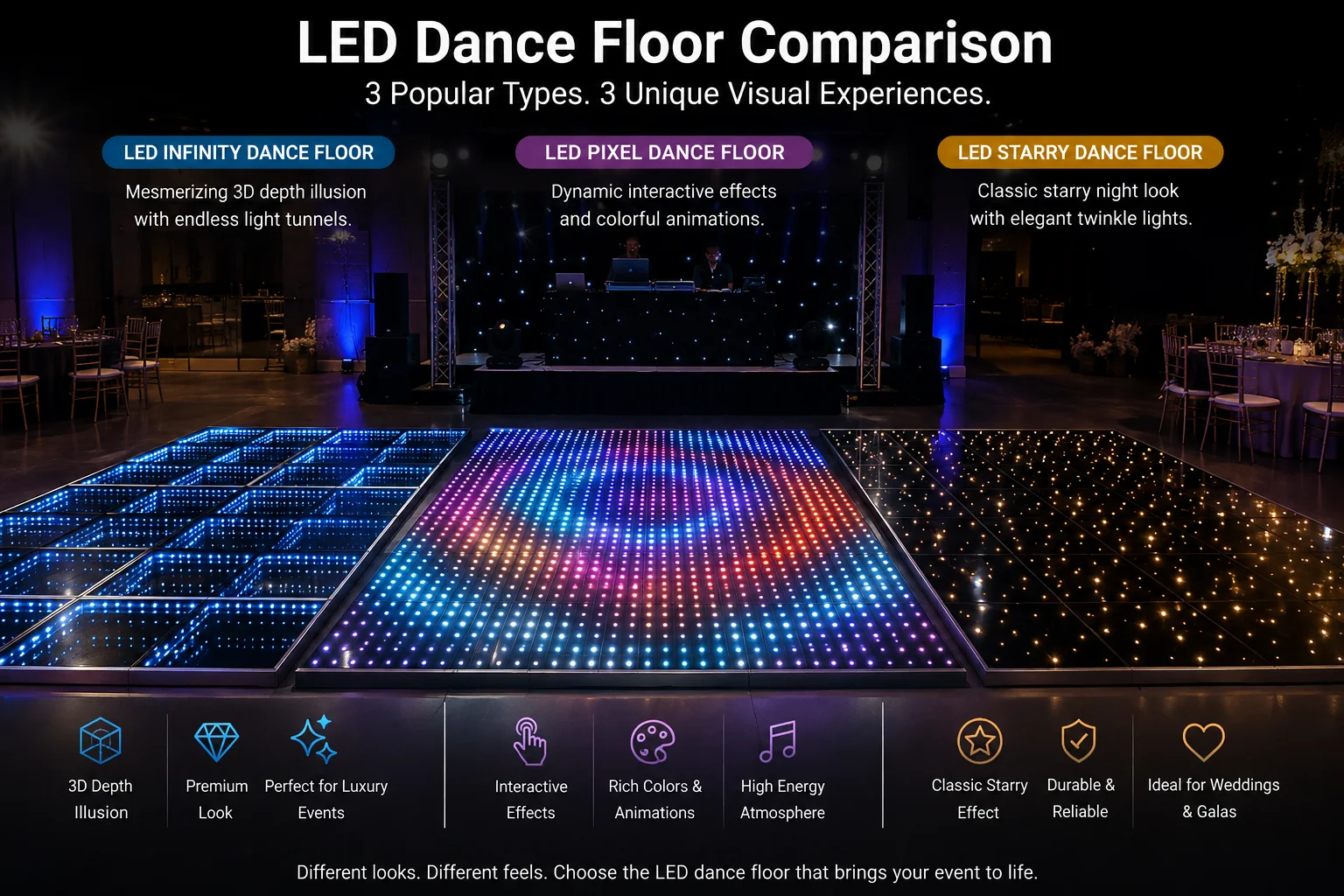
Three Floors, Three Different Jobs
Before you compare specs, understand that each floor exists to solve a different problem for a different buyer.
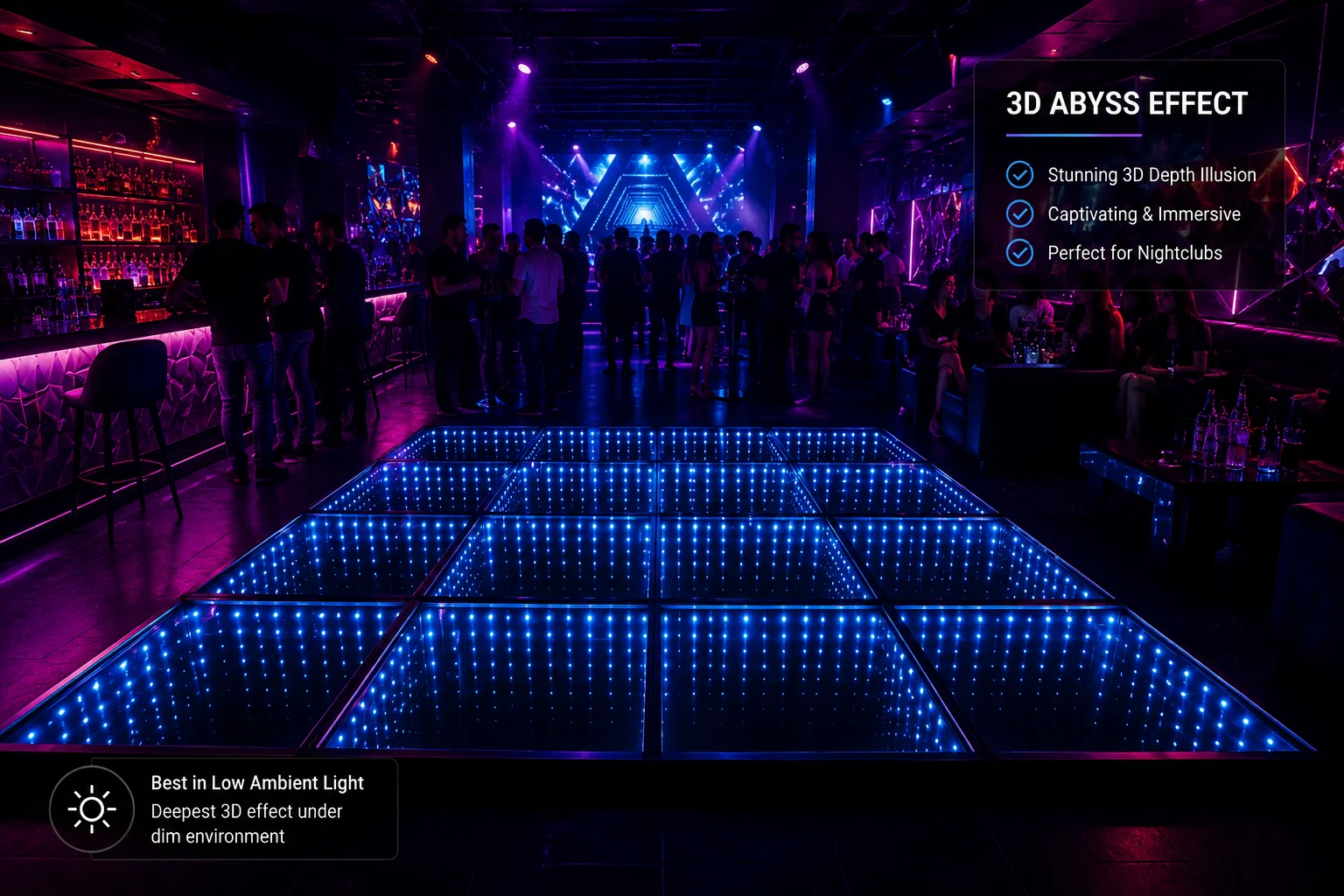
A 3D abyss LED dance floor sells spectacle. Its mirror layers create the illusion of an endless glowing tunnel underfoot, and it is the floor you buy to win a high-end nightclub contract or a brand activation that needs a centerpiece people will film.
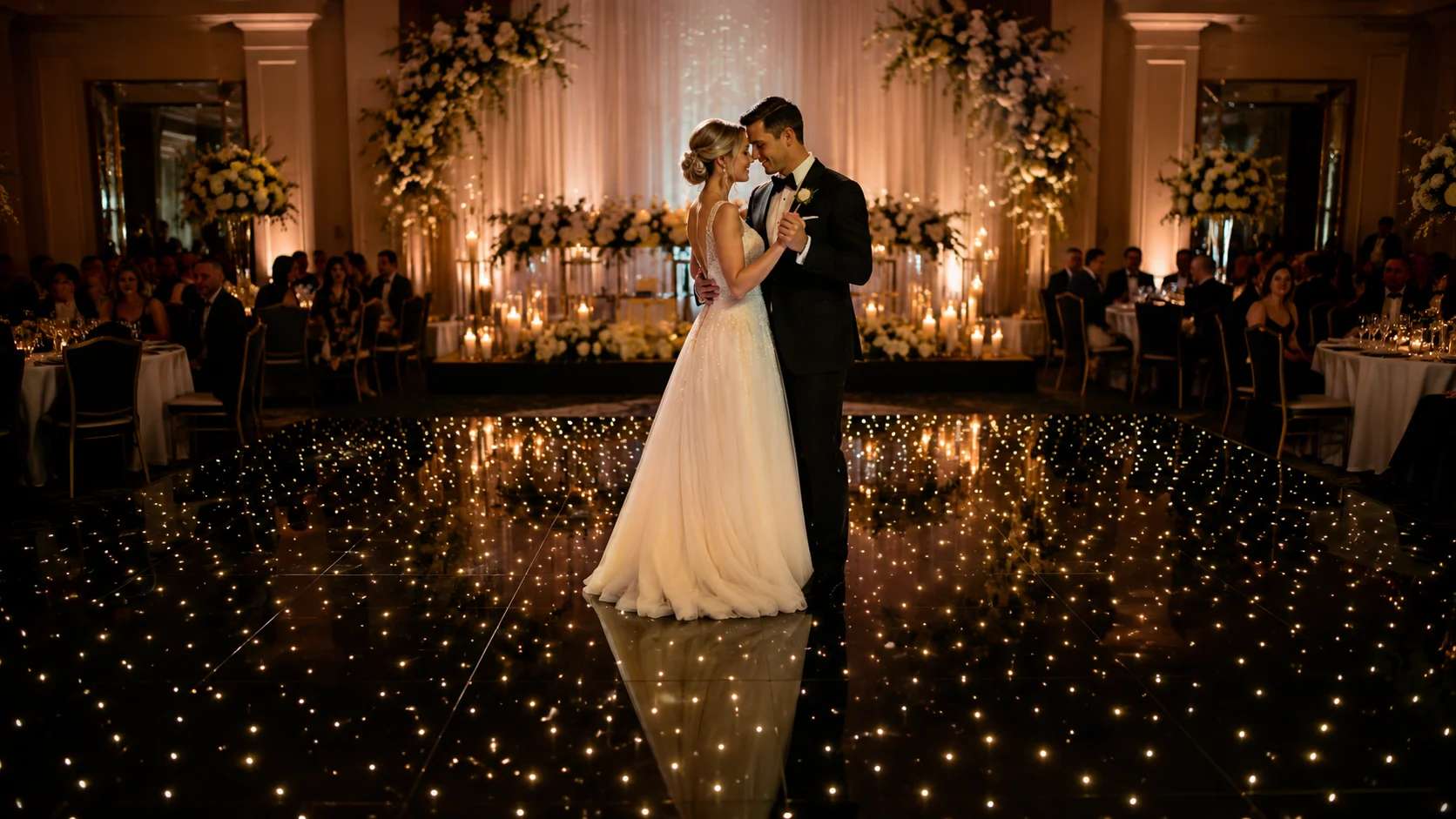
A star LED dance floor sells romance. Thousands of individually controlled LED points on a dark backing look like a night sky, which is why it is the floor you buy when weddings are your core business and couples will pay extra for that first-dance moment.
A magnetic RGB LED dance floor sells volume. It is a standard full-color floor, but its real advantage is tool-free magnetic assembly and a one-person setup in 15-20 minutes, which lets you run three events in a weekend instead of two.
Think of it this way: the 3D abyss is your flagship, the star is your wedding workhorse, and the magnetic RGB is your fleet backbone. Most serious operators eventually run at least two of the three.
Fact: BiaoMing (Event Golden) manufactures 3D abyss, star, and magnetic RGB LED dance floors with tool-free magnetic assembly, IP67 waterproof rating, and TÜV Rheinland certification.
3D Abyss: The Dramatic Showpiece
The 3D abyss effect works through a mirror-and-glass sandwich. An LED layer sits beneath a semi-transparent mirror, and tempered glass sits on top. Light bounces between the mirror layers, so each tile appears to drop into a deep, repeating tunnel. The result is the most dramatic floor effect available.
This is why the abyss dominates nightclubs and brand events. In low ambient light, the depth illusion is strongest, and it photographs well for social media. A venue that posts a clip of a 3D abyss floor gets the "wow" reaction that drives bookings.
The tradeoff is price and positioning. The 3D abyss is the most expensive of the three for a given size, and it is not the right fit for every event. It can feel too heavy for a soft, romantic wedding, and its mirror surface can raise an upskirting concern that needs a frosted variant to solve. It earns its keep in high-end, high-energy settings where spectacle is the product.
If your market has strong nightclub or corporate-event demand, read our full 3D LED dance floor guide for specifications and setup detail.
Star: The Romantic Wedding Favorite
A star LED dance floor uses a different trick. Instead of a mirror tunnel, it places a dense grid of small LED points, 16 to 32 per 60cm tile, on a dark backing beneath tempered glass. Each point is individually addressable, so the floor can twinkle, shoot a line of light across the surface, or hold a constellation pattern steady while others fade around it.
The dark backing is what makes it work. Against black, each point stands out, and the floor reads as a field of stars rather than a color wash. That is why star floors are the top choice for weddings and upscale celebrations. The effect is romantic, it photographs beautifully for the couple, and it fits the first-dance moment in a way a dramatic abyss or plain RGB cannot.
Pricing reflects the demand. Star floors rent for roughly 20-30% more than a standard RGB floor of the same size, with a typical 16x16 ft setup going for $ 1,200-$ 2,500 per event. Add-ons like custom constellation programming or music-reactive patterns can add another $ 200-$ 400 per event. Most operators recover the purchase price within 8-15 events, which for a wedding-focused business can mean one busy season.
For a full breakdown of variants and sizing, see our star LED dance floor guide.
Magnetic RGB: The Workhorse for Volume
The magnetic RGB floor is the least flashy of the three and the most operationally valuable. It displays the full 16.7-million-color RGB range in solid washes and animated patterns, but its defining feature is the connection, not the color.
Each tile snaps to its neighbor with built-in magnets. The magnetic connectors carry both power and data, so there are no inter-panel cables. One person can assemble a 16x16 ft floor in 15-20 minutes. A traditional wired floor takes 45-90 minutes with two people and leaves cables that must be taped down or covered.
That speed difference changes the economics of your whole operation. If setup drops from 90 minutes to 15, you can run a third event on the same Saturday with one less crew member. Magnetic floors cost 15-25% more per tile up front, but the labor savings usually cover that gap within a single season. A complete 16x16 ft system runs roughly $ 2,500-$ 4,500.
For the volume operator, this is the backbone floor: affordable, fast to deploy, and durable enough for weekly rotation. Pair it with a star or 3D floor as your premium upsell, and you cover both ends of the market. See our magnetic LED dance floor guide for connection and installation detail.
Head-to-Head Comparison Table
| Dimension | 3D Abyss | Star | Magnetic RGB |
|---|---|---|---|
| Visual effect | Infinite-depth tunnel, dramatic | Twinkling starfield, romantic | Solid color wash, functional |
| Single-event price | Highest | High (20-30% over RGB) | Lowest |
| Best events | Nightclubs, brand activations, premium weddings | Weddings, upscale celebrations | Parties, corporate events, volume work |
| Setup time | Magnetic, one person, 15-20 min | Magnetic, one person, 15-20 min | Magnetic, one person, 15-20 min |
| Load capacity | 500+ kg/tile | 500+ kg/tile | 500+ kg/tile |
| Waterproofing | IP67 | IP67 | IP67 |
| Payback logic | High price, lower frequency | High price, steady wedding demand | Low price, high frequency |
Which Floor Makes You More Money?
There is no single correct answer, only the answer for your event mix. The math splits into two paths.
One path is premium and low frequency. A 3D abyss or star floor earns more per booking. A star floor at $ 1,200-$ 2,500 per event pays for itself in 8-15 events. If you sell weddings or high-end corporate work, the premium floor is the profit engine, and the slower setup frequency does not hurt because the margin per event is high.
The other path is volume and high frequency. A magnetic RGB floor earns less per booking but can be booked far more often. When one person sets it up in 15-20 minutes, you can stack three events into a weekend. The per-event margin is smaller, but the weekly total can exceed the premium floor simply through throughput.
The highest-earning operators do not choose between these paths. They run both. A magnetic RGB floor handles the volume, and a star or 3D floor is the upsell that raises the average ticket. The question is which one you buy first.
Setup Time and Crew Requirements
The single biggest operating difference between LED dance floors is not in this comparison. It is between magnetic and wired floors of any visual type.
All three floors covered here are magnetic, so they share the same setup advantage: one person, 15-20 minutes, no tools, no cables. That is why the comparison rarely comes down to setup speed between 3D, star, and magnetic RGB. It comes down to the effect and the price.
If you are moving from a wired floor to any of these three, the labor change is the first thing you will notice. A wired floor needs two people for 45-90 minutes and leaves trip hazards to manage. The magnetic connection removes that entirely, and the 10,000+ connect-cycle rating means the connectors outlast the rest of the tile in most fleets.
How to Choose Based on Your Event Mix
Use this simple decision framework instead of a spec sheet.
First, name your core event. What do you book most? If it is weddings, buy a star floor first. If it is nightclubs or brand work, buy a 3D abyss first. If it is a mix of parties and corporate events, buy a magnetic RGB first.
Second, check your price ceiling. If your market will pay $ 1,200+ per event, a premium floor earns its cost back fast. If your average ticket is under $ 800, start with the volume floor and add a premium option later.
Third, plan the second floor. Almost no serious operator stops at one. The star or 3D floor is the upsell, and the magnetic RGB is the backbone. Buying them in that sequence, premium first or volume first, depends on which gap hurts your bookings more today.
Whichever you start with, buy all three from one supplier so the tiles, control systems, and spare parts are interchangeable. A mixed fleet from multiple manufacturers complicates setup, programming, and maintenance for no real benefit.
Fact: BiaoMing exports LED dance floors to over 200 countries, with North America at 55% of sales and Western Europe at 17%, and provides a 5-year warranty backed by 20+ overseas warehouses.
FAQ
What's the difference between 3D, star, and magnetic LED dance floors?
The difference is visual effect, not connection method. A 3D abyss floor uses mirror layers to create a deep, endless-tunnel illusion that reads as dramatic and futuristic. A star floor uses thousands of individually controlled LED points on a dark backing to look like a twinkling night sky. A magnetic RGB floor displays solid color washes and animated patterns across the surface and is defined by its tool-free magnetic connection for fast setup. All three are typically magnetic-connect tiles; what changes is what the light looks like and what kind of event it suits.
Which LED dance floor makes the most money for a rental business?
It depends on your event mix. A 3D abyss floor commands the highest per-event price and wins high-end nightclub and brand-activation work. A star floor rents for 20-30% more than a standard RGB floor and is the top choice for weddings, which are steady, high-volume bookings. A magnetic RGB floor has the lowest per-event price but the fastest setup, so you can book more events per weekend at lower labor cost. The highest-earning operators usually run a star or 3D floor as the premium option and a magnetic RGB floor as the volume workhorse.
How much does a 3D vs star vs magnetic LED dance floor cost?
A complete 16x16 ft magnetic RGB system typically runs $ 2,500-$ 4,500, with tiles from $ 30-$ 55 for wired versions and $ 40-$ 70 for battery versions. Star floors rent for $ 1,200-$ 2,500 per event, and 3D abyss floors sit at or above that range for premium events. Purchase price follows the same order: magnetic RGB is cheapest, star is in the middle, and 3D abyss is highest for a given size. Most operators reach full return on a star floor within 8-15 events.
Which LED dance floor is best for weddings?
Star LED dance floors are the wedding favorite. The twinkling starfield effect is romantic and photographs well, and it fits the first-dance moment better than a dramatic abyss or a plain RGB wash. A 12x12 ft or 16x16 ft star floor works for 60-200 guest weddings. Many operators use a star floor for the ceremony or first dance, then switch to standard RGB or 3D flooring for the open-dance portion of the evening.
Which LED dance floor is best for nightclubs?
3D abyss LED dance floors win in nightclubs. The infinite-depth mirror effect is the most visually striking option and holds up under low ambient light, which is where nightclub floors are judged. The dramatic tunnel look also photographs well for social media, which matters for venues that market themselves on Instagram. Star floors and RGB floors still work in clubs, but the abyss is the showpiece.
Are magnetic LED dance floors faster to set up than wired floors?
Yes, significantly. A magnetic floor can be assembled by one person in 15-20 minutes for a 16x16 ft layout, because tiles snap together with built-in magnets and no inter-panel cables. A wired floor takes 45-90 minutes with two people and creates cable trip hazards that must be taped or covered. Magnetic floors cost 15-25% more per tile up front, but the labor savings typically pay for the difference within a single busy season.
Can I use these LED dance floors outdoors?
Yes, if the tiles carry an IP65 or IP67 waterproof rating. BiaoMing LED dance floor tiles are IP67 rated, protecting against spilled drinks and light rain. Even waterproof tiles should not be submerged or left in standing water, and the control box and main power connection should be kept dry. For outdoor weddings, operators often run a star floor for the ceremony area and a more rugged RGB floor for the main dance floor.
How durable are they, and what's the weight capacity?
All three types share the same construction: 8-10mm tempered glass over an aluminum or ABS frame, with magnetic edge connectors. Load capacity is 500+ kg per tile, enough for heavy traffic, dancing, and even vehicle rollover on some models. LED modules are rated for 50,000 hours minimum, and magnetic connectors are rated for 10,000+ connect cycles, which translates to 5-7 years of weekly rental use before connector wear becomes a concern.
Conclusion
The 3D vs star vs magnetic LED dance floor decision comes down to one question: what do you sell?
Buy a 3D abyss floor if spectacle is your product and nightclub or brand work pays your bills. Buy a star floor if weddings are your core business and couples will pay for the night-sky moment. Buy a magnetic RGB floor if volume is your strategy and you need to run more events with less labor.
They are not competing answers. They are three tools for three jobs, and the operators who last are the ones who eventually hold at least two of them.
Explore the full BiaoMing LED dance floor range to compare specifications and request a quote for your fleet.
Sources
- BiaoMing (Event Golden). "LED Dance Floor." Event Golden product page. https://eventgolden.com/products/led-dance-floor/: Manufacturer technical specifications: magnetic assembly, IP67 waterproofing, load capacity, and LED lifespan. Pricing figures marked "typical" reflect industry estimates, not a manufacturer quote.
- Epic Experiences SoCal. "LED Dance Floor Rental." https://www.epicexperiencessocal.com/: Published rental listing for 20x20 ft LED dance floors for weddings and corporate events.
- NY LED Furniture. "Lighted Dance Floor Rentals." https://www.nyledfurniture.com/: Published LED dance floor rental pricing for event planners in the continental USA.
- Nite Time Events. "LED Video Dance Floor for Your Event." https://nitetimeevents.com/: Published LED dance floor rental offering for weddings, parties, and events.
- LED Party Floors. "LED Party Floors - Home." https://ledpartyfloors.com/: LED dance floor rentals and permanent installations, illustrating the rental-price tiers referenced in the comparison table.
Ready to start your event business?
Get a free wholesale quote within 24 hours. Product details are confirmed by direct inquiry.
Get a Free Quote