Mirror Photo Booth ROI: How Much Can a Premium Booth Earn?
What a mirror photo booth costs, what it rents for, and how many events it takes to pay back. Full ROI math and comparison with 360 booths.
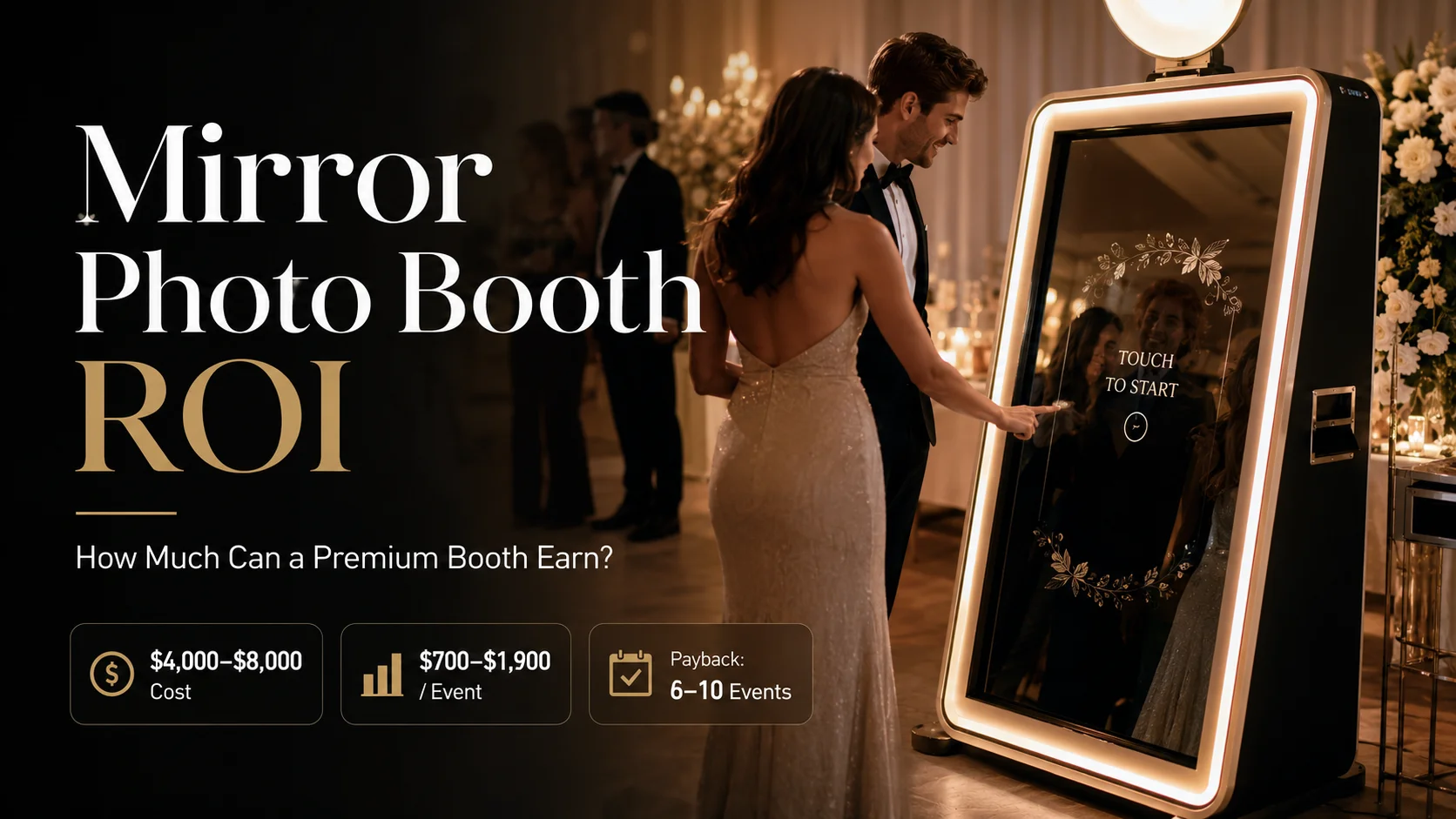
How Much Can a Premium Booth Earn?
The mirror photo booth is the quiet profit engine of the photo booth world. It costs less than a 360, sets up faster, handles more guests per hour, and still commands a premium rate because it photographs beautifully and matches high-end decor.
People assume the flashier 360 booth is the money maker. In a wedding-focused fleet, the mirror often pays back first. This guide runs the numbers.
What a Mirror Photo Booth Costs to Buy
A mirror photo booth typically costs $ 4,000 to $ 8,000. The range is driven by screen size, the enclosure material, and whether it includes the round Polaroid-style print option that high-end clients expect.
That price puts the mirror well below a 360 booth, which usually runs $ 6,000 to $ 15,000. The lower entry cost is the mirror's first advantage: you reach the premium wedding market for less upfront money.
These are industry estimates. Actual pricing varies by brand, screen quality, and whether you buy direct. For a full breakdown of what a mirror booth is and how it works, the mirror photo booth guide covers the product line.
Rental Rates and Revenue per Event
A mirror booth commonly rents for $ 700 to $ 1,900 per event, with premium weddings and corporate work at the top of that range. The vintage wood and round Polaroid-style enclosures carry a premium because they photograph well and match the aesthetic clients are paying for.
The useful framing is contribution per event. If a mirror booth rents for $ 1,200 and costs $ 250 in labor, transport, and wear, the booth contributes about $ 950 per event. That contribution is what pays off the purchase and later becomes profit.
For how the mirror compares to the iPad booth as an entry point, the mirror vs iPad comparison walks through the tradeoffs.
The ROI Math: Contribution and Payback
Run the numbers on a realistic mirror booth.
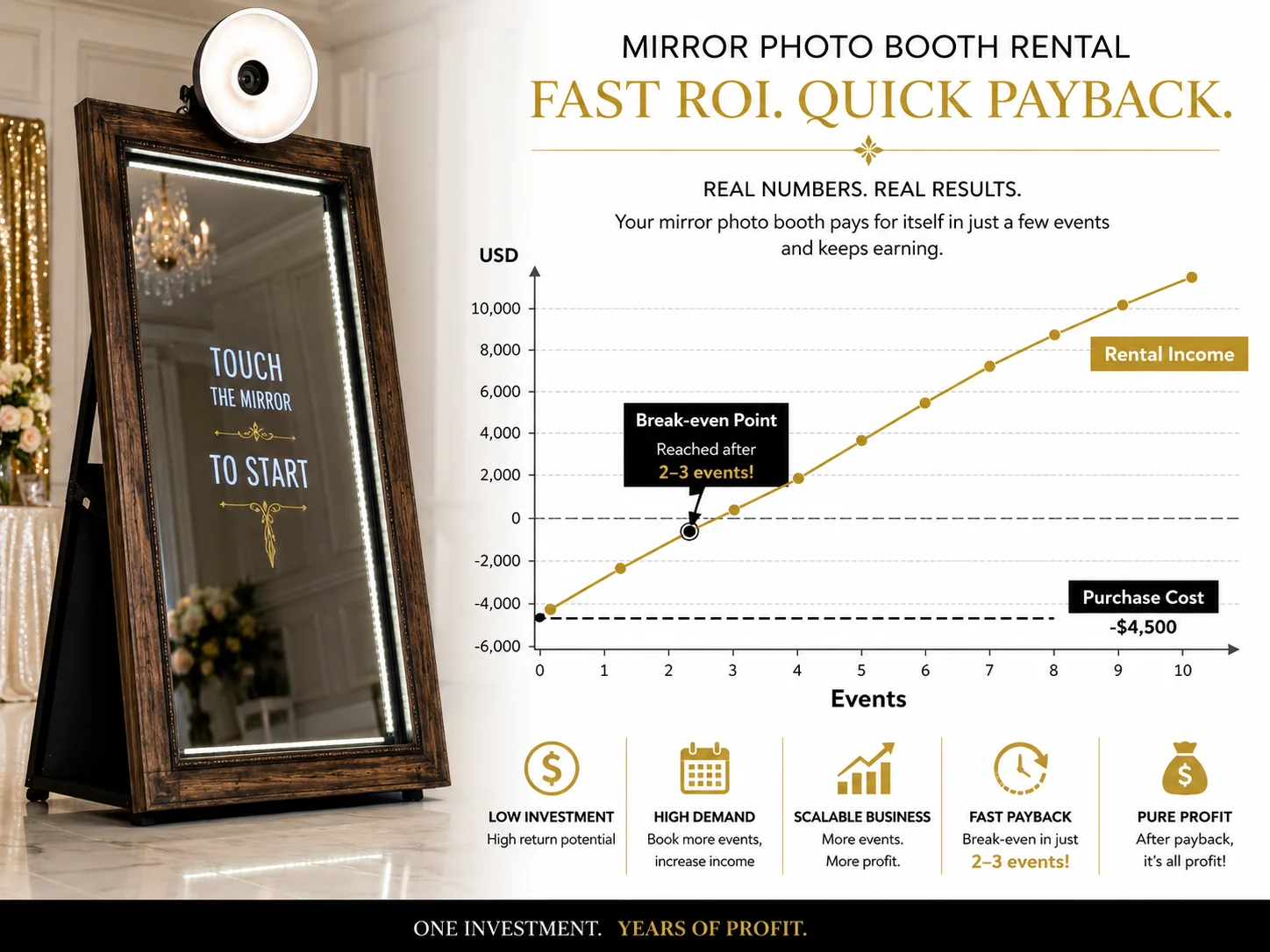
Assume a purchase price of $ 6,000, a rental rate of $ 1,200 per event, and variable costs of $ 250 per event. The contribution is $ 950 per event, and the booth pays back in about 6 to 7 events. Everything after that is profit.
The conservative case uses the bottom of the ranges: an $ 8,000 booth renting for $ 700 with $ 300 in costs contributes $ 400 and pays back in about 20 events. The aggressive case uses the top: a $ 4,000 booth renting for $ 1,900 with $ 150 in costs contributes $ 1,750 and pays back in about 3 events.
Both extremes are real, which is why the honest answer to "how long to pay back" is 6 to 10 events for a mirror booth under normal wedding bookings. The operating-cost figure here is an assumption for planning, not a universal number.
| Booth | Purchase (est.) | Rental per event (est.) | Contribution (est.) | Payback (est.) |
|---|---|---|---|---|
| Mirror | $ 4,000-$ 8,000 | $ 700-$ 1,900 | $ 400-$ 1,600 | 6-10 events |
| 360 | $ 6,000-$ 15,000 | $ 900-$ 2,000 | $ 500-$ 1,700 | 10-15 events |
Mirror vs 360: Different Money, Different Payback
The mirror and the 360 make money in different ways, and the comparison explains why the mirror is the wedding workhorse.
A 360 booth commands a higher per-event rate and is the right tool for brand activations where the shareable video is the product. But it costs more to buy, sets up slower, and handles only 15 to 25 guests per hour.
A mirror booth costs less, sets up faster, and handles 40 to 60 guests per hour, so it pays back in 6 to 10 events against the 360's 10 to 15. The mirror does not out-earn the 360 per event; it out-returns it per dollar and per hour of labor.
Most wedding-focused operators run the mirror as the primary booth and add a 360 later for premium upsells. The 360 vs mirror comparison covers the full decision, and the 360 photo booth ROI guide runs the 360's numbers separately.
Fact: EventGolden exports photo booths to over 200 countries, with North America at 55% and Western Europe at 17%, backed by TÜV Rheinland certification, a 5-year warranty, and 20+ overseas warehouses.
Hidden Costs
Three costs catch first-time mirror booth buyers off guard.
Software and print media. The mirror booth needs software for the touchscreen experience and print media if you offer the Polaroid-style prints. Both are recurring, not one-time.
Transport and enclosure care. The vintage wood enclosure looks premium but scratches and dings, so it needs careful packing and a case that costs real money.
Attendant time. A mirror booth runs itself more than a 360, but a high-end wedding still expects an attendant for the first hour to guide guests. Count that labor as part of the per-event cost.
None of these break the model, but they all reduce the per-event contribution, which is why the 6-to-10-event payback range is wider than people expect.
Bundling and Upsell
The mirror booth's ROI improves the moment it shares logistics with something else.
The mirror pairs naturally with a 360 booth as a two-tier photo offering, where the mirror handles the guest line and the 360 handles the hero shots. It also bundles with an LED dance floor for the full wedding package, sharing one truck and one crew across both assets.
That shared logistics is the same engine described in the photo booth and dance floor bundling guide, and the magazine photo booth ROI guide shows how the same math applies across booth types.
Seasonality and the Wedding Calendar
The mirror booth's ROI is seasonal because weddings are seasonal. In most markets, the spring and fall wedding seasons carry the booking volume, while midwinter and midsummer thin out.
That seasonality changes how you read the payback math. A booth that pays back in 7 events does so over one busy season, not across a full calendar year. Plan the purchase so the booth arrives before peak season, and price weekday and off-season bookings to keep the booth earning through the slow months.
The mirror's fast setup is the off-season advantage. A booth that goes up in 45 minutes can be priced competitively for weekday corporate events without eating your labor margin, which keeps the annual contribution high even when weddings are scarce.
FAQ
Is a mirror photo booth profitable?
Yes, and it often pays back faster than a 360 booth because it costs less to buy. A mirror booth commonly runs $ 4,000 to $ 8,000, rents for $ 700 to $ 1,900 per event, and pays for itself in about 6 to 10 events. Its high throughput and fast setup keep the per-event contribution healthy.
How much does a mirror photo booth cost?
A mirror photo booth typically costs $ 4,000 to $ 8,000 depending on the screen size, enclosure material, and whether it includes the round Polaroid-style print option. That is less than a 360 booth, which usually runs $ 6,000 to $ 15,000. These are industry estimates and vary by brand and configuration.
How much can I charge to rent a mirror photo booth?
A mirror booth commonly rents for $ 700 to $ 1,900 per event, with premium wedding and corporate markets at the top of that range. The vintage wood and round Polaroid-style enclosures command a premium because they photograph well and match high-end decor. Treat these as directional figures, not a rate card.
How long does it take for a mirror booth to pay for itself?
Most operators recover the purchase price in 6 to 10 events, faster than a 360 booth's typical 10 to 15 events. The mirror booth costs less to buy and sets up faster, so its payback is shorter even though its per-event rate is slightly lower. Consistent wedding bookings drive the timeline.
What is the ROI on a mirror photo booth?
On a $ 6,000 mirror booth renting for $ 1,200 per event with $ 250 in variable cost, the booth contributes about $ 950 per event and pays back in roughly 6 to 7 events. Everything after that is profit. Over a multi-year lifespan, a mirror booth booked weekly returns many times its purchase price.
Mirror photo booth vs 360: which makes more money?
A 360 booth commands a higher per-event rate and is the better choice for brand activations. A mirror booth costs less to buy, sets up faster, and handles more guests per hour, so it often pays back sooner and is the stronger wedding workhorse. Many operators run both: the mirror for weddings and volume, the 360 for premium upsells.
How much does it cost to rent a mirror photo booth per event?
Per-event rates for a mirror booth typically run $ 700 to $ 1,900 depending on market, duration, and whether it includes an attendant and print option. Corporate and high-end wedding markets sit at the top. The per-event figure is the right planning number, since transport and setup are charged per job.
Is a mirror photo booth a good investment for weddings?
Yes, because it matches wedding decor and handles high guest throughput. The vintage wood and round Polaroid-style enclosures photograph well and justify a premium rate, while the 40 to 60 guests per hour capacity keeps lines short. A mirror booth is often the highest-utilization piece in a wedding-focused fleet.
Conclusion
The mirror photo booth is the highest-return-per-dollar asset in the photo booth category. It costs less than a 360, sets up faster, handles more guests, and pays back in roughly 6 to 10 events.
For a wedding-focused fleet, buy the mirror first. It reaches the premium market for less money and earns its keep through throughput, then add a 360 later for the premium upsell.
Fact: EventGolden's mirror photo booth line includes vintage wood mirror and round Polaroid-style models, positioned for high-end weddings and corporate events.
Explore the EventGolden mirror photo booth range to compare models and run your own payback math with a quote.
Sources
- EventGolden (Event Golden). "Mirror Photo Booth." Event Golden product page. https://eventgolden.com/products/mirror-photo-booth/: Manufacturer specifications for vintage wood and round Polaroid-style models. Purchase, rental, and payback figures marked "typical" are industry estimates, not manufacturer quotes.
- ViewSonic. "Large Venue Display Solutions: Direct View LED vs Projectors." https://www.viewsonic.com/library/tech/large-venue-display-solutions-direct-view-led-vs-projectors/: total-cost comparison reference for the photo booth fleet's display components.
- Planar. "LED Video Walls." https://www.planar.com/products/led-video-walls/: display specifications referenced for booth screen quality.
Ready to start your event business?
Get a free wholesale quote within 24 hours. Product details are confirmed by direct inquiry.
Get a Free Quote