Commercial 360 Photo Booth: What Separates Rental-Grade from Consumer
Duty cycle, slewing ring, deck structure, capture loop and spares: how to tell a rental-grade commercial 360 photo booth from a consumer build.
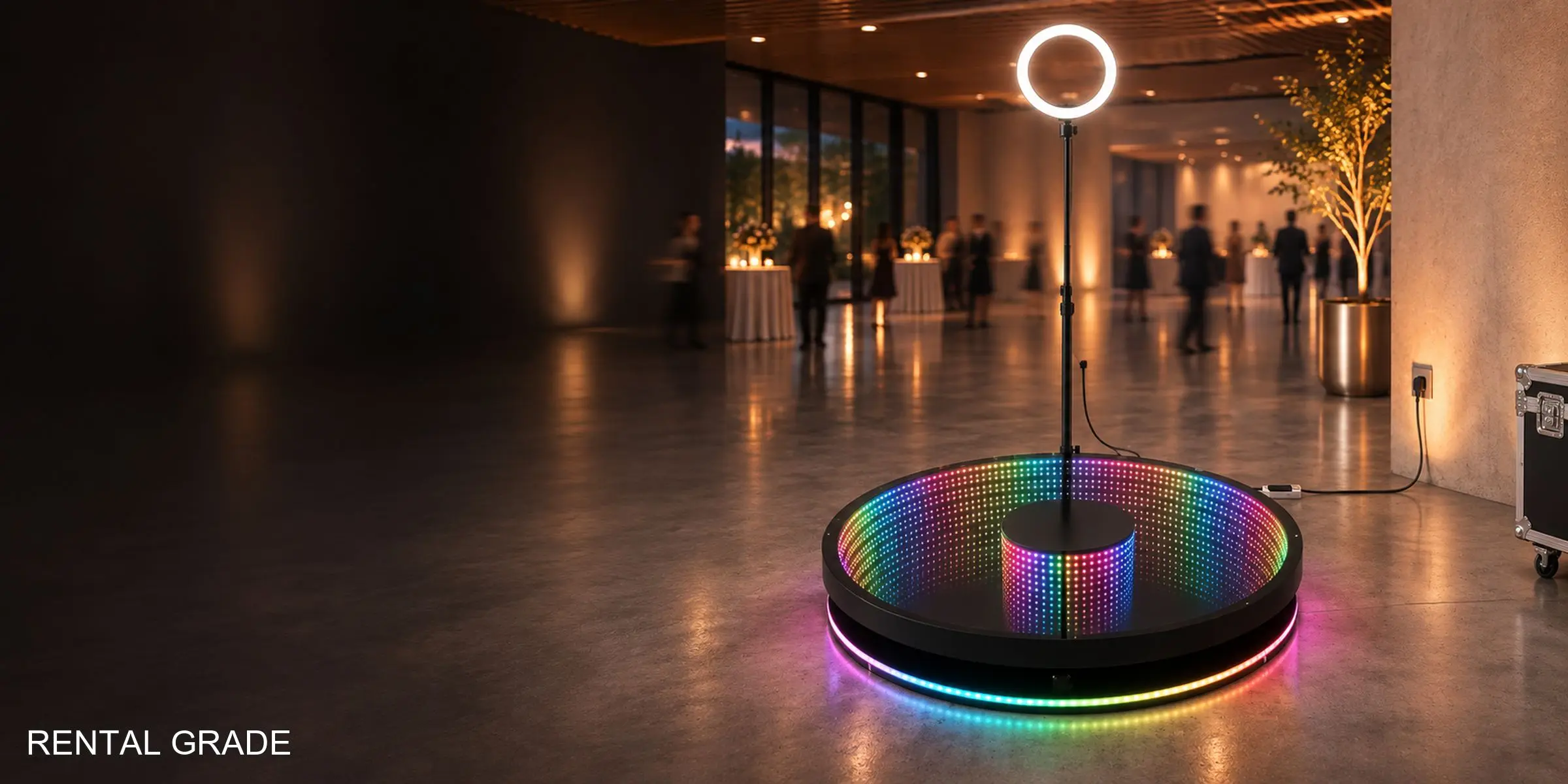
Commercial 360 Photo Booth: What Separates Rental-Grade from Consumer
Two 360 booths can look identical in a product photo and behave nothing alike on a Saturday night. One finishes a four hour reception at the rotation speed it started with. The other drifts, drops the camera trigger or stalls mid song, and you spend the last hour on the phone instead of packing the van.
Nothing in the average listing separates those machines, because the listing sells a look. A commercial 360 photo booth is defined by the duty cycle it was built for and by how fast a failed part can be replaced.
This article answers one question: which components separate a rental grade machine from a consumer build, and how those choices turn into unbillable downtime. For the category basics, start with the 360 photo booth guide; for a first purchase decision between product types, the 360 vs mirror comparison covers that instead.
What "Commercial" Has to Mean: Duty Cycle, Not Marketing
No standards body certifies the word commercial. It appears on retail boxes, on marketplace listings, and on machines that share a drive with a home turntable. What separates a rental machine is the duty cycle the drive was designed to survive: how long it runs, how often it starts, and how it sheds heat between groups.
A consumer booth runs a few minutes at a time and then sits idle. A rental booth runs a full event window, with a new group every few minutes, and often works Friday and Saturday in two venues. Every group is a start, and starts are where gearboxes and bearings accumulate wear.
IEC 60034-1 is the rating and performance standard for rotating electrical machines, so a supplier who knows the product can name the rating its motor is declared under and the conditions that rating assumes. A peak figure with no conditions specifies nothing.
The practical test is the service path. A rental grade unit can be diagnosed and repaired on site, at night, from parts you stock; a machine that must return to a factory has a consumer service model, whatever the listing says. Uptime is also an input to payback, which is how the 360 photo booth ROI breakdown treats it.
Fact: Event Golden has 13 years of manufacturing experience and exports to more than 200 countries, so spare parts and revisions for a booth bought today trace back to a production line rather than a marketplace listing.
Platform or Hanging: Which Build Is Rental-Grade for Which Venue
The two architectures differ in where the load goes, and that difference decides which venues you can serve. In a platform build the guest stands on a rotating deck and the camera stays fixed. The deck bearing carries the guest plus the moving weight of people shifting position, and all of it goes down into the floor.
In a hanging build the camera travels on an arm above a marked standing position. The guest stands still and the load goes up into the structure, which removes the deck bearing from the load path and adds an overhead attachment rated for the arm and its movement.
Neither design is automatically more commercial. The expensive mistake is buying a hanging unit for a venue that will not let anyone touch its ceiling, or a platform for a room with an uneven floor and a narrow load in door.
Rigging needs its own line in the contract. ANSI E1.21-2024 covers temporary structures for outdoor entertainment production, and ANSI ES1.19 covers special event structures more broadly; both appear in the ESTA published documents register. If a venue cannot produce a rigging plan, use a platform booth or get a written sign off from a qualified structural engineer working to local code.
| Venue situation | Platform (rotating deck) | Hanging (overhead arm) | What to check before quoting |
|---|---|---|---|
| Ballroom, finished ceiling, no rigging | Workable default | Usually refused | Floor level, carpet protection, lift access |
| Marquee or tent with certified frame | Workable | Only on rated members | Tent supplier's written point ratings |
| Open plaza or car park | Workable with weather plan | Needs engineered structure | Wind plan, ballast, IP rating of exposed parts |
| Venue with permanent truss grid | Workable | Natural fit | Truss capacity and rigging sign off |
| Tight load in, narrow doors, stairs | Deck size is the limit | Arm ships in short sections | Door widths, case sizes, crew size |
| Room with a low or fragile ceiling | Natural fit | Not an option | Headroom, fixing method |
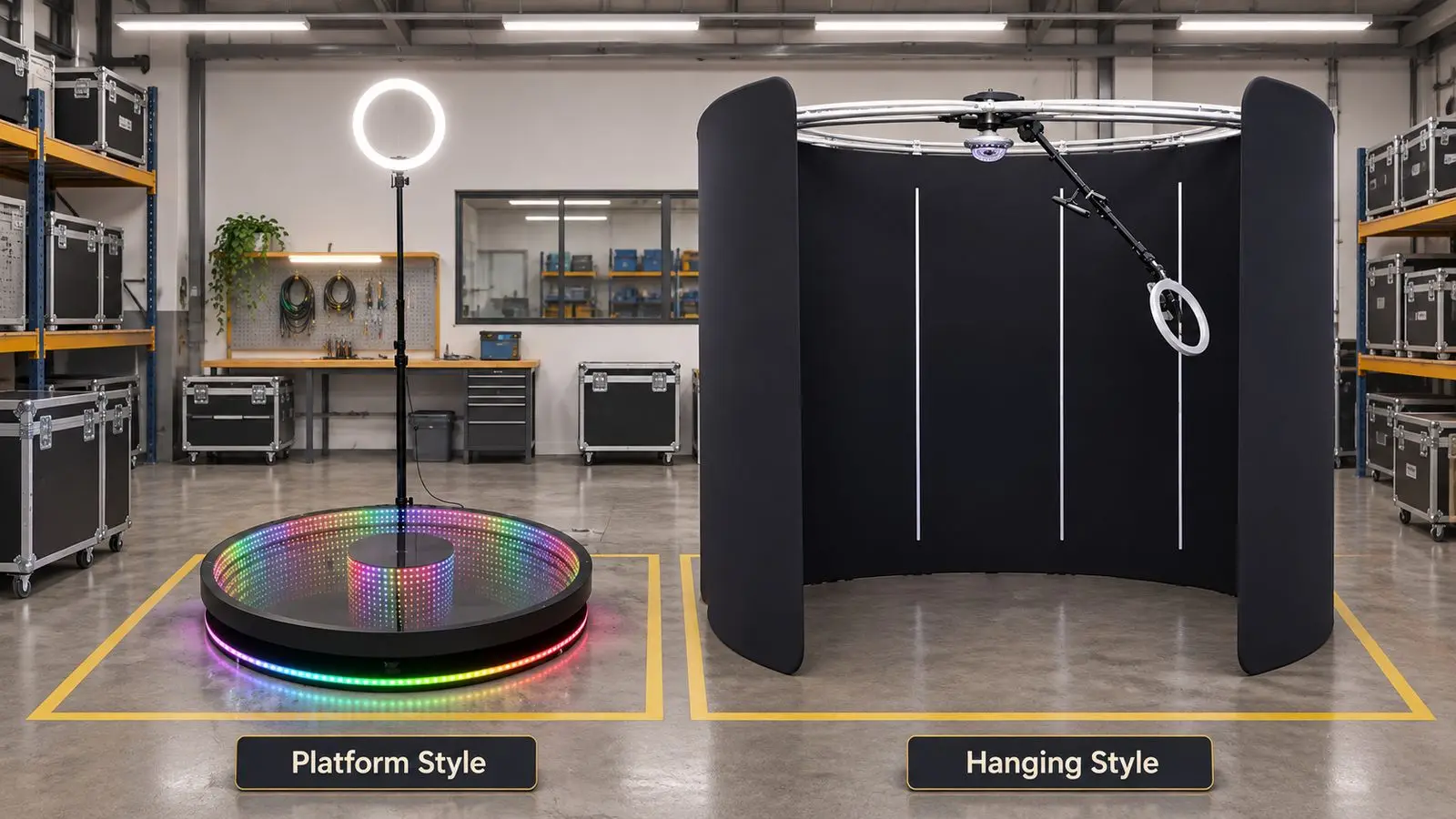
The Load-Bearing Chain: Motor, Slewing Ring, Deck, Hanging Points
Four links carry every cycle: the drive, the rotation bearing, the deck structure, and the points where the machine attaches to the floor or the building. A consumer build saves cost at each link, and the savings show up as wobble, noise and stalls long before anything breaks outright.
The drive is a motor, a gearbox and, on a deck, a brake. Rental duty wants a motor declared for the run and start pattern you work, thermal protection that trips before the winding cooks, and a brake that holds the deck when power drops. A gearbox with no stated service factor is a black box.
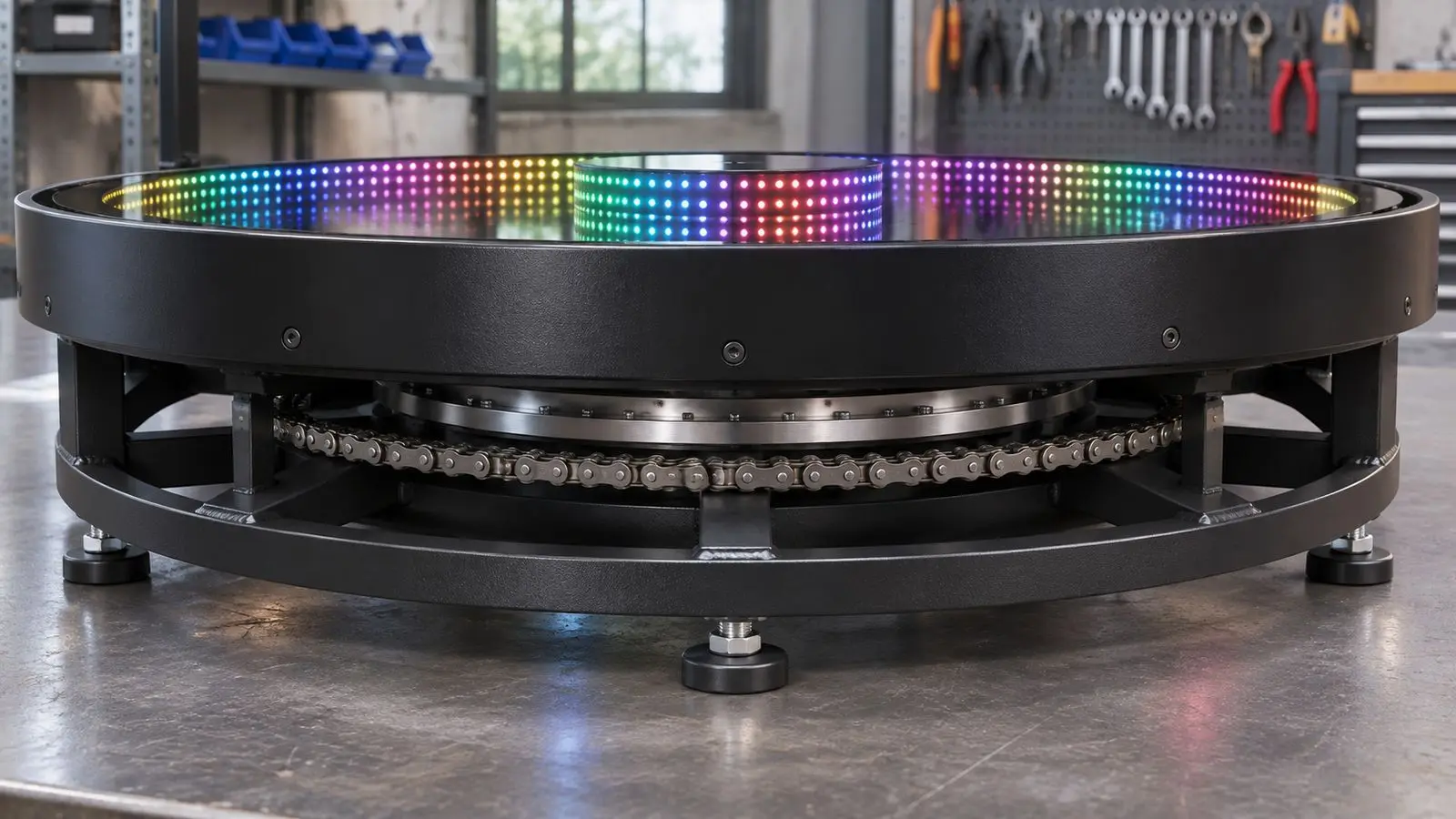
The rotation bearing is where most of the engineering hides. A slewing ring is a geared bearing with a defined raceway, preload and lubrication interval, built for combined axial, radial and tilting loads; consumer decks often ride on casters that were never meant to take an off centre load. Ask for bearing type, part number and lubrication interval, because those answers show whether the deck was engineered or assembled.
The deck decides how the machine feels underfoot. Plate thickness, frame spacing, edge trim, anti slip surface, weld quality and drainage all matter, and deflection is the number to ask about. A deck that flexes makes noise, wears its bearing faster and reads as cheap to the client standing on it.
Hanging builds replace the deck bearing with attachment hardware that needs a rating, secondary retention and an inspection routine. OSHA 1926.251 requires slings and fastenings to be inspected before each use by a competent person, with damaged items removed immediately. Run a documented pre event inspection on your own hardware regardless of what an inspector asks for.
| Component | Consumer build often uses | Rental duty needs | Evidence to demand |
|---|---|---|---|
| Drive | Short duty motor, no brake, belt drive | Stated rating and duty, thermal protection, holding brake | Motor label, rating declaration, brake type |
| Gearbox | Sealed unit, no published service factor | Published service factor and lubricant interval | Datasheet with part number |
| Rotation bearing | Casters or thin section bearing | Slewing ring sized for off centre load | Bearing type, part number, lube interval |
| Deck structure | Thin plate on light frame, no deflection figure | Stated deflection at rated load, anti slip surface | Drawing with plate and frame spec |
| Hanging hardware | General purpose shackles and hooks | Rated hardware, secondary retention, inspection log | Rating certificates, inspection sheet |
| Fasteners | Mixed hardware, no torque spec | Specified grade with a torque table | Assembly manual with torque values |
Camera, Lighting and the Capture Loop
The capture loop has five stages: trigger, rotation, exposure, encode and delivery. A consumer booth is judged on one good take; a rental booth is judged on the two hundredth take of the night, by a guest who does not hold still.
Start with the camera body. An interchangeable lens body covers a group of two or a group of eight and lets you replace a failed body without replacing the booth, while a phone based unit takes the whole product off the booking when its sensor fails. Ask whether exposure is locked manually, because auto exposure hunting under coloured event lighting ruins takes quietly.
Power and data are the quiet failure points. Mains power with a locking connector beats a battery that dies at the wrong hour, and cards wear out, so write to storage you can swap in seconds.
Lighting needs a duty rating as much as the motor does. A panel that is fine for a thirty second demo can overheat inside a closed frame after two hours, and heat shifts colour over the evening. With a strobe, confirm sync and recycle time, then test flicker on camera, since a steady looking panel can band at a fast shutter.
Weather protection is where marketing runs furthest ahead of documentation. IEC 60529 defines the IP code, which carries two digits: the first for solids such as dust, the second for water, and a high first digit says nothing about rain. The rating covers the enclosure tested, not the whole booth, so ask which components carry it; on a platform booth the deck motor and cable entry sit closest to spilled drinks, which a canopy does not cover.
| Capture loop stage | Failure symptom | Specification that fixes it | Acceptance test |
|---|---|---|---|
| Trigger | Missed takes, guests waving at nothing | Fixed trigger point with manual override | Twenty takes in a row, zero misses |
| Rotation | Judder, speed drift, noise | Rated drive with brake, stable speed control | Full length run, listen for drift |
| Exposure | Dark faces, colour cast, hunting focus | Manual exposure lock, lighting rated for the frame | Test under coloured and dimmed light |
| Encode and delivery | Long waits, dead QR codes | On site encoding, offline delivery with retry | Ten guest queue timed end to end |
Control and Software in a Paid-Event Environment
Software is where a good machine becomes an unreliable one, usually for reasons unrelated to the hardware. The control layer decides who starts a session, what the guest sees, where files go, and what happens when the venue has no internet.
Ask how the booth behaves when nobody is watching it. An unattended mode with a lock code, a session counter and an error log lets one operator cover two booths. Switching to a branded attended start screen should be a setting.
Then ask who owns the software. A licence that expires or an update that installs during a reception can take a working booth offline at the worst moment. Confirm that it runs offline, that updates are manual, that media exports in a format you can hand to a client without a converter, and where files are stored, because retention is a question clients now ask in writing.
Hardware in the control box matters less than how it is mounted. Look for locking connectors, strain relief and a mounting plate that does not rely on foam, and keep a spare control unit matching the fleet's model and firmware.
Transport, Setup and the Labor Story Nobody Quotes
Every quote compares the machine. Almost none compares the hour before the doors open, and that hour decides whether you can hold two bookings on the same night.
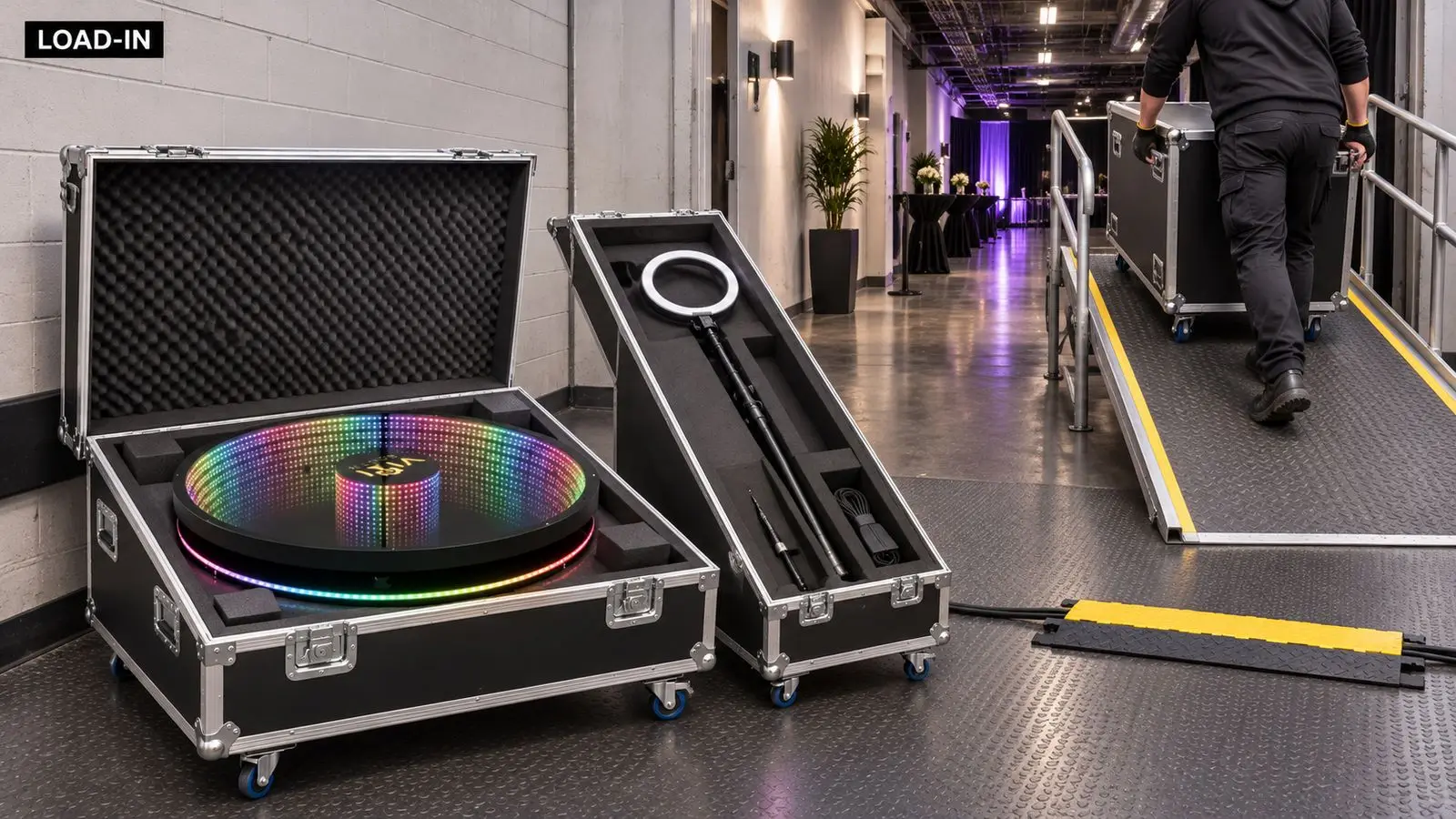
Start with the cases. A platform booth ships as a deck, frame, arm or column, ballast, lighting, camera, control box and cable set, and each has a carton with a weight and a dimension. Ask for that list with weights, then measure your van, your storage door and the service lift at your most common venue, because a booth that needs two people and a ramp at every load in costs more per event than one a single person can move.
Setup time is a specification, not a personality trait. Ask how long a two person crew needs from arrival to a tested session, and which steps need a tool or a calibration. A design that needs a level check, a focus check and a lighting test at every venue is fine, as long as those steps are written down and take minutes; untested assumptions here become late starts, and late starts are what clients remember.
Packing order is part of the design. Cases that nest, cables that coil into a labelled pocket, and a deck that stacks with trim protection all cut the time between events and the damage in transit. For how crew and setup time enter a quote, see the event rental pricing guide; for how route density changes the math, the guide to starting a 360 rental business covers it.
A Specification Sheet to Demand
A specification sheet is only useful if every line carries one of three states: included, not included, or to be confirmed in writing. Anything left blank is not included, whatever the sales conversation implied. Put the sheet inside the quotation, so the version you sign is the version you can compare against the delivered crate.
Watch for lines that appear in the brochure but not in the quote. Rigging hardware, ballast, spare parts, branding templates, training and the engineering sign off for a hanging installation are the usual candidates. None costs much on its own, and all of them are expensive to discover at a load in.
| Item | Often included | Often not included | Confirm in writing |
|---|---|---|---|
| Drive and rotation assembly | Core product | Brake, where the design allows one | Duty rating and thermal protection |
| Rotation bearing | Fitted | Lubrication schedule, spare bearing | Bearing type and part number |
| Camera and lens | Body only, or none | Lens, spare battery, tether | Exact model and mount |
| Control hardware | Tablet or mini PC | Spare control unit | Model, firmware, connector type |
| Software and branding | Base licence | Event templates, offline licence | Update policy, export format |
| Cases and packing | Basic cartons | Road cases, pallet, foam inserts | Case list with weights |
| Hanging hardware | Arm and clamp | Rated shackles, secondary retention | Certificates, inspection sheet |
| Structural sign off | No | No | Engineer confirmation per venue type |
| Spare parts kit | No | No | Contents list with part numbers |
| Warranty and freight | Term stated | Consumable exclusions, return freight | Full warranty document before order |
Two lines deserve a conversation rather than a tick: the structural sign off for hanging work, which protects the people under the arm, and the warranty document, which protects the money tied up in a fleet.
Warranty and Spares for a Fleet
A warranty length is a marketing number until you read the exclusions: five years on a frame and five years on a motor controller are different promises. Ask which components are covered, whether the remedy is a part or a unit, who pays freight both ways and how a claim is opened. A long warranty with a slow claim leaves you hiring a substitute for your own booking.
Spares are a scheduling decision. A fleet of three needs one of every part that can stop a show and can be swapped by one person without a specialist tool. Keep the list short: cable set, power supply, control unit, lighting unit, camera tether, deck fasteners, and whichever bearing or belt the design uses, with part numbers on the order confirmation so you can reorder a year later without a conversation.
Fact: Event Golden builds 360 booths, LED dance floors and rental LED displays with TÜV Rheinland certification plus CE, RoHS, FCC, LVD and CB compliance, backs the equipment with a 5-year warranty, and stocks 20+ overseas warehouses for fleet buyers who cannot wait on a factory shipment.
A part that arrives in three weeks is not a spare part, it is a future purchase. Ask where the part ships from, not just whether it exists.
FAQ
What makes a 360 photo booth commercial rather than consumer?
It is the duty cycle and the service path, not the word on the listing. A commercial unit is built to run a full event window with a new group every few minutes, weekend after weekend, and to be repaired on site from stocked parts, while a consumer unit is built for short sessions and is usually replaced rather than repaired. Ask for the motor duty rating, the bearing type and part number, and the spare parts list before you accept the word commercial.
Is a platform or a hanging 360 booth better for a rental business?
It depends on the venues you actually book. A 360 booth platform sends the guest's weight down through a rotating deck into the floor, so it needs a level floor, a clear footprint and no rigging permission. A hanging unit sends the load up into overhead steel and needs a structure an engineer has confirmed, so buy for your booking list, not for the product photo.
What duty cycle should I ask for on a commercial 360 booth?
Ask the supplier to state the motor rating and duty class in writing, with the conditions it applies to, then compare that against your longest event window and busiest start rate. There is no universal number that fits every market, so a supplier who answers with a vague claim about continuous use has told you nothing. A useful answer names the motor standard the rating follows, the thermal protection fitted, and the brake that holds the deck when the drive stops.
How do I verify the load rating of a 360 photo booth in writing?
Require a load rating expressed as a safe working load with the safety factor stated, plus the calculation or test that supports it, signed by the supplier. Do not accept a single peak figure on a webpage, and do not accept a number that changes between the product page and the quotation. For a hanging build, add a separate structural confirmation for the attachment points from a qualified engineer working to your local code.
What IP rating does an outdoor 360 booth need?
IEC 60529 rates enclosures with two digits: the first for solids such as dust, the second for water. A booth used under a marquee canopy and a booth standing in an open plaza do not need the same protection, and the second digit is the one that matters outdoors. An IP rating covers the enclosure only, not connectors, cable entries or the deck motor, so ask which specific components carry the rating and where they are mounted.
Why do rental 360 booths fail during events?
Failures usually trace back to the cheapest link in the load path or the capture loop, not to the camera. Common causes are an under-rated drive that overheats after hours of starts, a bearing that was never lubricated on a schedule, a loose cable at the control box, a lighting unit that overheats in a closed frame, and a software update that lands mid-event. Each one has a specification or a maintenance interval that prevents it.
What spare parts should a rental fleet keep on hand?
Keep the parts that stop a show and can be swapped by one person in minutes: drive belts or couplings where used, a control cable set, a power supply, a camera battery plate and tether, a lighting unit, and the fasteners specific to the deck or arm. Add a spare control tablet or mini PC if the software runs on one. Confirm the part numbers and prices in writing with the order, because generic substitutes often do not fit.
Does a five-year warranty cover wear parts?
Usually not, and the exclusions matter more than the term. Ask for the warranty document before you order and read which components are covered, which are excluded as consumables, and whether the remedy is a part, a repair or a replacement unit. Also confirm who pays freight both ways and how long a claim takes, because a long warranty with a slow claim process still leaves you renting a substitute for your own event.
Conclusion
Rental and consumer machines rarely differ in the parts you can see from the front. They differ in the drive that survives a thousand starts, the bearing that carries an off centre guest, the deck that stays flat, the lighting that holds colour, and the spares that decide whether a failure costs one evening or one season.
Buying against a written specification, with each line marked included, not included or to be confirmed, makes those differences enforceable. If you are ready to compare machines, the overhead 360 photo booth range covers both platform and hanging builds. To have the specification reviewed before you sign, send the RFQ template through the contact page.
Sources
- International Electrotechnical Commission. "IEC 60529:1989+AMD1:1999+AMD2:2013 CSV, Degrees of protection provided by enclosures (IP Code)." https://webstore.iec.ch/en/publication/2452. Defines the two digit IP code used to separate solid object from water protection.
- ESTA Technical Standards Program. "Published Documents register, ANSI E1.21-2024 and ANSI ES1.19." https://tsp.esta.org/tsp/documents/published_docs.php. Confirms the current editions of the temporary structure standards cited here.
- Occupational Safety and Health Administration. "1926.405, Wiring methods, components, and equipment for general use." https://www.osha.gov/laws-regs/regulations/standardnumber/1926/1926.405. Covers temporary wiring, hard usage cords and ground fault protection.
- Occupational Safety and Health Administration. "1926.251, Rigging equipment for material handling." https://www.osha.gov/laws-regs/regulations/standardnumber/1926/1926.251. Requires slings to be inspected before each use and removed when damaged.
- International Electrotechnical Commission. "IEC 60034-1:2010, Rotating electrical machines, Part 1: Rating and performance." https://webstore.iec.ch/en/publication/99. The rating framework behind a booth motor duty declaration.
Ready to start your event business?
Get a free wholesale quote within 24 hours. Product details are confirmed by direct inquiry.
Get a Free Quote