Event Rental Pricing: How to Build Rates That Cover Your Real Costs
How to price event rentals: cost per rental, utilization, delivery tiers, damage deposits, and the margin math behind a profitable rate card.

Event Rental Pricing: How to Build Rates That Cover Your Real Costs
Most rental businesses set prices by looking sideways. They check what the operator two towns over charges for a dance floor, price slightly below it, and call the number settled. The problem is that nobody can see another company's asset age, utilization rate, labor cost or debt, so copying a competitor's rate means copying a number that might not be profitable for the competitor either.
Event rental pricing works better when it starts from your own costs and ends with a market check, rather than the other way round. This guide builds that calculation from the ground up: what each booking actually costs you, how utilization changes the answer, where the margin leaks, and how to raise prices without losing the clients you want to keep.
Why Competitor-Based Pricing Fails in Equipment Rental
A rate is the visible tip of a cost structure, and the structure is invisible from outside. Two operators can quote the same $ 400 for the same tent; one owns it outright and runs it forty times a year, the other financed it last month and runs it eight times.
The first operator is earning well above their cost. The second is quietly losing money on every booking and will not discover it until the equipment needs replacing and there is nothing set aside. A market price tells you what customers will tolerate, and nothing about whether that price works for your balance sheet.
There is a second reason to start from costs. Competitive pricing tends to move in one direction only. The lowest quote in a market is often the one from an operator who has not calculated their costs, and once that figure becomes the anchor, every operator who priced by comparison inherits it.
The practical response is to arrive at your own number first, then use competitor rates as a sanity check on it. If your calculated floor is above the local market, that is useful information about your cost base or your segment, and it is worth acting on deliberately rather than discovering it at year end.
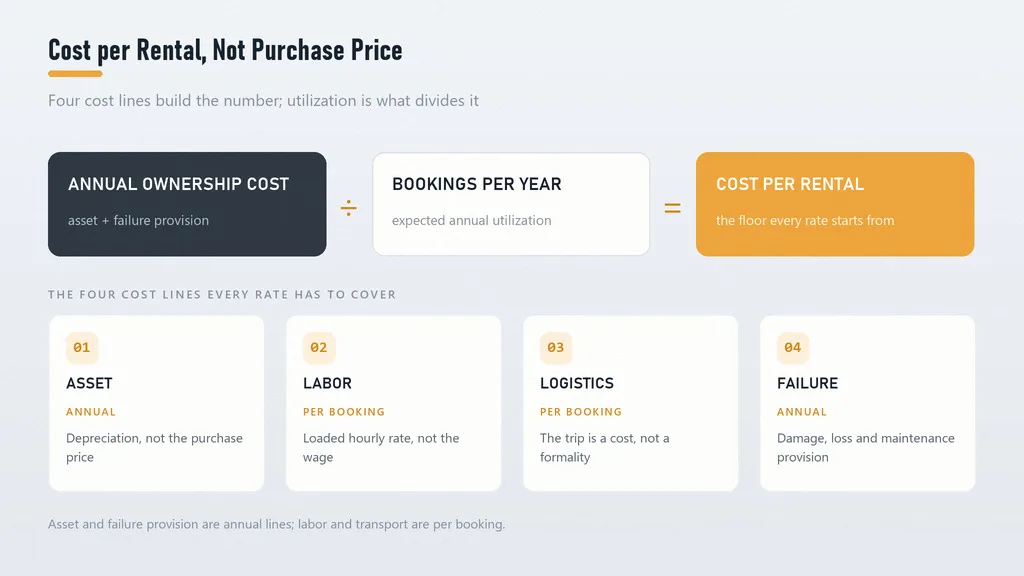
The Four Costs Every Rate Has to Cover
Almost every pricing failure in equipment rental traces back to one of four cost lines being undercounted. Work through all four for a single item before you set its rate.
| Cost line | How to calculate it | The usual mistake |
|---|---|---|
| Asset (depreciation) | Purchase price divided by expected service life in years, then divided by bookings per year | Using the purchase price as the cost of the booking |
| Labor | Crew hours multiplied by the fully loaded hourly cost, not the wage | Using the advertised wage and ignoring payroll costs |
| Logistics | Vehicle cost per trip plus fuel, tolls and load or unload time | Treating delivery as free because the van was already going out |
| Failure | Annual provision for damage, loss, maintenance and spare parts, divided by bookings | Assuming wear and tear will be absorbed by future revenue |
Asset cost: depreciation, not purchase price
Rental equipment is a depreciating asset, and the cost it adds to a booking is its decline in value, not its sticker price. Business equipment is depreciated over a set recovery period, and in the United States the IRS guidance that defines those periods is Publication 946 [1].
For planning purposes you do not need a tax schedule to make the point. Take the purchase price, divide by the service life you actually expect for rental use, then divide by the number of bookings in a year.
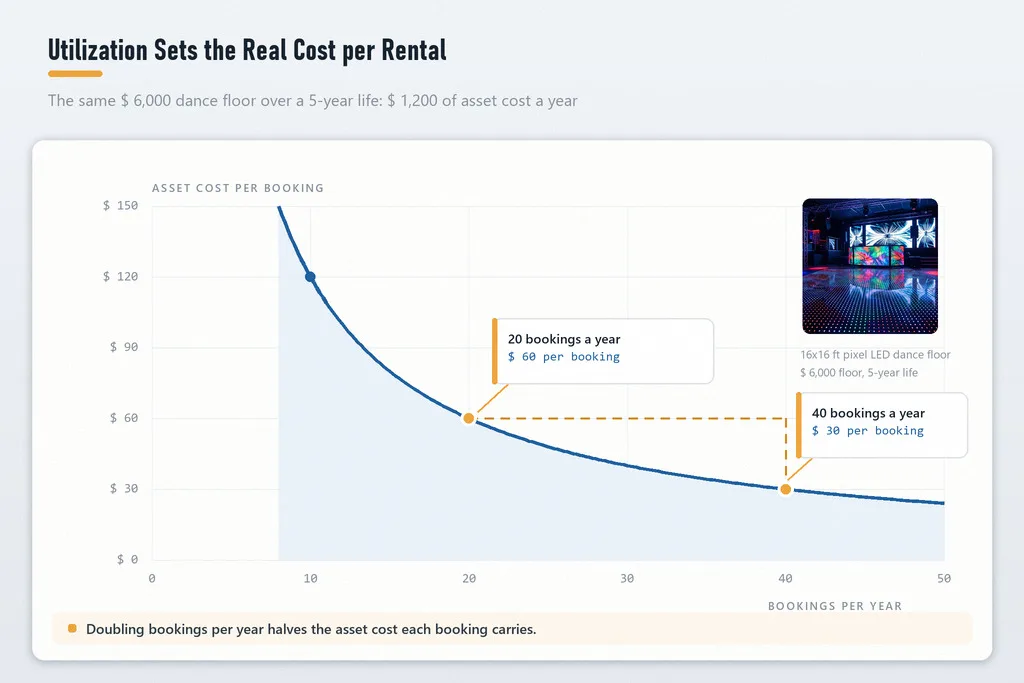
A $ 6,000 LED dance floor expected to last five years costs $ 1,200 a year in asset terms. At 20 bookings a year that is $ 60 per booking. At 40 bookings a year it is $ 30. The equipment did not change; only how hard you worked it changed.
Labor cost: the loaded hourly rate, not the wage
This is the line that is easiest to undercount, because the number on the payroll system is not what the crew member costs. Employer compensation data for the United States shows why: among private industry full-time workers, wages and salaries averaged $ 36.97 per hour while benefits added a further $ 17.03, bringing total employer compensation to $ 54.00 per hour worked [2].
Read that as a multiplier. Benefits add roughly 46 percent on top of wages, so a crew member paid $ 20 an hour costs your business about $ 29 an hour. Even the components you have no choice about are material: legally required benefits alone averaged $ 3.76 per hour for full-time private industry workers [2].
For event work specifically, employer compensation in the leisure and hospitality sector averaged $ 27.95 per hour for full-time workers and $ 17.21 for part-time workers in the same period [2]. Those figures are a useful benchmark when you are deciding whether an in-house crew or a freelance call-out is cheaper for a given booking.
The practical rule: multiply every crew hour by the wage times 1.46 before it goes into a rate calculation. On a four-crew-hour job at a $ 20 wage, that is $ 116.80 of labor rather than $ 80.
Logistics cost: the trip is a cost, not a formality
A vehicle that leaves the warehouse costs money whether it carries a full booking or a single table. Count fuel, vehicle wear, tolls, parking, the driver's hours, and the load and unload time at both ends.
The unload time is the part that surprises operators. A dance floor that takes 30 minutes to assemble in a warehouse bay can take 75 minutes in a hotel ballroom with a service lift queue.
Failure cost: provision for damage, loss and maintenance
Rental equipment gets broken, lost and worn, and the cost belongs in the rate rather than in the owner's head. Build an annual provision as a percentage of asset value, then divide by bookings. Consumable items, flight case repairs, replacement tiles, connectors, and a small budget for unrecovered damage all belong in this line.
When you buy equipment, the support terms you negotiate change this line directly. Event Golden backs its rental equipment with a 5-year warranty and 20+ overseas warehouses, which shortens the replacement time that shows up as a failure cost in any rental pricing model.
Utilization: The Number That Decides Your Real Cost per Rental
Utilization is bookings per year divided by the number of bookings the item could realistically serve. It matters because every fixed cost line, asset cost above all, is spread across the bookings you actually book.
The arithmetic cuts both ways. If a $ 6,000 floor runs 20 times, its asset cost is $ 60 per booking. If the same floor runs 10 times because you bought it late in the season or never marketed it, the asset cost doubles to $ 120 for identical service.
That is why two operators with identical equipment and identical rates can post completely different profits. The one with higher utilization is not charging more; they are carrying less idle cost per booking.
Idle equipment still costs money. A floor sitting in the warehouse keeps depreciating, needs storage and insurance, and loses value to age and inventory drift. Every booking that does not happen leaves its share of those costs to be absorbed by the bookings that do.
This also sets a floor on how aggressively you can discount. The lowest price you can profitably accept is your cost per booking at your expected utilization, and if you drop below it you are not buying market share, you are buying a slower path to replacing the asset.
Setting the Rate: Cost-Plus First, Market-Checked Second
With the four cost lines and a utilization estimate, the calculation itself is short.
Step 1: total the cost per booking
Add the four lines for that specific booking. Asset, loaded labor, logistics, failure provision.
Step 2: add your target contribution
Contribution is what is left after the direct costs of the booking, and it is what pays your fixed overheads and your profit. Choose a target as a percentage or as an absolute figure per booking. Both work, but an absolute figure is easier to defend on a high-ticket booking.
Step 3: check the result against the market
Now compare to what local operators charge for comparable equipment and service. If your number sits far above the market, look for a cost line that is out of line rather than assuming the market is wrong. If it sits far below, you are either unusually efficient or you have missed a cost.
Step 4: decide which figure is the rate and which is the floor
Publish the market-checked figure as your rate where the market supports it, and keep the calculated number as the internal floor below which you do not go. Discounting down to the floor is a decision you make deliberately; discounting below it is a mistake you make by accident.
A Worked Rate Card
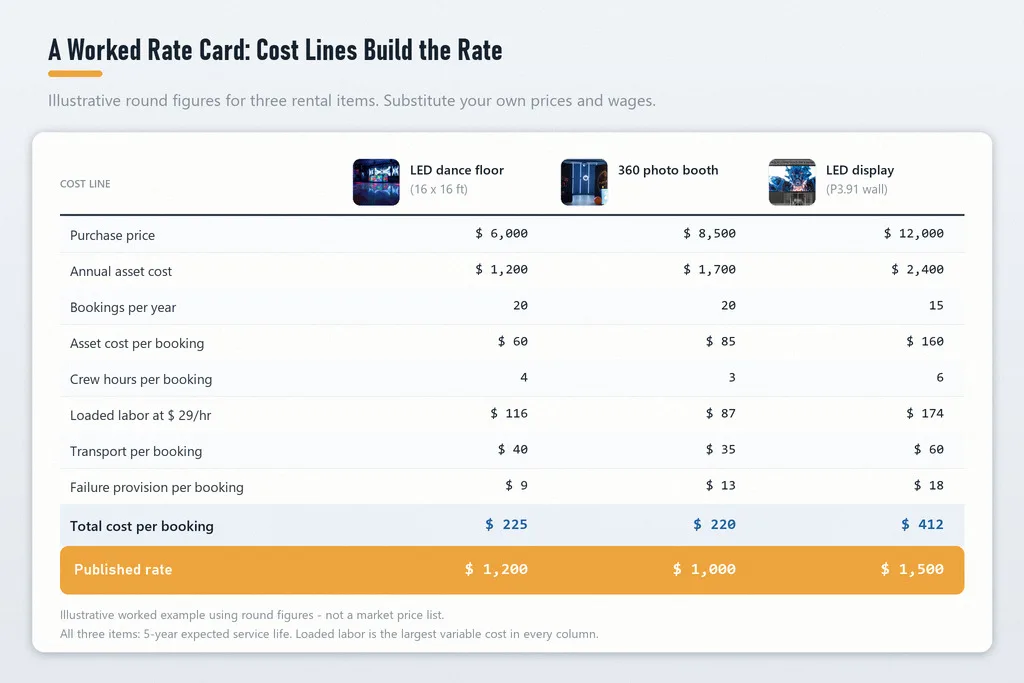
The numbers below are illustrative and use round figures so the arithmetic is visible. Substitute your own purchase prices, wages and travel distances.
| Line | LED dance floor (16x16 ft) | 360 photo booth | LED display (P3.91 wall) |
|---|---|---|---|
| Purchase price | $ 6,000 | $ 8,500 | $ 12,000 |
| Expected service life | 5 years | 5 years | 5 years |
| Annual asset cost | $ 1,200 | $ 1,700 | $ 2,400 |
| Bookings per year | 20 | 20 | 15 |
| Asset cost per booking | $ 60 | $ 85 | $ 160 |
| Crew hours per booking | 4 | 3 | 6 |
| Loaded labor per booking (at $ 29/hr) | $ 116 | $ 87 | $ 174 |
| Transport per booking | $ 40 | $ 35 | $ 60 |
| Failure provision per booking | $ 9 | $ 13 | $ 18 |
| Total cost per booking | $ 225 | $ 220 | $ 412 |
| Target contribution | $ 975 | $ 780 | $ 1,088 |
| Published rate | $ 1,200 | $ 1,000 | $ 1,500 |
Two features of that table matter for pricing. The equipment itself is the smallest line in every column, which is why pricing from the purchase price gets the answer wrong in both directions. Labor is the largest variable cost in all three columns, which is why the loaded hourly rate matters more than almost any other input.
Fact: Event Golden manufactures rental LED dance floors, LED displays in P1.9, P2.6 and P3.91, and 360, mirror, iPad and magazine photo booths for event rental businesses and distributors.
If you want the revenue side of those same assets worked through in more depth, the ROI guides cover rental rates and payback for the LED dance floor, the 360 photo booth and the LED display.
What a Rental Business Break-Even Looks Like
Cost per booking tells you whether a single job is worth taking. Break-even tells you how much work the business needs to cover itself. The United States Small Business Administration defines the break-even point as the level at which total cost and total revenue are equal, meaning there is no loss and no gain [3].
For a rental business, the calculation has two layers, and mixing them up is what makes owners think they are profitable when they are not.
| Layer | What it covers | How to find the break-even |
|---|---|---|
| Item level | The equipment's own asset, labor, transport and failure costs | Annual ownership cost divided by contribution per booking for that item |
| Business level | Overheads: storage, insurance, admin, software, marketing, vehicle fleet | Total annual overheads divided by average contribution per booking |
Work an example at the business level. Suppose annual overheads are $ 24,000 and your average contribution per booking across the fleet is $ 975. Break-even is $ 24,000 divided by $ 975, which is about 25 bookings a year.
That single number is more useful than any margin percentage, because it converts directly into a sales figure. If your calendar realistically holds 20 bookings, the fleet as configured does not cover its overheads, and the answer is either a higher contribution per booking or a lower overhead base. Neither answer is "work harder."
Price Delivery, Setup and Travel Separately
Bundling transport and setup into one headline rate combines two costs with different drivers into a single number, which is why it hides so much margin. It also makes you look more expensive than you are on short-distance jobs, because the customer pays for average travel whether they need it or not.
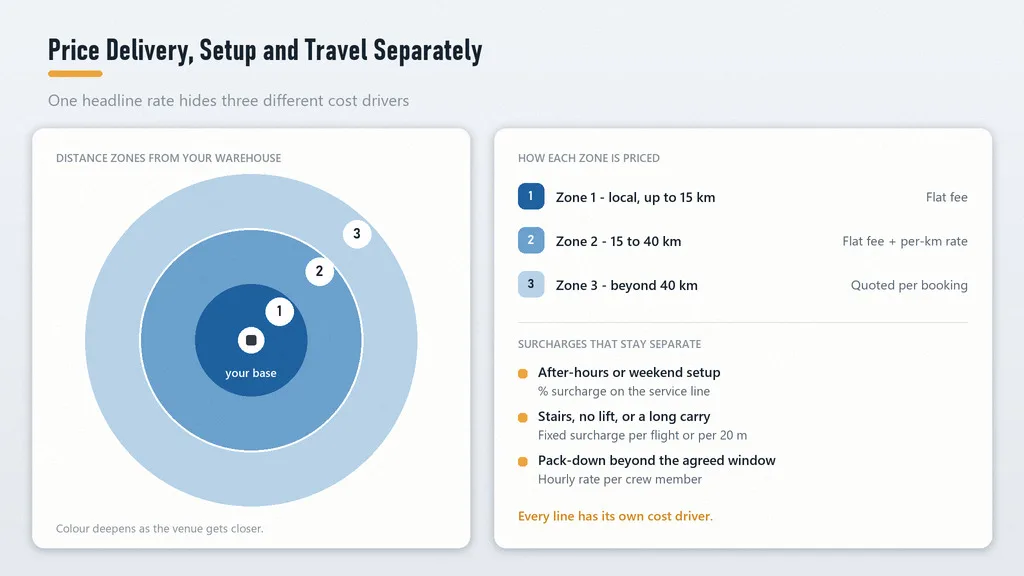
Quote the equipment and the service as separate lines, then price the service by zone.
| Service line | How to price it | Why it is separate |
|---|---|---|
| Zone 1 delivery (local, up to about 15 km) | Flat fee | Covers the trip that almost every booking requires |
| Zone 2 delivery (about 15 to 40 km) | Flat fee plus per-kilometre rate | Distance is the variable, not the equipment |
| Zone 3 delivery (beyond about 40 km) | Quoted per booking | Two-way travel time can rival the setup time |
| After-hours or weekend setup | Percentage surcharge on the service line | Crew scheduling cost, not equipment cost |
| Stairs, no lift, or long carry | Fixed surcharge per flight or per 20 m | The single biggest cause of unplanned crew hours |
| Pack-down beyond the agreed window | Hourly rate per crew member | Protects you when the event runs long |
The pattern is that every line has its own cost driver, and pricing them together hides which driver is actually expensive. It also changes customer behaviour in your favour: when the long-carry surcharge is visible, more clients arrange a loading bay.
Deposits, Damage and Loss: Price the Risk Instead of Absorbing It
Damage is a certainty in equipment rental, and the only question is whether you priced it or whether you are paying for it out of margin. Two mechanisms handle it, and they are not the same thing.
A damage deposit is money you hold and return. It is a liability on your books, not income, and treating it as revenue is one of the fastest ways to lose track of whether the business is profitable. The deposit's job is to protect you when equipment comes back unusable, not to fund operations.
A damage waiver is a separately charged, non-refundable fee that transfers normal accidental damage to you in exchange for a small percentage of the rental fee. It is income, it is predictable, and it removes most of the argument at collection time.
Used together, they cover two different failure cases: the waiver handles small accidents that are not worth a dispute, and the deposit handles total loss and gross negligence.
Whichever you use, the failure provision in your cost model should reflect what you actually experience. Track damage costs by item for a full season, then set the provision from your own data. An operator who has never measured damage frequency is guessing.
Fact: Event Golden exports to over 200 countries, with North America at 55% of sales and Western Europe at 17%, and holds TÜV Rheinland certification plus CE, RoHS, FCC, LVD and CB compliance.
Package Pricing Without Discounting Yourself
Packages raise the average booking value when they add items the customer would not have booked alone. They destroy margin when they discount items the customer was already going to book.
The distinction matters because the two look identical on an invoice. A couple books a photo booth and a dance floor, and you offer $ 200 off for taking both. If they had decided on the dance floor regardless and the booth was genuinely incremental, the discount is a real cost against new revenue. If they were going to book both anyway, you gave away $ 200 for nothing.
Price the package from the standalone rates first.
- Total the standalone rates of every item in the package.
- Confirm that the total still clears your contribution target after any discount.
- Apply a discount only in exchange for something: a larger booking, an off-peak date, a longer hire period, or a confirmed repeat.
- Never build a package by discounting until the number looks attractive.
The cross-category bundling strategy guide works through how to structure a photo booth and dance floor combination so it lifts the ticket rather than cutting it.
When and How to Raise Prices
Prices that never move are a slow-margin leak, because crew wages, fuel, insurance and replacement equipment costs all drift upward. The businesses that avoid painful corrections are the ones that adjust a little every year.
Review the rate card on a fixed schedule, and immediately whenever a major input moves. Wages, fuel and insurance are the three lines that most often change faster than the calendar.
Communicating an increase is easier than most owners expect, provided you do three things. Give notice before the season starts rather than mid-season. Explain the change as a cost or service fact rather than an apology. And honour existing quotations for events already confirmed, so the increase applies to new bookings only.
There is also a segment question worth asking each year. If your equipment has paid for itself and your bookings are consistently turning away demand, your price is probably below what the market accepts for your service level. That is a profitable problem, and the fix is a price change rather than more equipment.
Seven Pricing Mistakes That Kill Rental Margin
Pricing from competitors instead of costs. You cannot see another operator's asset age or utilization, so their rate carries no information about whether your business can survive at that number.
Using the wage instead of the loaded hourly cost. Employer compensation data puts benefits at roughly 46 percent on top of wages for full-time private industry workers [2]. A rate built on the wage understates labor by nearly a third.
Bundling logistics into the headline rate. Delivery, setup and travel have their own cost drivers. Hiding them inside the equipment rate means short-distance jobs subsidise long-distance ones.
Discounting to fill a quiet weekend without checking the floor. Your cost per booking at expected utilization is the lowest price that makes sense. Below it, the booking consumes asset value rather than contributing to it.
Treating deposits as revenue. A deposit is held money. Counting it as income flatters the month it is collected and distorts every comparison after that.
Selling packages as discounts. A package that reduces the price of items the customer already wanted is a price cut with extra steps. Build packages that add items and raise the total.
Never revisiting the rate card. Cost inflation is continuous while prices tend to sit still. If your rate card has not moved in three years while wages, fuel and insurance have risen, that margin has been absorbed rather than protected.
If you are still building out the equipment base that these rates will apply to, the guide to starting an event rental business covers the sequencing question, and the supplier checklists for LED dance floor manufacturers and photo booth manufacturers cover the purchase side. For booth-specific payback figures, the mirror, iPad and magazine ROI guides each run the same calculation on a different product.
FAQ
How do I calculate what to charge for an event rental?
Start with cost per rental, not the purchase price. Divide the annual cost of owning the item by the number of times you rent it in a year, then add the labor, transport and loss provision for that specific booking. That gives you a cost floor. Add your target margin to set the rate, then check the result against what local competitors charge for comparable equipment and service.
What profit margin should an event rental business aim for?
Once equipment is paid off, gross margin on a single booking commonly lands in the 70 to 85 percent range, because the remaining costs are mostly crew time, transport and minor wear (indicative range, check it against your own numbers). New equipment carries a lower effective margin while depreciation is still being recovered. The figure that matters more than the percentage is contribution per booking, because that is what pays your fixed costs.
How many bookings per year does equipment need to pay for itself?
Divide the annual ownership cost of the item by your contribution per booking, and you have the number of bookings needed to cover that item alone. A $ 6,000 item depreciated over five years costs $ 1,200 a year before maintenance, so at $ 900 contribution per booking it needs under two bookings a year to cover itself. Covering your business overheads takes far more bookings, which is a separate calculation.
Should delivery and setup be charged separately?
Yes. Bundling delivery and setup into the headline rate prices a central-city job and a three-hour round trip the same, which is where margin disappears. Price transport by distance zone, add surcharges for after-hours work, stairs without a lift and long carry distances, then quote the equipment rate separately so the customer can see what each part costs.
Is a damage deposit part of revenue?
No. A deposit is a liability you hold until the equipment comes back, and it should be recorded and refunded as such rather than treated as income. The revenue is the rental fee plus any separately charged damage waiver. If you keep part of a deposit for damage, that is a recovery of a loss, not a sale, and it should be tracked so you can see whether your damage provision is set correctly.
How do I price a package instead of individual items?
Price each item at its standalone rate first, then build the package total from those rates and apply a modest package discount that your contribution math still supports. Never assemble a package by discounting the items until the total looks attractive. A package should raise the average booking value by adding items the customer would not have booked alone, not by cutting the price of items they would have booked anyway.
How often should I raise rental prices?
Review your rate card at least once a year, and whenever your largest cost lines move: crew wages, fuel, insurance or equipment replacement cost. Apply increases to new bookings rather than retroactively, and give repeat clients notice before the season starts instead of mid-season. Small annual increases are easier to communicate than a large correction every few years.
What is the most common pricing mistake in equipment rental?
Pricing from competitors instead of from costs. You cannot see another operator's asset age, utilization rate, labor cost or debt position, so copying their rate means copying a number that may be unprofitable for them or irrelevant to you. Build the cost floor first, then use competitor rates only as a market check on the number you already arrived at.
Conclusion
Event rental pricing is a cost calculation with a market check at the end, and the order matters more than the precision. Get the four cost lines right, use the loaded hourly rate instead of the wage, and let utilization rather than the purchase price set the asset cost per booking.
Then turn the answer into two numbers you can actually run the business on. Cost per booking is your floor, and it tells you which bookings are worth taking. Break-even in bookings is your target, and it tells you how full the calendar has to be before the fleet pays for itself.
Fact: Event Golden backs its rental equipment with a 5-year warranty and 20+ overseas warehouses, which shortens the replacement time that shows up as a failure cost in any rental pricing model.
If you are rebuilding your rate card around real equipment costs, review the LED dance floor product range or send your equipment list and target utilization through the contact page for a factory quote. Buyers comparing supply routes can also start from the factory buying guide hub.
Sources
- Internal Revenue Service (United States). "Publication 946: How To Depreciate Property." https://www.irs.gov/publications/p946: official guidance defining what business property can be depreciated, over what recovery period, and by which method. Cited for the depreciation concept behind asset cost per booking.
- U.S. Bureau of Labor Statistics. "Employer Costs for Employee Compensation Summary, June 2026." https://www.bls.gov/news.release/ecec.nr0.htm: private industry full-time workers averaged $ 36.97 per hour in wages and salaries plus $ 17.03 in benefits, a total of $ 54.00 per hour worked; legally required benefits averaged $ 3.76 per hour; leisure and hospitality employer compensation averaged $ 27.95 per hour for full-time and $ 17.21 for part-time workers. Cited for the loaded labor multiplier and the event-sector labor benchmark.
- U.S. Small Business Administration. "Calculate your startup costs." https://www.sba.gov/business-guide/plan-your-business/calculate-your-startup-costs: defines the break-even point as the level at which total cost and total revenue are equal, meaning no loss and no gain. Cited for the break-even definition used in the business-level calculation.
- Event Golden. "LED Dance Floor." Event Golden product page. https://eventgolden.com/products/led-dance-floor/: manufacturer specifications, warranty terms, overseas warehouse coverage and certification scope referenced in the Fact Blocks (per manufacturer specifications).
Ready to start your event business?
Get a free wholesale quote within 24 hours. Product details are confirmed by direct inquiry.
Get a Free Quote