Wholesale LED Display Quotes: How to Compare the Full System Cost
Compare wholesale LED display quotes line by line: cabinets, processor, power, structure, spares, freight, and install, using an included or not matrix.
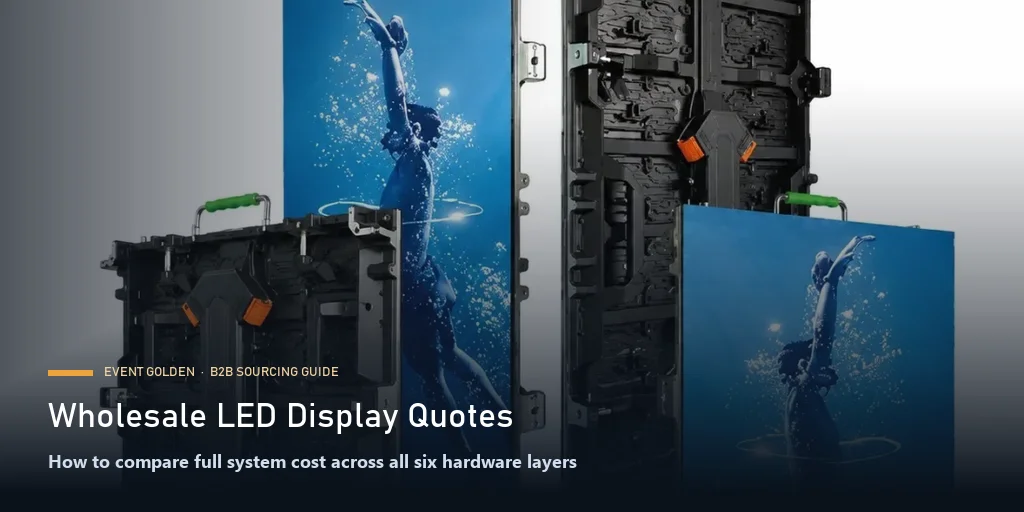
Wholesale LED Display Quotes: How to Compare the Full System Cost
Two wholesale LED display quotes for the same 6 by 3 meter wall can sit tens of percent apart and still cover identical panels. The difference is almost never the screen. It is what each supplier chose to include, leave out, or leave for you to discover after the order. This guide shows how to break a wholesale led display quote into line items, pull every quote onto one scope, and compare the full led display system cost rather than the headline figure. Forget the cheapest number on the page. What you want is the quote you can build, install, and run without a second invoice.
Why Wholesale LED Display Quotes Are Not Comparable
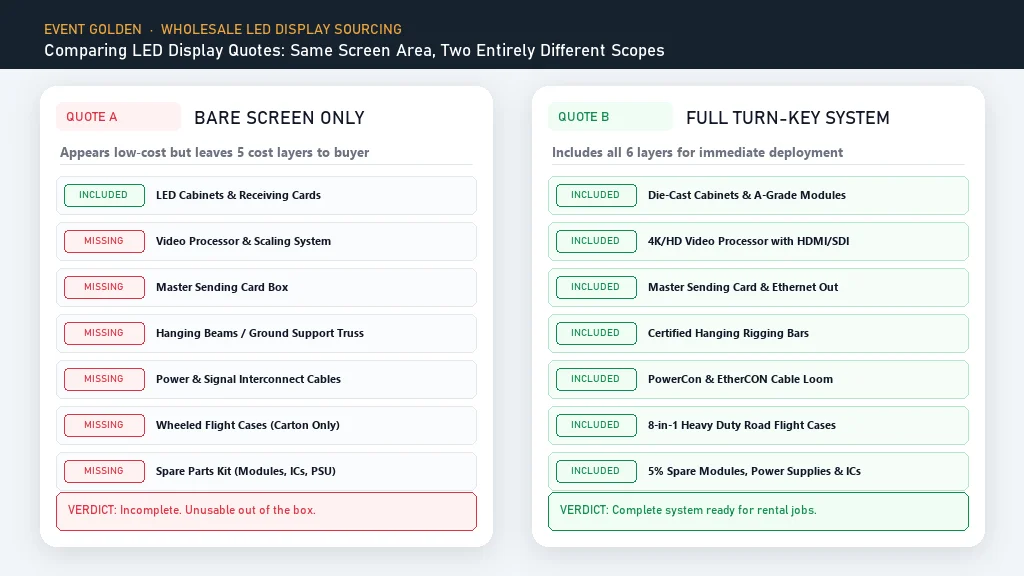
A quote is a scope, not a price. When a wholesaler replies with one line for "LED screen, 6x3m, P3.91," they have already made dozens of decisions on your behalf: which cabinet series, which processor, how many receiving cards, whether spares ship with the order, and who pays the freight. Two honest suppliers can describe two different systems.
So before you compare anything, align the scope. Until the quotes describe the same thing, the price gap between them is noise, and you risk picking the cheaper one only to buy the missing items later at retail prices.
The real shift here is from buying panels to buying a working system. Panels are the visible cost; the processor, power, structure, cabling, and spares around them are where the money and the gaps hide. Buyers who fixate on the panel price keep paying for the rest of the system later.
Fix the Screen Spec Before You Compare Price
You cannot compare wholesale led display quotes until every quote is for the same screen. Pin down the variables that move the bill, then send every supplier the same specification.
The main drivers are pixel pitch, cabinet size, and brightness. Pixel pitch sets both resolution and price per square meter, so a P2.6 quote and a P3.91 quote are not competing for the same job. Cabinet dimensions decide how many panels tile your target size and how much structure you need. Brightness and refresh rate matter most for outdoor and camera-facing work, where a cheaper, lower-grade panel is visibly worse on camera. If pitch is still open, the LED screen pixel pitch guide maps pitch to viewing distance.
Indoor and outdoor are separate purchases. An outdoor wall needs a higher brightness class, weather sealing, and a heavier structure, so an outdoor quote will not match an indoor one item for item. The indoor vs outdoor LED display comparison settles the category question before you ask anyone for pricing.
Once these are fixed, put them on a one-page spec sheet and attach it to every request. A supplier cannot exploit ambiguity you have removed. Every supplier now quotes the same wall, and any remaining difference is a difference in scope rather than in product.
The Anatomy of a Full LED Display System
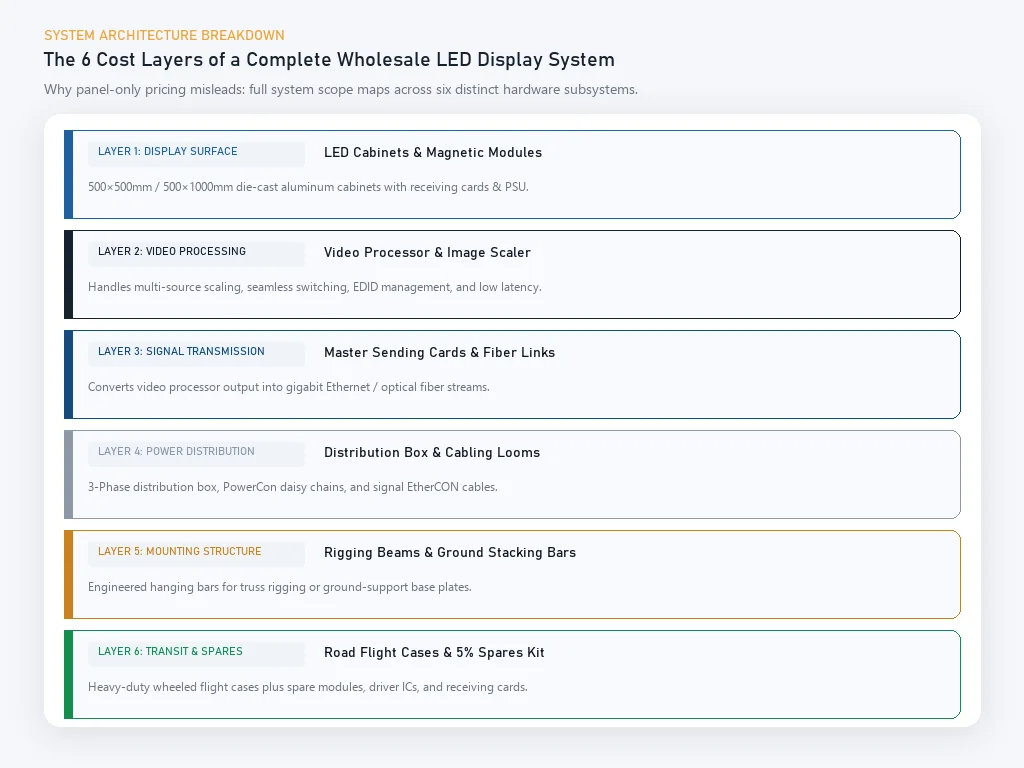
A video wall is a system, and the panel is only its most visible part. Read every quote against the component list below, because each item is a place where one supplier includes and another quietly excludes.
Cabinets, Modules, and Spare Parts
The cabinet is the frame that holds the modules plus the power and data electronics. Two suppliers can quote the same pitch, the same brightness, and a different cabinet: a lighter die-cast aluminum version, a heavier steel version, or a cheaper plastic-backed design. Weight changes your transport and rigging, so it belongs in the comparison, not in the small print.
Spares are the item most often forgotten. LED walls fail module by module, not all at once, and a dead module during a live event is a problem you solve with a spare on site. Ask each supplier what spare modules, spare power supplies, and spare receiving cards ship with the order. If none are listed, price them separately before you compare totals.
Video Processor and Control System
The processor takes the source signal and maps it onto the wall's pixel grid. It is frequently quoted as a separate line, and it is frequently missing. A wall without a suitable processor is not a working system, which is why this line should never be left blank on a wholesale led display quote.
Confirm the processor model, its input types, and its mapping capacity against the resolution of your wall. A processor that is adequate for one small screen may not drive a larger wall or a multi-window feed. Ask whether the processor is bound to a specific brand, because that affects what software and content pipeline you can use later, and whether you are locked into one supplier for replacements.
Sending and Receiving System
Behind every cabinet sits a receiving card, and at the source sits a sending card or sending box. The receiving cards are cheap per unit and expensive to be short of, because each cabinet needs one. A quote that lists a sending card but not the receivers on a large wall is incomplete.
Confirm that the receiver count matches the cabinet count, that hot spares are included, and that the sending system can address your full cabinet quantity. On a wall that will travel, this is also the part most likely to be swapped out on site, so spare receivers are not optional.
Power Supply and Distribution
Inside the cabinets are the power supplies. Outside them is everything that gets mains power to the wall: distribution, breakers, and the cabling to site power. Cabinet-level PSUs are usually included; site distribution usually is not.
Confirm the voltage, the phase, the connector type, and the power draw per square meter, because these decide whether your venue can run the wall at all. Site power and the equipment's electrical safety fall under local code and, for the hardware itself, standards such as IEC 62368-1, so the plan should be signed off by a qualified electrician on site rather than assumed from a quote line. A wall that cannot be powered by the venue is the most expensive kind of gap, because you discover it on installation day.
Cabling and Signal Path
Short internal ribbon and power cables usually come with the cabinets. The long data and power runs between cabinets, the main feed, and the spares do not. Cable is a small line item that can stop a build, so count the runs and confirm the lengths and connector types.
Ask specifically for the main data feed length and the main power feed length, since those are the two runs that are almost always short in a first quote. Add spare cables for the runs that fail most often.
Mounting Structure and Rigging
The structure decides how the wall stands or hangs. Some quotes include a basic frame; many do not. Truss, clamps, base plates, custom frames, and any rigging hardware are almost always separate.
For anything hanging overhead, the load rating and rigging plan must be confirmed by a qualified rigger and the venue. A quote cannot certify that a truss can carry your display, so treat the structure as a designed part of the system rather than an accessory. Getting this wrong is where safety and cost both go wrong.
The Included, Not Included, To Confirm Matrix
This is the table to keep open while you read quotes. It sorts each system item into three states: what wholesale led display quotes usually contain, what they usually leave out, and what you must confirm in writing before you order.
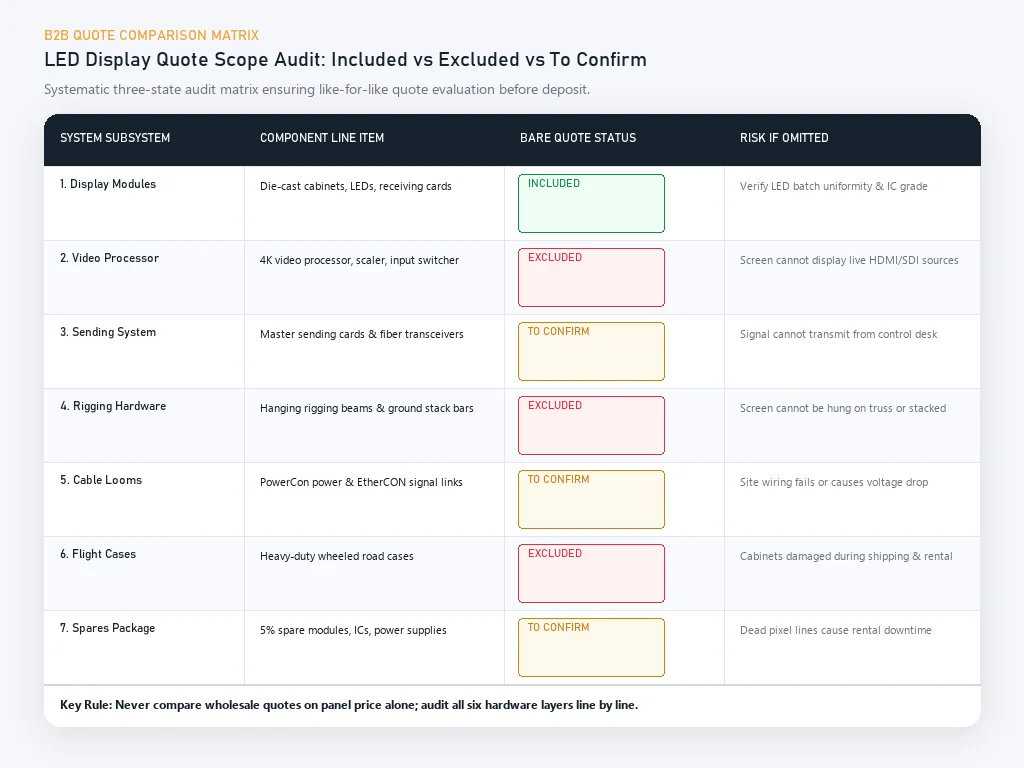
| System item | Usually included | Usually left out | Confirm before ordering |
|---|---|---|---|
| Cabinets and modules | Panel count, pitch, cabinet size | Spare modules and spare PSUs | Spare quantity shipped with the order |
| Video processor | Sometimes, as a separate line | Processor for larger walls | Model, inputs, mapping capacity, brand lock-in |
| Sending and receiving | Sending card | One receiver per cabinet | Receiver count equals cabinet count, plus spares |
| Power supply | Cabinet-level PSUs | Site distribution, breakers, main feed | Voltage, phase, connector type, power draw per square meter |
| Cabling | Short internal cables | Long data and power runs, spares | Cable length, count, and connector types |
| Mounting structure | Basic frame, sometimes | Truss, clamps, base plates, custom frames | Structure drawing, load rating, rigging points |
| Flight cases | Sometimes | Case count and custom foam | Cases per panel group, wheels, stacking |
| Installation | Rarely | Local labor, rigging, site power | Who installs, who signs off, site survey |
| Freight and duty | Rarely | Ocean or air freight, duty, insurance | Incoterm, delivered or ex works |
| Warranty and support | Partial | On-site support, spare lead time | Term, coverage, response time, spare shipping point |
Read the three states as a filter. If an item sits in the middle column and your quote does not mention it, treat it as a cost you will pay later.
How to Level Quotes That Are Not Comparable
When two quotes describe different scopes, do not compare the totals. Normalize them first. This is the sequence that turns a pile of quotes into a decision.
- Freeze the specification. Lock pixel pitch, cabinet size, brightness, refresh, and target dimensions in one document and confirm every supplier is quoting against it.
- Ask for a line-item bill of materials. Request each quote itemized against the matrix above, not a single lump sum. A supplier who cannot itemize cannot be compared.
- Map each quote to the matrix. Mark every line as included, left out, or to confirm, using the same table for all suppliers.
- Price the gaps. For anything left out, ask the same supplier to quote it, or use a market reference for that line. Now every quote covers the same list.
- Compare normalized totals, then terms. Only after scope matches do the numbers mean anything. Then weigh warranty, spare lead time, and freight terms, which are not on the price line but change your real cost.
- Put the outcome in writing. Send the normalized comparison back to each supplier and ask them to confirm the scope. This closes the gap between what you think you bought and what will arrive.
Run the same six steps on every led video wall quote you receive, and you will quickly spot which suppliers were quoting a system and which were quoting a panel.
The Landing Cost: What Arrives After the Order
The quote is the start of the cost, not the end. Two more layers arrive after the order.
The first is logistics. Freight, insurance, customs duty, and clearance depend on the Incoterm, the delivery term defined by the International Chamber of Commerce that sets where the supplier's responsibility ends. An ex works price and a delivered price are not the same number, so confirm the term before you compare. When you buy led screen wholesale from overseas, the goods are usually handed over at a port or a door, and the last leg is yours.
The second is local installation. Rigging, mounting, commissioning, electrical work, and any certification the venue requires are almost always local costs, not supplier costs. These are the items that make an led video wall quote look cheap until the wall is on site. Plan them before you commit, and confirm the electrical and structural assumptions with qualified professionals rather than relying on a line in a quote.
Rental-Specific Line Items
If the wall will be rented out rather than fixed to a wall, the cost list changes. A rental screen travels, so it needs flight cases, road-ready cabinets, and spares that follow it to every job.
The flight cases themselves are a real line item. So are the spare modules and power supplies that let you fix a failure on site, and the redundancy that keeps a paid event running. For a rental fleet, the rental LED display range is built around this travel and repair reality, and the LED rental display guide covers how rental screens are specified and operated. If you are weighing a rental purchase against its payback, the LED display ROI guide runs the numbers on contribution and booking frequency.
A rental led display quote should therefore be read on the same matrix, plus these rental-only items. Do not compare a rental quote against a fixed-install quote without first adding the cases and spares to the fixed side, or the fixed side will look cheaper than it is.
A Quote Comparison Workflow You Can Run in an Afternoon
Pull it together in a fixed order so you do not compare the wrong things.
Build one spec sheet and send it to every supplier with the matrix attached. Collect the itemized quotes. Fill in the matrix for each supplier in a single spreadsheet, one column per quote. Mark gaps in a different color so they are visible at a glance. Normalize the totals, then add logistics and installation as their own rows so they sit next to the hardware, not below the fold.
When the spreadsheet is done, the cheapest column is rarely the cheapest wall, because the columns no longer hide their differences. That is the point: you are comparing delivered, installable systems rather than panel prices.
Fact: BiaoMing's LED display line spans P1.9, P2.6, and P3.91 rental screens plus indoor and outdoor advertising panels, built for both rental and fixed installation.
Fact: BiaoMing exports LED displays to over 200 countries, with North America at 55% and Western Europe at 17%, backed by TÜV Rheinland certification, a 5-year warranty, and 20+ overseas warehouses.
FAQ
What should a wholesale LED display quote include?
A complete quote lists the cabinets and modules, the spare modules and power supplies, the video processor, the sending and receiving cards with one receiver per cabinet, the power and data cabling, the mounting structure, and the flight cases if the wall travels. It should also state the warranty, the spare lead time, and the Incoterm. Anything not on the list is a cost you will meet later.
Why are LED display quotes for the same screen so different?
Because they are rarely for the same screen. A quote is a scope, not a price. Pixel pitch, cabinet design, brightness class, spares, processor, and freight terms all change between suppliers, and a one-line total hides every one of them. Normalize the scope before you read the numbers, or the comparison is meaningless.
How do I compare a wholesale LED display quote?
Freeze one specification, ask every supplier for an itemized bill of materials, and map each quote onto the same included, left out, and to confirm matrix. Price the gaps so every quote covers the same list, then compare the normalized totals and the terms. The lowest normalized total is your real starting point, not the lowest headline figure.
What is usually missing from an LED video wall quote?
The most common gaps are spares, a suitable video processor, the receiving cards, and the mounting structure. Site power distribution and the freight and duty terms are also frequently left out. Each is cheap to add at the quoting stage and expensive to add after the wall has shipped.
How do I handle a rental LED display quote?
Read it on the same matrix, then add the rental-only items: flight cases, spare modules, spare power supplies, and the redundancy that keeps a paid event running. A rental quote and a fixed-install quote are not directly comparable until the fixed side also carries the cases and spares.
How do I compare quotes when freight and duty differ?
Check the Incoterm first. If one quote is ex works and another is delivered, add the freight, insurance, duty, and clearance to the ex works figure before you compare. The supplier's responsibility ends at a different point in each case, so the numbers only line up once both quotes describe the same delivery point.
Can I ask a supplier to match another quote's scope?
Yes, and you should. Send the normalized comparison back and ask them to confirm or amend their scope to match. This closes the gap between the quote you read and the system that arrives. It also reveals which suppliers understand their own scope and which are simply quoting a panel price.
Conclusion
The number at the bottom of a wholesale led display quote tells you what the supplier chose to sell. It does not tell you what your wall will cost. The only way to compare honestly is to fix the specification, break the system into its parts, and normalize every quote onto one matrix.
Do that and the cheapest column often stops being the cheapest. The quote that already includes the processor, the receivers, the structure, the spares, and the delivered freight is the lower risk, and risk is what you are actually buying when you compare wholesale led display quotes.
Confirm the electrical, structural, and rigging assumptions with qualified professionals before you commit, then ask each supplier to sign off on the normalized scope. To compare a full system quote against screens built for rental and fixed installation, see the BiaoMing LED display range or contact the Event Golden team with your specification.
Fact: BiaoMing has 13 years of LED display manufacturing experience and supports both OEM and ODM customization across its screen range.
Sources
- BiaoMing (Event Golden). "LED Display." Event Golden product page. https://eventgolden.com/products/led-display/: manufacturer specifications for P1.9, P2.6, and P3.91 rental screens and indoor and outdoor panels. System components and scope items referenced throughout.
- AVIXA. "Audiovisual Industry Standards and Best Practices." https://www.avixa.org/: reference for display system integration, installation, and commissioning practice.
- Planar. "LED Video Walls." https://www.planar.com/products/led-video-walls/: LED panel specification and pixel pitch reference.
- ViewSonic. "Large Venue Display Solutions: Direct View LED vs Projectors." https://www.viewsonic.com/library/tech/large-venue-display-solutions-direct-view-led-vs-projectors/: display system and total-cost reference.
- International Chamber of Commerce (ICC). "Incoterms 2020 rules." https://iccwbo.org/business-solutions/incoterms-rules/: definition of delivery terms that set where a supplier's responsibility ends, referenced in the landing-cost section.
- International Electrotechnical Commission (IEC). "IEC 62368-1: Audio/video, information and communication technology equipment." https://www.iec.ch/: electrical safety standard referenced for display equipment.
Ready to start your event business?
Get a free wholesale quote within 24 hours. Product details are confirmed by direct inquiry.
Get a Free Quote