How to Choose an LED Dance Floor Manufacturer: A Buyer's Checklist for Rental Businesses
How to vet an LED dance floor manufacturer: certifications, QC testing, spare parts, order quantity, lead time. A buyer's checklist for rental businesses.
How to Choose an LED Dance Floor Manufacturer: A Buyer's Checklist for Rental Businesses
Most rental businesses spend weeks deciding between 3D, star, and magnetic floors, then spend about twenty minutes checking who actually builds them. That ratio is backwards. What an LED dance floor purchase really includes, beyond the tiles themselves, is three years of spare parts, firmware updates, and a supplier who still answers the phone when a panel dies on a Saturday night in July.
Choosing the right LED dance floor manufacturer is the decision that determines whether that floor stays a revenue asset or becomes a source of refunds. This checklist walks through the ten things worth verifying, how to verify each one, and the red flags that show up before you pay a deposit.

Why the Manufacturer You Pick Decides Your First Two Seasons
A floor that fails twice in a season costs more in refunds and reputation than the price gap between a cheap supplier and a good one. Vendor selection deserves more of your time than product selection, for that reason alone.
The failure modes are predictable, and none of them are exotic. A tile stops lighting up because a connector corroded after an outdoor event. A control box dies and the supplier quotes a 45-day replacement. The software that maps your patterns stops receiving updates because the vendor switched to a newer controller. A second order of panels arrives a slightly different shade of white than the first, and now the floor looks patched.
Most of these failures trace back to the supplier rather than the hardware. The panels themselves are usually fine. What is missing is any plan for what happens after the sale.
Factory, Trading Company, or Assembler? How to Tell the Difference
There are three structures selling under the label "LED dance floor manufacturer," and the differences matter more than the marketing.
Integrated manufacturer
An integrated manufacturer owns the production steps that determine quality: LED module assembly, the SMT line that populates the driver boards, the aging room used for burn-in testing, and the final assembly of panels into floors. When you ask for a spare part in year two, this is the company that can still make one.
Trading company
A trading company sources finished panels from one or more factories and resells them. Pricing can be competitive and communication can be professional, so it is not automatically a bad option. The risk is continuity: your second order may come from a different factory, with different LED bins, a different connector design, and a control system that is not compatible with your existing tiles.
Assembler
An assembler buys modules, drivers, and control hardware from other manufacturers and builds the finished floor. This can work well, but it means the quality of your product depends on supply relationships you cannot see. Ask directly who makes the control card, the power supply, and the LED module, then judge whether the answer is specific or evasive.
| Structure | Owns production | Spare parts continuity | Customization | Typical price level | Main risk |
|---|---|---|---|---|---|
| Integrated manufacturer | SMT line, aging room, assembly | Strong: same tooling, same bins | High: custom sizes, branding, firmware | Mid to high | Higher order quantity on fully custom work |
| Trading company | No | Weak: depends on third-party factory | Limited to what the factory offers | Low to mid | Batch and shade mismatch on repeat orders |
| Assembler | Partial: assembly only | Medium: depends on component suppliers | Medium | Mid | Hidden dependency on unverified component supply |
How to tell in ten minutes
Ask four questions and watch how quickly the answers come.
- What is the manufacturing scope on your business license?
- Can we do a live video tour of the SMT line and the aging room today?
- Who manufactures the control card and the power supply?
- Can you provide the LED bin code for the modules you would use on my order?
A factory answers all four immediately, while a reseller tends to stall on the first and third. If a supplier cannot produce a bin code, it is usually because it does not know its own incoming materials, does not want you to compare them, or both.
The 10-Point LED Dance Floor Manufacturer Checklist
This is the core of the evaluation. Work through the points in order, and ask for written evidence at each one. Verbal assurance is worth nothing here, because every supplier will give it.
1. Panel and connector engineering
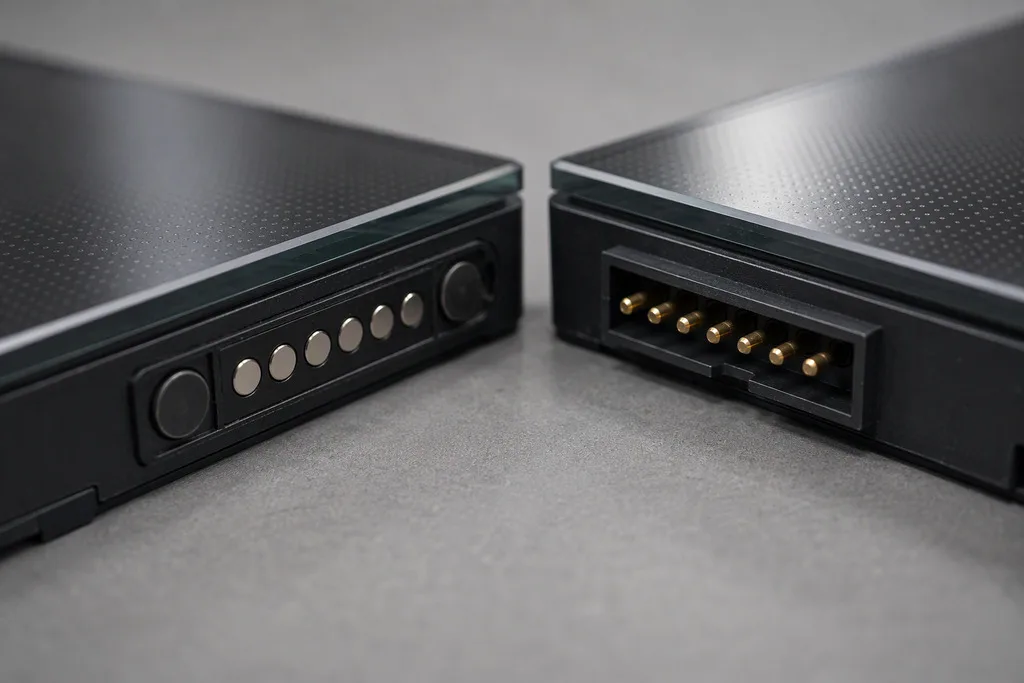
The connector is the part that kills rental floors. Look for the mating mechanism (magnetic or pin-type), the rated mating cycle count, and the IP rating of the assembled panel. Magnetic connectors rated for 10,000+ mating cycles are the usual specification for rental fleets (per manufacturer specifications), because a busy floor may be assembled and broken down dozens of times per season.
How to verify: ask for the connector specification sheet and any cycle-test report. Ask what the IP rating is for the assembled floor, not just the individual tile, since water ingress usually happens at the seams. IP ratings are defined by IEC 60529, where the first digit covers protection against solids and the second covers liquids, so an IP67 floor is dust-tight and protected against temporary immersion [6].
2. LED chips, drivers, and brightness consistency
Two floors can use the same nominal specification and look noticeably different. The variables are the LED chip tier, the binning discipline, and the driver IC quality. Binning means grouping chips by color and brightness so that every tile in your floor matches. Suppliers that skip binning produce floors with visible bright or dim tiles.
How to verify: ask for the LED bin code and the batch consistency policy. Then ask the question that separates real factories from resellers: what happens if my second order arrives from a different batch?
3. Control system and mapping software
Ask which protocol the floor uses, whether the mapping software is developed in-house or licensed from a third party, and how software updates are delivered. The control system determines what your floor can do in two years, not just on day one.
How to verify: request a screen recording of the mapping software running on a real floor. Then ask what happens if the control box fails in year three, and whether a replacement is guaranteed to be compatible.
4. Certifications and test documentation
At minimum you want CE and RoHS, plus FCC for the US market and LVD and CB for electrical safety [1][2][3][4][5]. Note what CE marking actually is: a manufacturer's declaration that the product meets the applicable EU requirements, not an approval issued by an EU authority [1]. Product certificates prove that a sample passed a test. A factory-level audit proves that the production site is real and controlled.
How to verify: collect certificate numbers and issuing bodies, then check them independently rather than accepting a PDF. TÜV Rheinland, for example, publishes certificate and test-mark records in its Certipedia database, so a claimed certificate number can be looked up rather than trusted [7]. Confirm that the audited factory address is the same address your goods will ship from. If the audit covers a different site than the shipping address, ask why.
Fact: EventGolden (Event Golden) manufactures magnetic RGB, star, and 3D abyss LED dance floors with tool-free magnetic assembly, IP67 waterproofing, and TÜV Rheinland certification.
5. Quality control: aging test and waterproof test
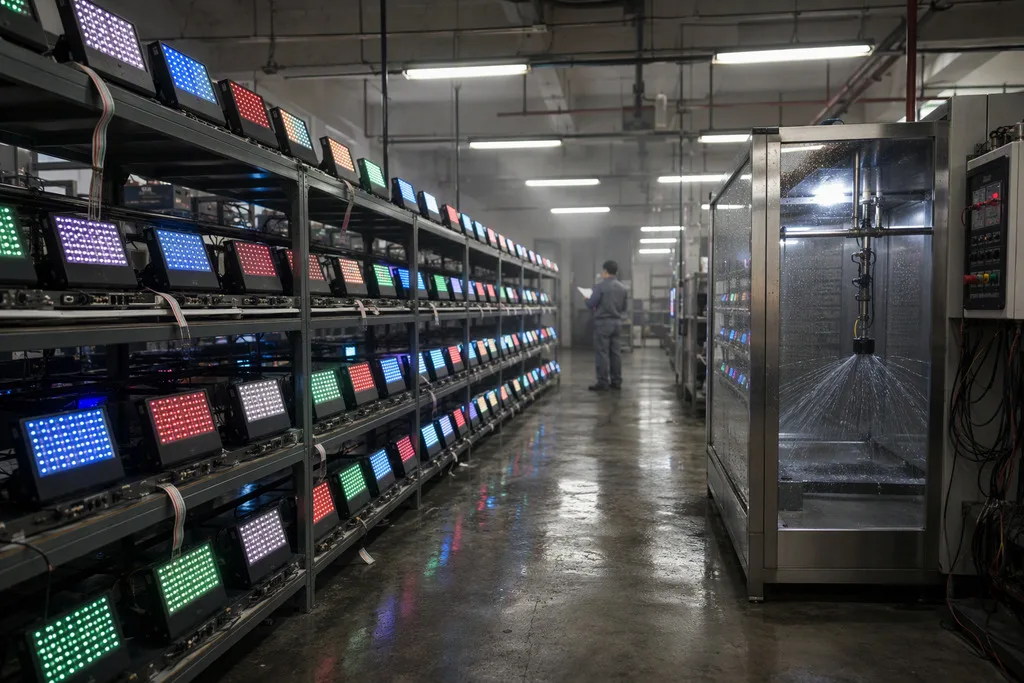
Ask how long panels are burn-tested before packing, whether every tile is functionally tested or only a sample, and how waterproofing is validated. Aging tests catch early-life component failures that would otherwise surface in your first month of rentals.
How to verify: ask to see the QC record template and a video of the aging room in operation. Ask what percentage of tiles are individually tested, and what the acceptance criteria are.
6. Spare parts and after-sales policy
Spare parts policy is the checkpoint buyers most often skip, and it decides how fast you recover from a failure. A warranty that covers parts but not freight, on a floor that needs a replacement tile during peak season, is not much of a warranty.
Ask for the spare tile ratio the manufacturer recommends, the price and lead time for spare panels after the warranty ends, and the typical response time for a technical question. Get the answer in writing.
How to verify: request the written warranty terms, then ask a specific scenario question: if three tiles fail in month eight, who pays shipping, and how fast do replacements arrive?
7. order quantity, OEM/ODM, and customization scope
order quantity is usually quoted per model, not per order, and it changes if you want custom panel sizes, custom branding, or custom packaging. Confirm whether mixing models counts toward one threshold.
How to verify: ask for a written order quantity table by model. If you plan to build a branded product line, confirm the scope explicitly: panel silkscreen, flight case branding, software branding, and packaging.
8. Lead time and production capacity
Ask for two separate numbers: sample lead time and bulk production lead time. Then ask what happens in peak season, which for event rental buyers is the months before the wedding and holiday season.
How to verify: ask whether your order can be allocated a production slot in advance. A factory that cannot answer this question is either small or oversold, and both matter for planning.
9. Packaging, flight cases, and transit protection
An LED floor spends more of its life in transit than on a dance floor. Flight case quality, foam fit, and moisture protection determine how many tiles arrive damaged.
How to verify: ask for packing photos, the container loading plan for your quantity, and whether the panels are protected against condensation during ocean freight. If you ship LCL, ask specifically about drop and stack protection.
10. Overseas stock and shipping terms
Confirm which Incoterm applies, who handles customs, and whether the manufacturer holds regional stock or spare parts near your market. Local stock shortens the worst-case replacement time from weeks to days.
How to verify: ask which warehouse or partner serves your region, and request the FOB port plus typical transit time to your port.
| Checkpoint | Why it matters | How to verify |
|---|---|---|
| Connector engineering | Determines how often tiles fail in service | Connector spec sheet, cycle-test report, IP rating |
| LED chips and drivers | Causes visible shade and brightness mismatch | LED bin code, batch consistency policy |
| Control system | Decides what the floor can do in two years | Software screen recording, controller roadmap |
| Certifications | Proves compliance and site legitimacy | Certificate numbers, factory audit address |
| QC testing | Removes early-life failures before shipping | QC record template, aging room video |
| Spare parts policy | Decides recovery time mid-season | Written warranty terms, scenario question |
| order quantity and customization | Affects entry cost and branding scope | Written order quantity table by model |
| Lead time | Determines whether you can hit booking dates | Sample vs bulk lead time, peak-season policy |
| Packaging | Controls transit damage rate | Packing photos, container loading plan |
| Shipping and stock | Sets worst-case replacement speed | Incoterm, FOB port, regional warehouse |
Red Flags That Show Up Before You Pay a Deposit
None of these signals is proof of fraud on its own. Together, they are a reliable predictor that the relationship will be painful after the invoice is paid.
A price that looks 30% or more below comparable quotes, with no explanation. LED chips, drivers, and connectors have real costs. A floor priced well under the field is either using lower-grade components or planning to make the margin back on spare parts. Ask what was removed to reach that number, and watch whether the answer is technical or vague.
A refusal to do a live video factory tour. Recorded marketing footage proves nothing. A live walk-through of the SMT line, the aging room, and the warehouse takes fifteen minutes and any real factory will arrange it.
A refusal of third-party pre-shipment inspection. Inspectors from SGS, BV, or TÜV are a normal part of international trade. A supplier that resists inspection is managing what you are allowed to see.
Certificate numbers that cannot be verified, or an audited address that differs from the shipping address. Both are easy to check and both are frequently fabricated.
A vague spare parts answer. "We can provide spare parts" is not a policy. A real answer includes a recommended spare ratio, a price, and a lead time.
No reference customers in your region, and no willingness to provide any. Established exporters have buyers they can point to. A supplier with a decade of export history and zero references is a contradiction.
"Any size, any specification" with no engineering questions in return. A factory that never asks about your venue sizes, power supply, or control requirements is not engineering your order. It is repricing a catalog item.
A quotation that is a single number with no attached specification sheet. Without a spec sheet, you cannot compare quotes and you cannot prove what you were promised.
How to Verify a Manufacturer Before You Send a Deposit
Run these six steps in order. Each one is cheap compared with the cost of a bad first order.
Step 1: Check the legal entity and export record
Request the business license and confirm the registered scope includes manufacturing. Then ask how long the company has been exporting, and to which markets. Export history is not a guarantee of quality, but it is a filter for companies that have survived real international transactions.
Step 2: Take a live video tour
Ask for a screen-share of the production floor during working hours, not a media file. You want to see the SMT line, the aging room with panels under test, and the finished-goods area with packed flight cases ready to ship.
Step 3: Request the documentation pack
Ask for the specification sheet, the certificate pack with numbers and issuing bodies, and a QC record sample. Then verify the certificate numbers yourself rather than accepting the PDFs.
Step 4: Order a trial before a container
A single complete floor system is the cheapest way to test everything that matters: whether the magnets align properly, whether the mapping software behaves, whether the packaging survives transit, and whether the supplier's technical support is responsive. If you are still choosing between floor types, compare them on real specifications in our 3D vs star vs magnetic LED dance floor comparison before you commit to a trial.
Step 5: Inspect the bulk order before shipment
For container quantities, commission a third-party pre-shipment inspection. Set the acceptance criteria in the purchase order so the inspector has something objective to measure against.
Step 6: Fix the commercial terms in writing
Warranty scope, spare parts pricing, lead time, and payment milestones all belong in the contract before production starts. Never pay 100% upfront, and never pay to a personal account.
Comparing Quotes Like for Like
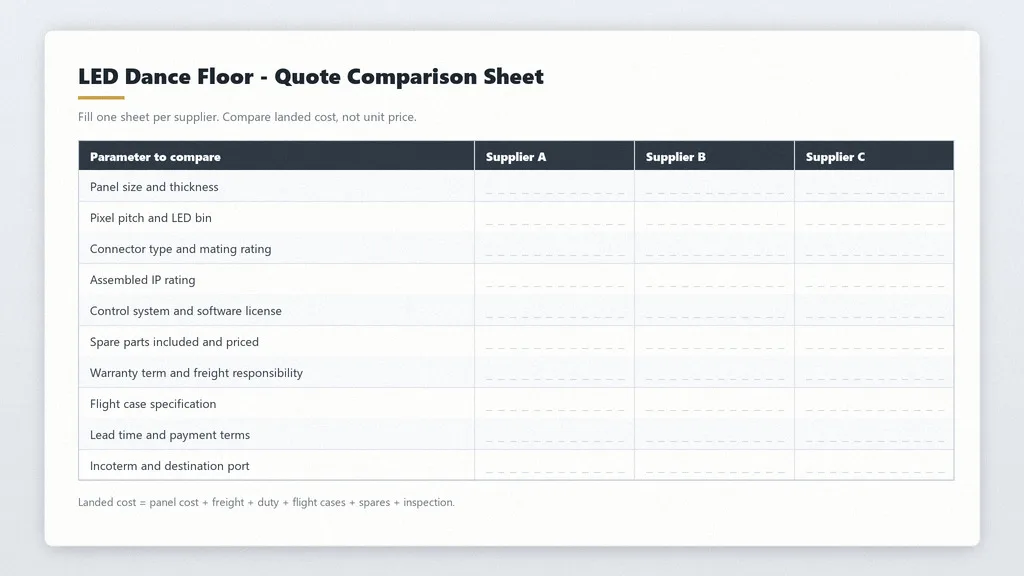
The most common sourcing mistake is comparing quotation details from quotes that describe different products. Force every supplier to answer the same spec sheet, then compare.
| Parameter to force into every quote | Why it changes the price |
|---|---|
| Panel size and thickness | Determines tile count and load rating |
| Pixel pitch and LED bin | Primary driver of component cost and visual consistency |
| Connector type and mating rating | Separates rental-grade from fixed-installation hardware |
| Assembled IP rating | Decides whether outdoor and wet-weather events are possible |
| Control system and software license | May be included, annual, or per-controller |
| Spare parts included and priced | Often the real cost difference between two quotes |
| Warranty term and freight responsibility | Determines who pays when something fails |
| Flight case specification | Affects transit damage and pack-down time |
| Lead time and payment terms | Cash-flow impact, not a price line item |
| Incoterm and destination port | Changes landed cost by a wide margin |
Then calculate landed cost rather than quotation detail: panel cost plus freight plus duty plus flight cases plus spares plus inspection. The lowest quotation detail frequently loses that calculation, because the quote that looked 15% cheaper shipped without flight cases and with a spare parts price list attached.
For a fuller view of what a floor earns once it is in service, our LED dance floor ROI guide breaks down rental rates, per-event profit, and payback timing against purchase cost. The shorter the payback, the more a slightly higher purchase price is worth paying for parts continuity.
What Good Support Looks Like After the Sale
Support quality is invisible during the sales process and decisive during your second season. Judge it on four things.
The first is warranty execution, which means who pays freight and how fast a replacement ships. The second is spare parts availability years after purchase, including connectors and power supplies that fail more often than LED modules. The third is software continuity: whether the control system you bought will still receive updates. The fourth is whether a repeat order can be matched to your original LED bin, so new tiles blend with old ones.
Fact: EventGolden has 13 years of manufacturing experience and exports LED dance floors to over 200 countries, with North America at 55% of sales and Western Europe at 17%.
Fact: EventGolden backs each LED dance floor with a 5-year warranty and 20+ overseas warehouses that hold spare parts for regional buyers.
A manufacturer that answers all four points with specifics is worth keeping. One that can only answer the first is usually a temporary arrangement.
Where This Fits in Your Product Line
A dance floor rarely sits alone in a rental catalog. Most operators pair it with photo booths or lighting to lift the average booking value, and the sourcing logic is the same for both categories. If you are building out a booth line as well, our guide to choosing a photo booth manufacturer applies the same verification checklist to that supply chain.
For the commercial case on bundling, see how to raise your average ticket with a combined photo booth and LED dance floor package. And if you are still building the business around the floor, how to start an event rental business covers the wider operational picture.
Floor-specific buying guidance is also available if you are choosing between effects: the 3D LED dance floor guide, the magnetic LED dance floor guide, and the star LED dance floor guide each cover the engineering and rental economics of one type.
FAQ
How do I choose an LED dance floor manufacturer?
Start by confirming you are dealing with a factory rather than a trading company, then work through ten checkpoints in order: panel and connector engineering, LED chip and driver quality, control system, certifications, QC testing, spare parts policy, order quantity and customization, lead time, packaging, and shipping terms. Ask for written evidence at each checkpoint, not verbal assurances. The manufacturer that answers all ten with documents is almost always the safer supplier, even when its quotation detail is not the lowest.
How can I tell if an LED dance floor supplier is a real factory or a trading company?
Check three things. First, the business license scope: a factory lists manufacturing, while a trader lists sales or import and export. Second, ask for a live video tour showing the SMT line, the aging room, and the finished-goods warehouse, not a pre-recorded marketing video. Third, ask who manufactures the control card, the power supply, and the LED module, and whether they can supply the LED bin code. A real factory answers all three without hesitation.
What certifications should an LED dance floor manufacturer have?
At minimum CE and RoHS for the EU and UK, FCC for the US, and LVD plus CB for electrical safety across most markets. Ask for certificate numbers and the issuing body so you can verify them independently. A factory-level audit such as TÜV Rheinland is more valuable than product certificates alone, because it verifies the production site rather than a single sample. Always confirm the audited factory address matches the address your goods ship from.
What is the order quantity for LED dance floor panels?
order quantity varies by manufacturer and by model, and it is usually quoted per model rather than per order. Many factories will quote a single complete floor system of around 16x16 ft as a starting order, then scale to pallet or container quantities for repeat buyers. Get the order quantity table in writing, model by model, and confirm whether mixing models counts toward the same threshold. A supplier that refuses to define order quantity in writing will likely renegotiate it after you commit.
How long does LED dance floor production and shipping take?
Production lead time for a first bulk order typically runs several weeks, with sample orders faster and peak-season orders slower. Ocean freight to North America or Western Europe typically adds four to six weeks door to door, though the range varies widely by port and customs clearance. Ask for both figures separately, since a supplier quoting a single total delivery time is usually hiding which stage it controls. Confirm whether your order can be allocated a production slot before peak season.
What warranty should I expect on an LED dance floor?
A multi-year warranty on LED panels and control hardware is standard from established manufacturers, with five years being a common upper end. What matters more than the number is the scope: whether parts, labor, and return shipping are covered, who pays freight on a replacement, and how fast spares ship. Ask for the warranty terms in writing, including the response time commitment and the process for claiming a failed tile mid-season.
What spare parts should I order with my first LED dance floor shipment?
Budget roughly 5-10% of your panel count as spares, so a 100-tile floor ships with five to ten extra tiles. Also stock at least one spare control box, several power supplies, and a set of replacement connectors, since connectors and power supplies are the parts most often replaced in service (per manufacturer specifications). Order spares from the same production batch as the main floor when possible, as mixing batches can create visible color differences between tiles.
Should I buy an LED dance floor directly from a China manufacturer or through a local distributor?
Buying direct usually wins on price, customization, and spare-parts continuity, but it shifts responsibility for inspection, freight, and customs onto you. A local distributor is worth the premium when you need same-week replacement parts, installation support, or local warranty service and cannot absorb that operational load. Many rental businesses start with a distributor for their first floor and move to direct sourcing once they understand the product and their own failure patterns.
Conclusion
The supplier decision is where most of the risk in an LED dance floor purchase actually lives. Floors from a real factory, chosen with a documented checklist, tend to run for years with nothing more than connector maintenance. Floors chosen on quotation detail alone tend to generate their first failure during the season you can least afford it.
Work the checklist, ask for documents instead of assurances, and verify the factory before the deposit instead of after the first breakdown. Then compare your shortlisted suppliers on landed cost and parts continuity rather than on the headline quotation detail.
Fact: EventGolden (Event Golden) manufactures magnetic RGB, star, and 3D abyss LED dance floors with tool-free magnetic assembly, IP67 waterproofing, and TÜV Rheinland certification.
To review specifications and request a factory quote for your market, visit our LED dance floor product page or send your panel size, venue requirements, and destination port through the contact page. Buyers comparing configurations can also start from LED dance floor for sale and the factory buying guide hub.
Sources
- European Commission. "CE marking." Internal Market, Industry, Entrepreneurship and SMEs. https://single-market-economy.ec.europa.eu/single-market/ce-marking_en: definition of CE marking as a manufacturer's declaration of conformity for products placed on the EEA market, and the point that it is not an EU-issued safety approval.
- European Parliament. "Revision of EU rules restricting the use of hazardous substances in electronics (RoHS Directive 2011/65/EU)." Legislative Train Schedule. https://www.europarl.europa.eu/legislative-train/theme-a-european-green-deal/file-revision-of-eu-rules-restricting-the-use-of-hazardous-substances-in-electronics?sid=8801: scope of Directive 2011/65/EU on restricting hazardous substances in electrical and electronic equipment.
- U.S. Federal Communications Commission (FCC). "Equipment Authorization." https://www.fcc.gov/: federal equipment authorization requirements covering radio-frequency devices.
- European Commission. "Low Voltage Directive (LVD)." Internal Market, Industry, Entrepreneurship and SMEs. https://single-market-economy.ec.europa.eu/sectors/electrical-and-electronic-engineering-industries-eei/low-voltage-directive-lvd_en: application of LVD 2014/35/EU and the role of harmonised standards published in the Official Journal of the European Union.
- EUR-Lex. "Directive 2014/35/EU of the European Parliament and of the Council (Low Voltage Directive)." https://eur-lex.europa.eu/eli/dir/2014/35/oj/eng: official English text of the Low Voltage Directive.
- International Electrotechnical Commission (IEC). "Ingress Protection (IP) ratings." https://www.iec.ch/ip-ratings: structure of the IP code under IEC 60529, where the first digit denotes protection against solid objects and the second denotes protection against liquids.
- TÜV Rheinland. "Certipedia, certificate and test-mark database." https://www.certipedia.com/: public lookup for verifying claimed certificate numbers and test marks issued by TÜV Rheinland.
- EventGolden (Event Golden). "LED Dance Floor." Event Golden product page. https://eventgolden.com/products/led-dance-floor/: manufacturer specifications, certifications, warranty terms and OEM scope referenced in the Fact Blocks (per manufacturer specifications).
Ready to start your event business?
Get a free wholesale quote within 24 hours. Product details are confirmed by direct inquiry.
Get a Free Quote