How Many LED Dance Floor Panels Do I Need? A Buyer's Planning Guide
Work out how many LED dance floor panels you need, plus the power, circuit size and shipping weight: a buyer's planning guide with the math shown.
How Many LED Dance Floor Panels Do I Need? A Buyer's Planning Guide
Factory specification sheets tell you what a panel is. They rarely tell you what your order should be, which is why a quotation often arrives without the numbers needed to sanity-check it. The number that matters is not on the spec sheet: it is how many panels your floor area actually requires, what that many panels draws in power, what it weighs, and how much space it takes in the van.
This guide does that conversion. It assumes you have already settled the floor area you need, and picks up from there: area to panel count, panels to power, power to circuit size, and panels to shipping volume.
The Two Panel Sizes and What They Mean for Quantity
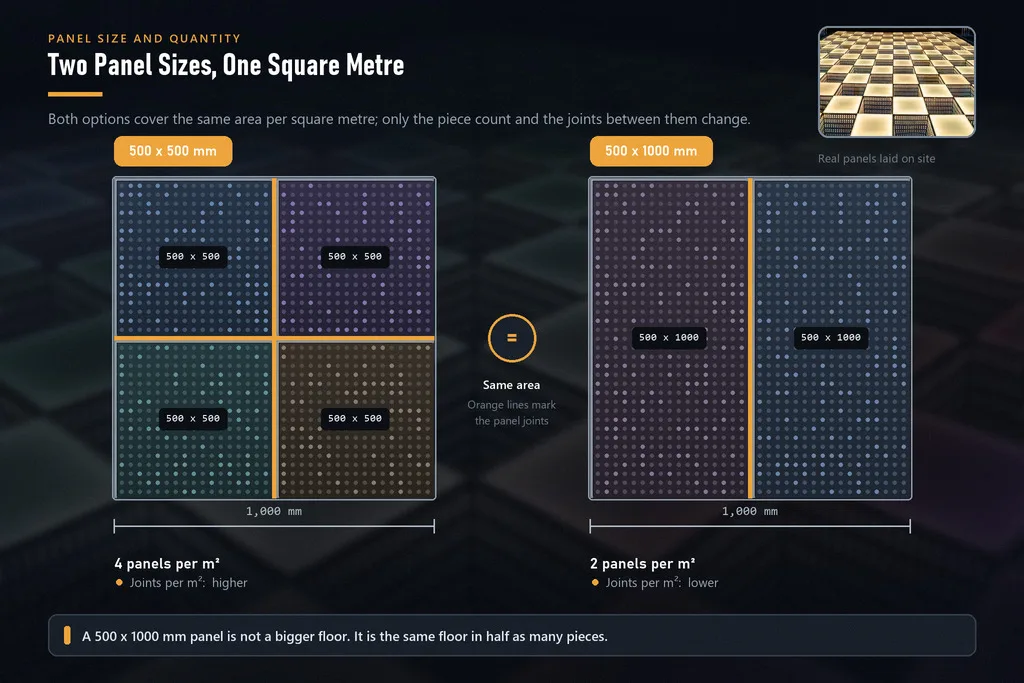
Almost every LED dance floor in the rental market is built from one of two panel sizes. Getting clear on which one you are buying answers the quantity question before any other calculation.
| 500 x 500 mm panel | 500 x 1000 mm panel | |
|---|---|---|
| Coverage per panel | 0.25 m² | 0.5 m² |
| Panels per m² | 4 | 2 |
| Joints per m² | higher | lower |
| Typically used for | smaller floors, tighter layouts | larger floors, faster builds |
| Effect on assembly time | more pieces to place and connect | fewer pieces, fewer checks |
The important point is that both options deliver the same coverage per square meter. A 500 x 1000 mm panel is not a bigger floor; it is the same floor in half as many pieces.
That difference shows up in three places that all cost you something. Fewer pieces means fewer connectors to mate and verify on site, which shortens setup and pack-down, and panel joining is covered in more detail in the magnetic LED dance floor guide. Fewer joints means fewer potential water entry points on a floor that gets used anywhere near a bar. And fewer pieces usually means fewer flight cases, which is what you pay for on freight.
Why you cannot cut panels to fit
A panel is an electronic assembly, not a floorboard. There is no trimming a tile to close a 30 cm gap, because the LED modules, driver board and connector positions are fixed at manufacture.
That constraint is why ordering is done in whole-panel increments and why your floor dimensions should be planned around the panel grid rather than the other way round. If your usable area is 4.8 m by 4.8 m and the panel grid is 0.5 m, you build a 4.5 m or a 5.0 m floor and adjust the surrounding space.
Fact: Event Golden manufactures magnetic RGB, 3D abyss and star LED dance floors with tool-free magnetic assembly and IP67 waterproofing, certified to TÜV Rheinland plus CE, RoHS, FCC, LVD and CB.
Turning Floor Area into a Panel Count
The calculation is one division, but the order you do it in matters. Convert the area to square meters first, then divide by the coverage of a single panel.
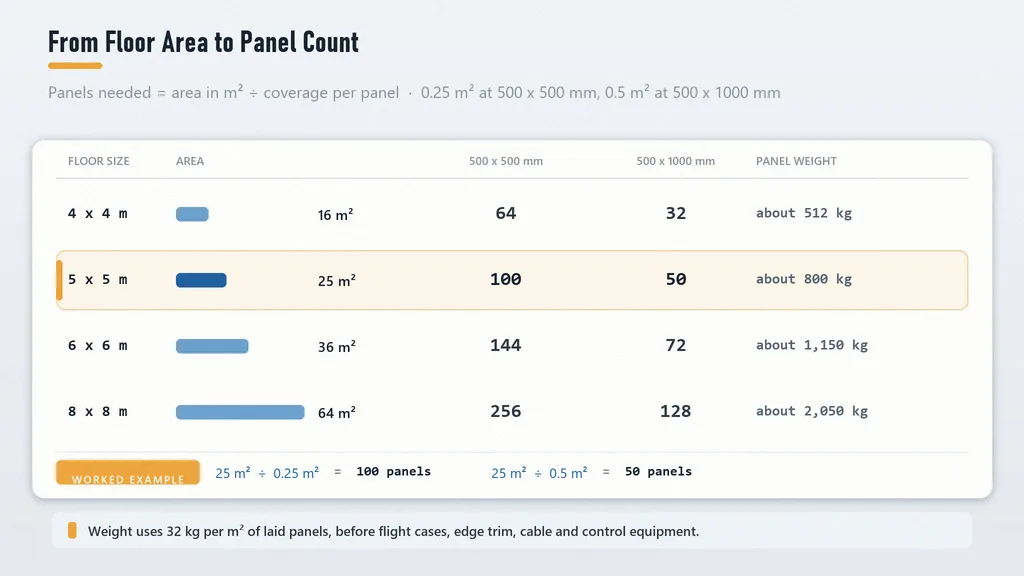
Panels needed = floor area in m² ÷ coverage per panel in m²
| Floor size | Area | 500 x 500 mm panels | 500 x 1000 mm panels | Panel weight at 32 kg/m² |
|---|---|---|---|---|
| 4 x 4 m | 16 m² | 64 | 32 | about 512 kg |
| 5 x 5 m | 25 m² | 100 | 50 | about 800 kg |
| 6 x 6 m | 36 m² | 144 | 72 | about 1,150 kg |
| 8 x 8 m | 64 m² | 256 | 128 | about 2,050 kg |
Work the 5 x 5 m case by hand to see how the figures are built. The area is 25 m². At 0.25 m² per 500 x 500 mm panel, that is 100 panels. At 0.5 m² per 500 x 1000 mm panel, it is 50 panels.
Round up, then add spares
Two adjustments turn a theoretical count into an order. Round up to a whole panel in each direction, and add a spare allowance on top.
A common planning figure in this category is 5 to 10 percent of the panel count held as spares, ordered from the same production batch as the main floor. Dark tiles and light tiles from different batches can look different side by side, and a mismatched replacement panel on a dance floor is visible from across the room.
Power Draw: Average, Peak and Why Both Matter
Power is the part of the specification that most buyers treat as someone else's problem, usually until the venue's breaker trips during the first dance. Two figures govern it, and they answer different questions.
Average draw is what the floor consumes over time with typical content playing. It is the figure that sizes your circuit and your continuous load calculation.
Peak draw is what the floor consumes at maximum output, effectively the whole surface at full white. It is the figure that sizes your generator, your distribution board and your cabling, even though it rarely lasts long.
Category specifications for LED dance floors commonly quote roughly 240 to 480 W per square meter average and roughly 550 to 1,200 W per square meter peak (indicative manufacturer range; confirm against your supplier's datasheet). The spread reflects pixel pitch and panel design rather than quality. For how that draw translates into revenue, the LED dance floor ROI guide covers the income side.
The calculations below use mid-range assumptions of 360 W per square meter average and 900 W per square meter peak. Substitute your own panel's figures; the arithmetic is the same.
Total watts = floor area in m² × watts per m²
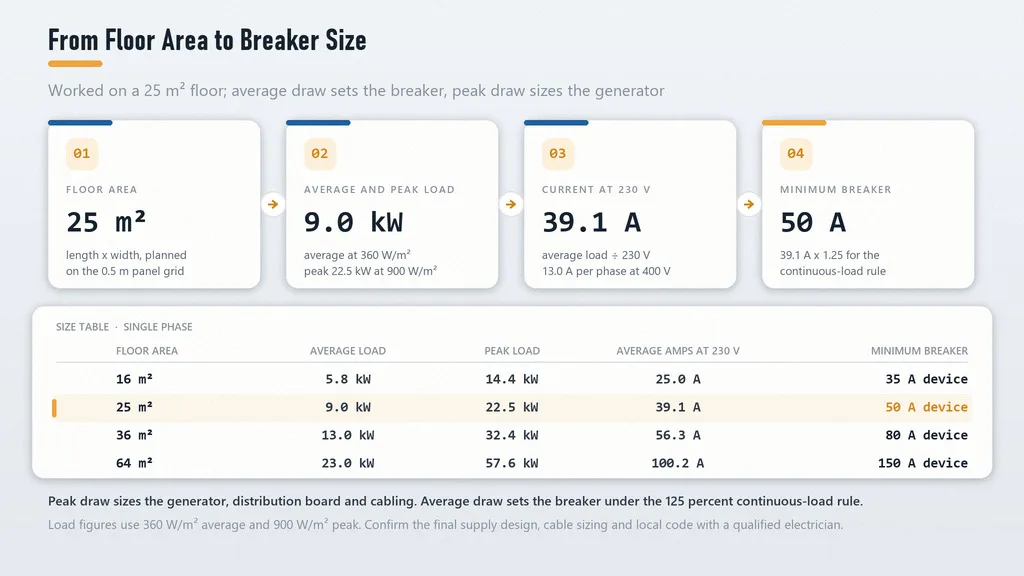
For a 25 m² floor, the average load is 25 × 360 = 9,000 W, or 9 kW. The peak load is 25 × 900 = 22,500 W, or 22.5 kW.
Sizing the Circuit: The Continuous-Load Rule
Converting watts to amps is the easy part. Converting amps to a breaker size is where the rule that most buyers miss comes in.
Watts to amps
For a single-phase supply, current equals power divided by voltage.
Amps = watts ÷ volts
At 230 V, a 9,000 W average load draws 9,000 ÷ 230 = 39.1 A. For a three-phase supply, current per phase equals power divided by the square root of three times the voltage, so the same 9,000 W at 400 V is 9,000 ÷ (1.732 × 400) = 13.0 A per phase.
Why the breaker is not simply 40 A
A dance floor at a reception runs for hours, and that changes which electrical rule applies to it. The National Electrical Code defines a continuous load as one where the maximum current is expected to continue for three hours or more [4]. A floor running through a five-hour reception meets that definition.
For continuous loads, NEC sections 210.19(A)(1) and 210.20(A) require the conductor ampacity and the overcurrent device rating to be at least 125 percent of the continuous load current, which is the same as limiting the load to 80 percent of the branch circuit rating [3].
So the minimum breaker for our 25 m² floor is not 39 A and not 40 A; it is 39.1 × 1.25 = 48.9 A, which rounds up to a 50 A device.
| Floor size | Average load (360 W/m²) | Peak load (900 W/m²) | Average amps at 230 V | Minimum breaker at 125% |
|---|---|---|---|---|
| 16 m² | 5.8 kW | 14.4 kW | 25.0 A | 31.3 A, so a 35 A device |
| 25 m² | 9.0 kW | 22.5 kW | 39.1 A | 48.9 A, so a 50 A device |
| 36 m² | 13.0 kW | 32.4 kW | 56.3 A | 70.4 A, so an 80 A device |
| 64 m² | 23.0 kW | 57.6 kW | 100.2 A | 125.2 A, so a 150 A device |
Three-phase changes the picture enough to be worth stating. That 64 m² floor that needs a 150 A single-phase device needs only 23,040 ÷ (1.732 × 400) = 33.3 A per phase on a 400 V three-phase supply. This is the reason anything above a small floor is specified and supplied three-phase.
Two cautions before you use these numbers. The watt-per-square-meter figures are category-indicative rather than universal, and a qualified electrician must confirm the final supply design, local code requirements and cable sizing for your specific installation.
What the Venue Has to Provide
Your calculations tell you what the floor needs. The venue decides whether it can be delivered, which is a conversation worth having before you order panels rather than after.
Ask the venue four specific questions. What dedicated circuits exist and at what rating? Where are they in relation to the dance floor? Are they shared with catering, lighting or sound? And is the supply single-phase or three-phase?
Shared circuits are a common cause of mid-event trips. A floor on the same circuit as a catering hot cupboard and a lighting rig is a floor nobody planned for.
Temporary wiring requirements at events
Event power is temporary wiring, and in the United States that brings specific requirements under OSHA's construction electrical standard. The provisions for temporary power and lighting require that all conductors be protected by overcurrent devices at their ampacity, and state that no branch-circuit conductors shall be laid on the floor [1].
In practical terms that means cable runs need routing, matting or cable ramps rather than being taped across a walkway. The same standard requires grounding-type receptacles and a separate equipment grounding conductor for branch circuits supplying receptacles or fixed equipment, with ground-fault protection where portable lighting is used in wet or conductive locations [1].
Outdoors there is one further specification to confirm in writing: the cabinet's IP rating. The IP code's first digit covers protection against solid objects and the second covers liquids, under IEC 60529 [2], so an IP65 floor is dust-tight and protected against water jets. Ask for the rating of the assembled cabinet rather than the individual panel, because water enters at the joints.
Outdoors, the generator should be sized from the peak figure rather than the average, with headroom for the lighting and audio on the same supply. Undersizing a generator so that the floor browns out when the full-white content hits is a failure that looks like an equipment fault to the client.
Weight, Load Capacity and Floor Protection
Weight is the specification that decides whether the floor can physically go where you want it, and it is easy to underestimate because it accumulates.
A 500 x 500 mm panel in this category commonly weighs between about 7.6 and 8.5 kg, which is roughly 30 to 34 kg per square meter once the panels are laid (indicative manufacturer range; confirm against your supplier's datasheet). Our 25 m² worked example therefore weighs around 800 kg in panels alone, before flight cases, edge trim, cables and control equipment.
Load capacity per panel
Panel specifications in this category commonly quote a load capacity in the region of 500 to 600 kg per panel, which is the figure that makes a crowded dance floor viable. Confirm it in writing with your supplier, because it is a safety parameter rather than a marketing one.
The failure mode to watch is point loading rather than distributed crowd weight. A speaker on a heavy stand, a truss foot or a bar unit resting on a small area concentrates force in a way that evenly distributed dancers do not. Plan where heavy items will sit before the floor is laid, not after.
Upper-floor venues need one more question asked: the building's floor loading rating. A ballroom on the second floor of an older building may not be rated for a tonne of panels plus several hundred guests, and that is a venue limitation rather than an equipment one.
Packing, Flight Cases and Shipping Volume
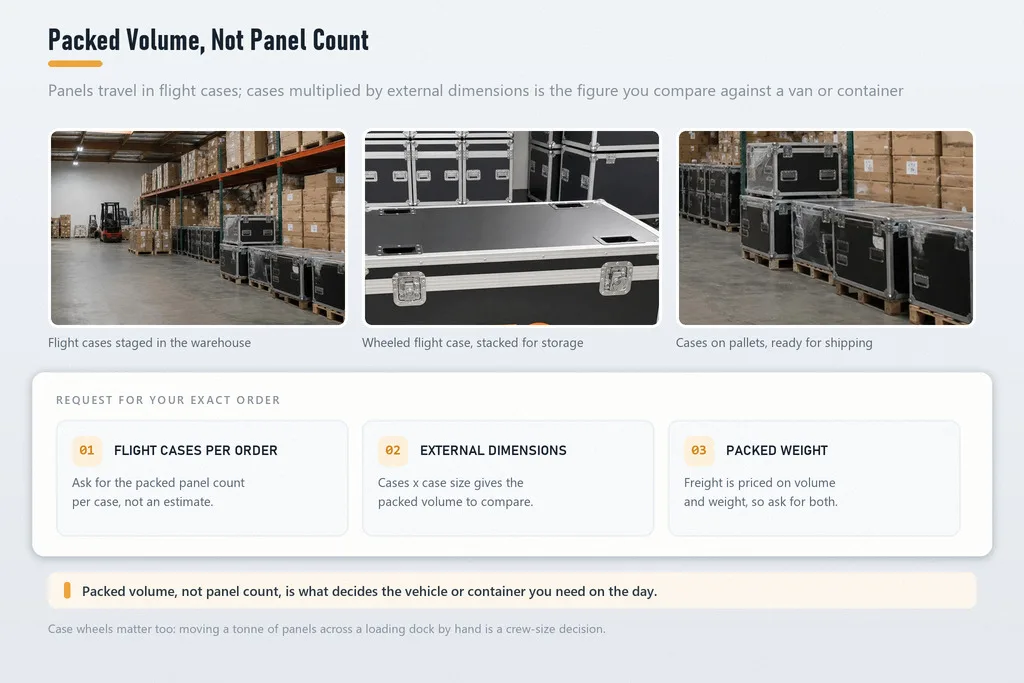
Panels arrive in flight cases, and the packed volume rather than the panel count is usually what constrains which vehicle or container you need.
The number of panels per case varies by manufacturer and case design, so request the packed panel count and the external dimensions of each case for your exact order rather than estimating from a photo. Multiply cases by external dimensions and you have the volume to compare against your van, trailer or container.
Request the packed weight as well as the volume, because freight is priced on both. Case wheels matter too, since moving a tonne of panels across a hotel loading dock by hand is a crew-size decision rather than a detail. If you are importing rather than buying locally, check whether the panels are protected against condensation during ocean freight.
Fact: Event Golden exports LED dance floors to over 200 countries, with North America at 55% of sales and Western Europe at 17%.
The Parts People Forget to Order
The panels are the visible purchase and the extras are where orders come up short. Each of these items turns up as a mid-event problem rather than a line on a quotation.
Edge trim and access ramps. A floor with a 20 mm lip is a trip hazard and an access barrier. Ask for trim sized to your panel thickness, and ramps if guests or trolleys need to cross the edge.
Control equipment, plus a spare. The control box is a single point of failure for the whole floor. Carry a spare unit rather than discovering the lead time during peak season.
Cables sized to your largest floor. Interconnect and power cables are usually quoted for a standard configuration. If your largest build is 8 x 8 m, order for that build, not for the average one.
Spare panels from the same batch. Five to ten percent of the panel count, ordered with the main floor so the colour and brightness match.
Spare connectors and a small tool kit. Connectors are the most frequently replaced part on a rental floor, and they are cheap to hold and slow to source mid-season.
Floor protection. Matting under the panels protects polished venue floors, which is a damage deposit issue as much as an equipment one.
Fact: Event Golden backs its LED dance floors with a 5-year warranty and 20+ overseas warehouses, which shortens the replacement time for a failed panel during a season.
Your Order Checklist
Run this list against any quotation before you commit. Each line is something that becomes expensive to add later.
| Item | What to confirm |
|---|---|
| Floor area | Length x width in meters, planned on the panel grid |
| Panel size | 500 x 500 mm or 500 x 1000 mm |
| Panel count | Area divided by per-panel coverage, rounded up |
| Spare panels | 5-10% of the count, same production batch |
| Average and peak draw | W per m² for your specific model |
| Supply design | Single-phase or three-phase, breaker size, cable runs |
| Packed volume and weight | Number of flight cases, external dimensions, case weight |
| Edge trim and ramps | Sized to panel thickness |
| Control equipment | Including one spare control unit |
| Cables | Sized to your largest planned build |
| Connectors and spares | Small quantity held in stock |
| Certifications | Product certification documents and IP rating for outdoor use |
| Warranty and parts | Term, what it covers, and how fast a replacement panel ships |
If you are still comparing panel types rather than quantities, the type guides cover the 3D, magnetic and star floors, and the three-way comparison sets them against each other.
Five Quantity-Planning Mistakes
Ordering by panel count instead of by area. A panel count means nothing until it is tied to the area you are covering. A panel count quoted without an area is assuming a size on your behalf.
Sizing the circuit from peak draw. Peak sizes the generator. The breaker follows the continuous-load rule, which for a floor running a five-hour event means at least 125 percent of the average current [3][4].
Assuming the venue socket will carry it. A 64 m² floor needs roughly 100 A at 230 V. That is not a wall socket, and discovering it on the load-in day is not recoverable.
Leaving transport volume to the end. Packed volume decides the vehicle. Choosing panels first and calculating volume afterwards is how a fleet ends up hiring a larger van for every job.
Forgetting that spares must be same-batch. A spare panel that does not colour-match is not a spare, it is a visible repair. Order them with the main floor.
Once the quantity is settled, the two decisions that follow are supplier selection and payback. The manufacturer checklist covers the first, the ROI guide covers the second, and the pricing guide shows how the asset cost of this purchase feeds into the rate you charge per event.
FAQ
How many LED dance floor panels do I need?
Divide your floor area in square meters by the area of one panel. A 500 x 500 mm panel covers 0.25 square meters, so a 25 square meter floor needs about 100 panels. With 500 x 1000 mm panels, each covering 0.5 square meters, the same floor needs about 50 panels. Always round up and add spares, because a partial tile cannot be cut and fitted like a floorboard.
How many panels are in one square meter?
Four 500 x 500 mm panels, or two 500 x 1000 mm panels, both of which give 0.25 and 0.5 square meters of coverage per panel respectively. The coverage per square meter is the same in total; only the number of pieces and the number of joints between them change. Fewer, larger panels mean fewer connections to check on site and faster assembly.
How much power does an LED dance floor draw?
Typical manufacturer specifications for this category quote an average draw of roughly 240 to 480 W per square meter and a peak draw of roughly 550 to 1,200 W per square meter when the floor is lit fully white (indicative range, confirm against your supplier's datasheet). A 25 square meter floor therefore averages around 9 kW and can peak near 22.5 kW using the mid-range figures of 360 and 900 W per square meter.
What size circuit does an LED dance floor need?
Size the circuit from the average draw, not the peak. A 25 square meter floor drawing about 9 kW takes roughly 39 A at 230 V single phase, and the 125 percent rule for continuous loads pushes the overcurrent device to at least 50 A. On a 400 V three-phase supply the same floor needs only about 13 A per phase, which is why larger floors are almost always supplied three-phase.
Can a standard venue supply power an LED dance floor?
Small floors often can, large ones usually cannot. A 16 square meter floor drawing about 5.8 kW fits within a dedicated 32 A single-phase circuit, but a 64 square meter floor needs around 100 A at 230 V, which no ordinary venue socket provides. Ask the venue for the rating and location of the nearest dedicated supply before you assume the building can carry the floor.
How much does an LED dance floor weigh?
A 500 x 500 mm panel commonly weighs between about 7.6 and 8.5 kg, which works out at roughly 30 to 34 kg per square meter (indicative range, confirm against your supplier's datasheet). A 25 square meter floor therefore weighs around 800 kg in panels alone, before flight cases, edge trim, cables and control equipment. That figure matters for upper-floor venues and for crew size.
How many spare panels should I order?
A common planning figure is 5 to 10 percent of your panel count as spares, ordered from the same production batch as the main floor. A 100 panel floor therefore carries 5 to 10 spares. Batch matters because a panel from a different run can show a visible colour or brightness difference next to the rest of the floor.
How many panels fit in a flight case?
It depends on the case the manufacturer supplies, so ask for the packed panel count and the packed dimensions rather than estimating. As a planning shortcut, request the number of flight cases and their external dimensions for your exact order, then compare that volume against your vehicle or container. Transport volume is usually the constraint that decides between two panel sizes.
Conclusion
The gap between a panel specification and a usable purchase order is four calculations. Area divided by panel coverage gives the panel count. Area multiplied by watts per square meter gives the load. Average load divided by voltage, then multiplied by 1.25, gives the minimum breaker under the continuous-load rule. And panel count multiplied by packed case volume tells you whether it fits in the vehicle.
None of those four numbers appears on a typical specification sheet, and all four decide whether the floor works on site. Work them before ordering, then confirm the power design with a qualified electrician and the load and weight figures in writing with your supplier.
To put together a panel count with matching power, packing and spares, review the LED dance floor product range or send your floor dimensions through the contact page for a factory configuration and quote. Buyers comparing supply routes can also start from buy an LED dance floor, LED dance floors for sale and the factory buying guide hub.
Sources
- Occupational Safety and Health Administration (United States). "29 CFR 1926.405: Wiring methods, components, and equipment for general use." https://www.osha.gov/laws-regs/regulations/standardnumber/1926/1926.405: governs temporary electrical power and lighting wiring on construction sites, and requires that all conductors be protected by overcurrent devices at their ampacity, that no branch-circuit conductors be laid on the floor, that receptacles be of the grounding type with a separate equipment grounding conductor, and that ground-fault protection be provided where portable lighting is used in wet or conductive locations.
- International Electrotechnical Commission (IEC). "IP ratings." https://www.iec.ch/ip-ratings: the IP code uses two numerals, the first for protection against solid objects (0-6) and the second for protection against liquids (0-9), with full testing conditions defined in IEC 60529.
- International Association of Electrical Inspectors (IAEI). "100% vs 80%: Choosing the right OCPD solution." IAEI Magazine. https://iaeimagazine.org/2016/may2016/100-vs-80-choosing-the-right-ocpd-solution/: states that where a branch circuit carries a continuous load, NEC 210.20(A) requires the overcurrent protective device rating to be 125 percent of the calculated continuous load current.
- EE Power. "National Electrical Code Basics: Sizing and Protecting Branch-circuit Conductors." https://eepower.com/technical-articles/national-electrical-code-basics-sizing-and-protecting-branch-circuit-conductors/: explains that demanding 125 percent of the continuous load is equivalent to limiting the load to 80 percent of the branch-circuit ampere rating, and that NEC Article 100 defines a continuous load as one where the maximum current is expected to continue for three hours or more.
- Category manufacturer specifications, aggregated. Panel size (500 x 500 mm and 500 x 1000 mm), average and peak power draw, panel weight and load capacity figures in this article are the published ranges observed across suppliers in this product category. Representative pages: Reiss Display "Dance Floor LED Display" https://reissdisplay.com/ldf-series/; Leeman LED "Interactive LED Floor Display Screen 500×1000" https://www.leemanled.com/interactive-led-floor-display-screen/; Unilight LED "500x500mm Rental LED Screen" https://www.unilightled.com/product/rental-led-screen-500/. Used only for product-operational detail. All figures are indicative and must be confirmed against the datasheet for the specific model being purchased.
- Event Golden. "LED Dance Floor." Event Golden product page. https://eventgolden.com/products/led-dance-floor/: manufacturer specifications, assembly method, IP rating, warranty terms, overseas warehouse coverage and certification scope referenced in the Fact Blocks (per manufacturer specifications).
Note on the power figures
The watt-per-square-meter ranges quoted in this article are aggregated manufacturer specifications, not a standard. A panel's actual draw varies with pixel pitch, drive design and content. Every worked example in the article states its own assumption (360 W per square meter average, 900 W per square meter peak) so that a reader with different datasheet figures can substitute them and rerun the arithmetic, which is why the formulas are shown rather than only the results.
Ready to start your event business?
Get a free wholesale quote within 24 hours. Product details are confirmed by direct inquiry.
Get a Free Quote